

Key Takeaways
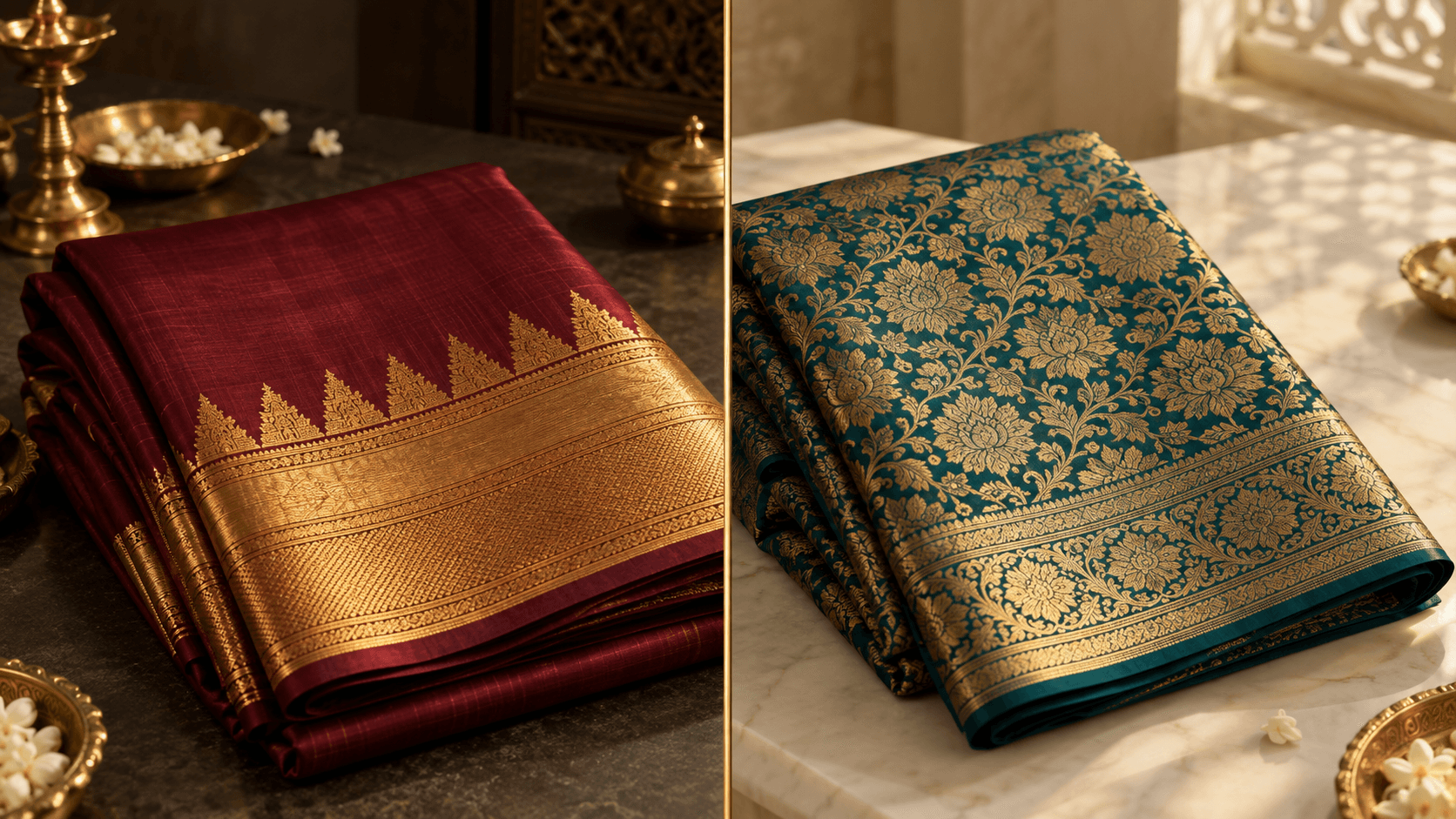
- Banarasi is built on the naqsha brocade system for dense, all-over gold patterning and a lighter, more fluid drape; Kanjivaram is built on the korvai join for a heavier, contrast-bordered, structural drape.
- Kanjivaram received its GI tag in 2005-06; Banarasi received its GI tag in 2009 — both protect a weaving district and technique, not a look.
- The fastest real-world test is weight: a genuine double-warp Kanjivaram sits noticeably heavier in the hand than even a heavy Banarasi katan.
- Kanjivaram’s structured drape holds up better through long, seated ceremonies; Banarasi’s katan and georgette variants move more fluidly through functions with more walking and dancing.
- Genuine handloom in either tradition starts near ₹7,000-8,000 at the entry tier; bridal-grade pieces in either can run past ₹1,00,000-2,00,000.
- Many brides now buy one of each — Kanjivaram for the wedding ceremony, Banarasi for the reception — rather than treating it as an either/or decision.
Every wedding season, the same question arrives in our inbox: which one should I actually buy? Usually it comes from a bride who has already fallen for both — a Kanjivaram her mother wore, and a Banarasi she saw on a cousin’s Instagram — and can’t tell whether the difference between them is real or just marketing.
It is real. I write this from Varanasi, standing on the same lanes where Banarasi katan comes off the pit loom, and having spent time in Kanchipuram’s weaving households comparing that saree, thread by thread, against what leaves our own looms in Madanpura. The two traditions don’t compete on quality — both are among the finest handloom silks India produces — they compete on what the saree is for.
Where each tradition actually comes from
Banarasi silk is woven in Varanasi and its surrounding districts — Mirzapur, Chandauli, Bhadohi, Azamgarh — a tradition that traces back over a thousand years to Mughal court weaving, when Persian and Central Asian textile motifs met Hindu temple aesthetics on the same loom. See our complete Banarasi saree guide for the full weave-type breakdown.
Kanjivaram is woven in and around Kanchipuram, Tamil Nadu, a temple town whose silk economy predates the saree tradition itself. In the fifteenth century, silk-weaving families migrating south from Saurashtra settled in Kanchipuram and fused their craft with the town’s existing silk trade — a lineage detailed in our Kanjivaram saree guide.
Both traditions are protected by a Geographical Indication tag, but at different times: Kanjivaram received its GI registration in 2005-06, and Banarasi followed in 2009. GI status means the name legally belongs to sarees made in that specific district using the defined technique — not to any saree that merely looks the part.
How they’re actually woven — the real difference
This is the part most comparisons skip, and it’s the part that explains everything else.
Banarasi uses the naqsha system — a punch-card mechanism, historically read by a second weaver called the naqshaband, that lifts specific warp threads to create a brocade pattern across the entire body of the fabric. The gold or coloured pattern is woven into the ground itself, thread by thread, which is why a dense Banarasi jangla pattern can take a master weaver 15-45 days on the loom.
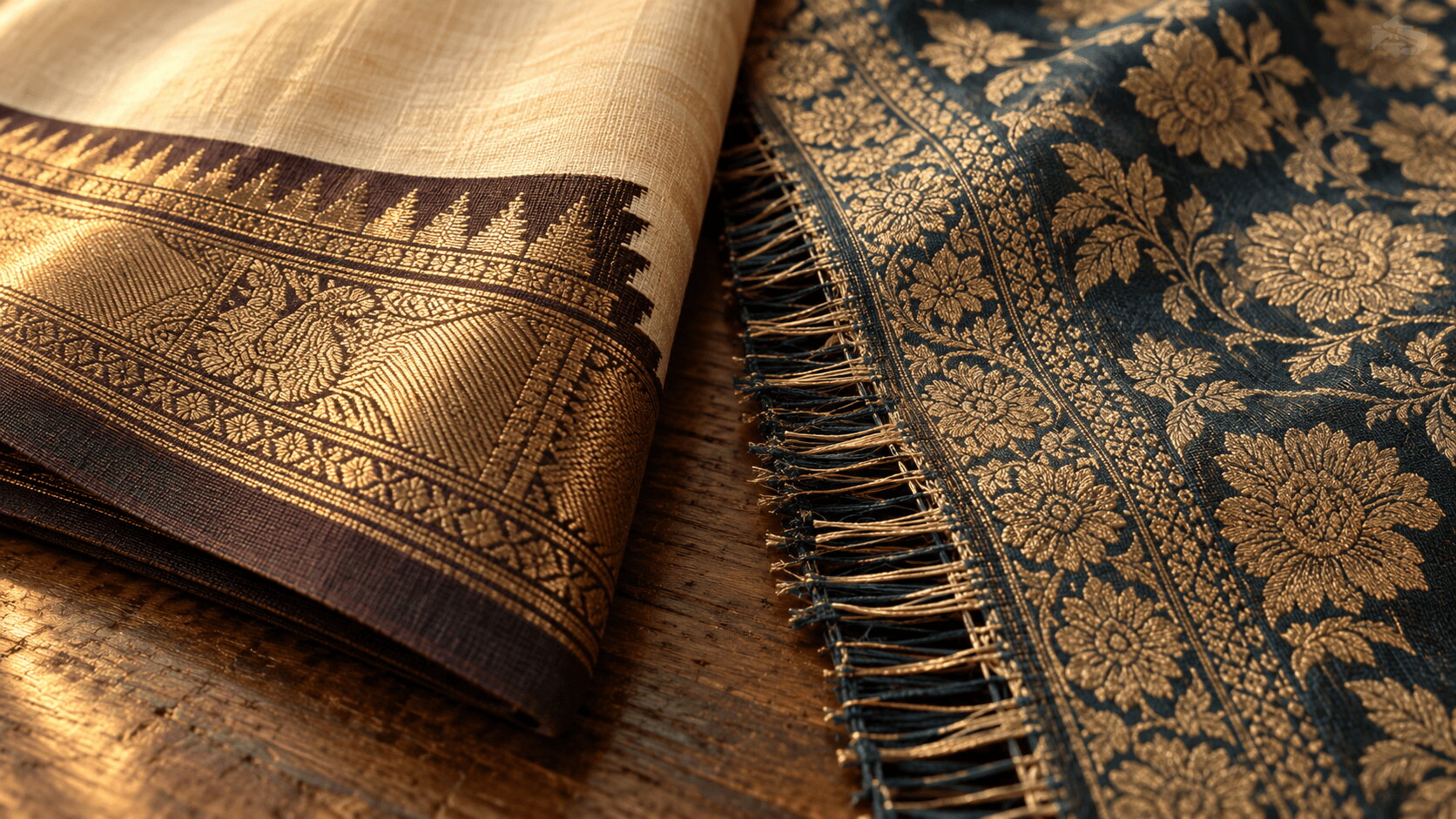
Kanjivaram uses the korvai technique — a joining method, not a patterning one. The body is woven in one colour on one set of shuttles, the border in a contrasting colour on a separate set, and the two are interlocked at the loom during weaving rather than stitched afterward. Turn a genuine korvai border over and you’ll see a slightly raised zig-zag line where body meets border — the saree’s structural signature.
| Banarasi | Kanjivaram | |
|---|---|---|
| Signature technique | Naqsha — punch-card brocade woven through the ground | Korvai — body and border interlocked at the loom, not stitched |
| Where the pattern lives | All over the field | Concentrated in a contrast border and pallu |
| Typical silk | Katan (twisted mulberry silk warp and weft) | Heavier, more tightly twisted mulberry silk, often double-warp |
| GI tag year | 2009 | 2005-06 |
Tell them apart in ten seconds
- Pick it up. A genuine double-warp Kanjivaram has real, almost architectural heft. A comparable Banarasi katan feels lighter and softer in the hand — the difference is immediate, not subtle.
- Look at the border join. On a Kanjivaram, the border is a different colour from the body with a visible interlocked seam. On a Banarasi, the border pattern usually continues the same gold-on-ground brocade as the rest of the saree.
- Check where the pattern sits. Dense gold covering the entire field, front to back — that’s Banarasi’s naqsha signature. Pattern concentrated at the border and pallu, with a plainer body — that’s Kanjivaram’s korvai logic.
- Turn it over. A Banarasi kadhua (kadwa) weave shows a clean, dense reverse, because each motif is woven separately; floating threads or clipped ends on the back point to fekwa or cutwork instead. A Kanjivaram shows the korvai’s zig-zag join line at the border edge.
Weight, drape, and how each wears through a full day
This is the comparison brides underrate and regret skipping. A wedding saree isn’t worn for a photograph — it’s worn for six, eight, sometimes twelve hours, through rituals that involve sitting, standing, walking around a fire, and being hugged by three hundred relatives.
Kanjivaram’s weight gives it a stiffer, more upright drape that holds its pleats and its shape through long seated ceremonies — one reason it remains the default for South Indian weddings, where the bride is often seated for extended ceremonial stretches. Banarasi’s katan and, especially, its lighter georgette and organza variants drape more fluidly and move more easily, which suits North Indian ceremonies built around more walking, more dancing, and more changes of setting across a single day.
Motifs — what the patterns are actually saying
Neither tradition’s motifs are decorative accidents; both encode where the saree comes from.
| Banarasi motifs | Kanjivaram motifs |
|---|---|
| Kadhua (kadwa) — each motif woven separately by hand, the most labour-intensive Banarasi technique | Gopuram (temple border) — a stepped, pyramidal pattern referencing Kanchipuram’s temple towers |
| Jangla — dense, allover pattern covering the entire field | Rudraksham — a border of small round beads, referencing Shaivite prayer beads |
| Shikargah — Mughal-origin hunting scenes with animals and figures | Mayil and annam — peacock and swan motifs woven into the pallu, drawn from temple sculpture |
| Meenakari — coloured, enamel-like inlay in the zari work | Rekku (checks) — an allover checked ground pattern, among the oldest Kanjivaram styles |
The visual grammar tells you the source at a glance: Mughal-court floral and figurative motifs point to Varanasi; temple-architecture and figurative pallu motifs point to Kanchipuram.
Price, tier by tier
Both traditions span an enormous price range because cost tracks silk weight, zari grade, and hand-labour hours — not brand or marketing. These are indicative 2026 loom-side ranges for genuine handloom in each tradition.
| Tier | Banarasi (katan) | Kanjivaram (silk) |
|---|---|---|
| Entry handloom, minimal border | ₹7,000 – ₹14,000 | ₹8,000 – ₹15,000 |
| Mid, elaborate border and pallu | ₹14,000 – ₹50,000 | ₹15,000 – ₹40,000 |
| Bridal, dense work (jangla / temple border, pure zari) | ₹35,000 – ₹2,00,000+ | ₹40,000 – ₹2,00,000+ |
Which one for your wedding — a decision framework
- Long seated ceremony, South Indian rituals — Kanjivaram’s structured drape and weight hold their shape through hours of sitting.
- Dancing, movement, multiple functions in one day — Banarasi’s katan or georgette moves more easily and tires the wearer less.
- Hot, humid climate — Banarasi georgette or organza breathes better than a heavy double-warp Kanjivaram.
- Wanting the saree to double as an heirloom for one’s daughter — both age well if cared for, but Kanjivaram’s structural border join is engineered specifically to survive decades without separating.
- Budget-first decision at the entry tier — the two traditions start within a few thousand rupees of each other; let occasion and climate decide, not price.
- Can’t choose — many brides now buy one of each: Kanjivaram for the wedding ceremony itself, Banarasi for the reception, treating them as two different outfits rather than two competing options.
Do they age and care for differently?
Both are dry-clean-only silks that should never be machine-washed, but they don’t behave identically over decades. Kanjivaram’s korvai border, precisely because it’s interlocked rather than stitched, tends to resist separating from the body even after heavy wear — the border can outlast the body fabric itself, which is part of why old Kanjivarams retain resale value. Banarasi’s naqsha brocade sits within a lighter fabric base, so the priority in storage is protecting the zari from tarnishing and the silk from creasing along the same fold lines year after year. For either tradition: store in muslin, not plastic, re-fold along new lines periodically, and keep away from direct humidity — the same care principles covered in our complete saree care guide.

Frequently asked questions
Neither is consistently more expensive — both start around ₹7,000-8,000 for genuine entry-level handloom and can exceed ₹2,00,000 for bridal-grade pieces with dense zari work. Price within each tradition tracks silk weight and hand-labour hours, not which region it comes from.
Kanjivaram is almost always heavier. It uses a thicker, more tightly twisted mulberry silk, often doubled (double-warp), which gives it a stiffer, more structured drape than even a heavy Banarasi katan.
Yes — there’s no rule against it, and both are considered prestigious anywhere in India. The practical consideration is drape and climate: Kanjivaram’s structure suits long seated ceremonies, while Banarasi’s lighter variants suit more movement-heavy functions.
Check where the pattern sits. If gold or coloured brocade covers the entire body of the saree, it’s Banarasi’s naqsha technique. If the pattern is concentrated in a contrast-coloured border with a plainer body, that’s Kanjivaram’s korvai construction.
Both traditions are centuries old and their exact origins are debated by historians, but their GI registrations were granted in different years — Kanjivaram in 2005-06 and Banarasi in 2009 — reflecting when each region’s weavers’ associations formalised the claim, not which craft came first.
It’s increasingly common. Many brides choose a Kanjivaram for the wedding ceremony and a Banarasi for the reception, treating the two traditions as distinct outfits for distinct moments rather than choosing one over the other. A third tradition brides often consider is Maharashtra’s Paithani, covered in our Paithani saree guide.
Not sure which one suits your own wedding calendar and climate? Join The Nakshapatta Edit for our monthly guide to buying handloom with confidence — one weave deep-dive, one styling idea, and one honest recommendation a month, never paid for.
Editorial independence: Nakshapatta does not accept payment for recommendations. Prices are indicative 2026 loom-side ranges and vary by weaver, zari grade, and technique.