


Key Takeaways
- The best saree blouse design ideas for 2026 depend on the saree’s weight and fabric, not just trends.
- Heavy zari sarees pair well with simple, solid blouses, while lighter weaves allow for more detail and embellishments.
- A small blouse wardrobe — three or four well-cut blouses rotated across sarees — makes a saree collection feel larger.
- Consider neckline, sleeve, and back styles carefully; options include structured high necks and puff sleeves for different sarees.
- Always prioritize a good fit when tailoring; a well-fitted blouse can elevate even a modest saree.
The best saree blouse for 2026 depends on the saree, not the trend chart. As a starting rule: heavy zari sarees like Banarasi and Kanjivaram carry the weight — pair them with a plain-cut, high-neck or boat-neck blouse in a solid colour so the border stays the star. Lighter weaves like Chanderi and Maheshwari can take more blouse detail — cutwork backs, contrast piping, puff sleeves — because the saree itself is quieter. The 15 designs below are grouped by neckline, sleeve, back, and fabric and cut, so you can mix and match instead of copying one look wholesale.
If you’ve ever stood in a tailor’s shop with a Pinterest folder open and no idea which of the forty saved images actually suits your saree, this is the article that untangles it.
Why the Blouse Matters More Than the Saree This Year
For years, the blouse was an afterthought — same boat neck, same three-quarter sleeve, stitched once and reused for a decade. It does not have to be. A blouse wardrobe — three or four well-cut blouses that rotate across sarees, the way a good blazer rotates across trousers — is the cheapest way to make a saree collection feel larger, and a blouse can be commissioned separately from the saree.
That shift matters for handloom buyers specifically. A ₹15,000 Banarasi saree with a rushed, ill-fitting blouse photographs badly and drapes worse. The saree did its job; the blouse let it down. Get the blouse right and even a modest Chanderi looks considered.
How to Choose: Match the Blouse to the Weave, Not the Trend
Before the fifteen designs, one rule that saves most people from an expensive mistake: let the saree’s zari density decide how loud the blouse gets.
- Heavy zari (Banarasi, Kanjivaram, bridal silks): Plain or single-detail blouse. One statement — a high neck, or a deep back, never both.
- Medium-weight silks (Chanderi, Maheshwari, Tussar): Room for one or two design elements — a contrast yoke, piping, or a patterned back.
- Cottons and lighter handlooms (Jamdani, everyday cottons): The most forgiving category. Puff sleeves, ruffles, and prints all sit comfortably here.
Keep this hierarchy in mind as you go through the list — it’s the difference between a blouse that elevates the saree and one that competes with it. Not sure which weave category your saree falls into? Our Weave Guide covers each one in depth, and the Indian Textile Glossary is a quick way to look up any unfamiliar term.
Necklines — 5 Ideas
1. The Structured High Neck
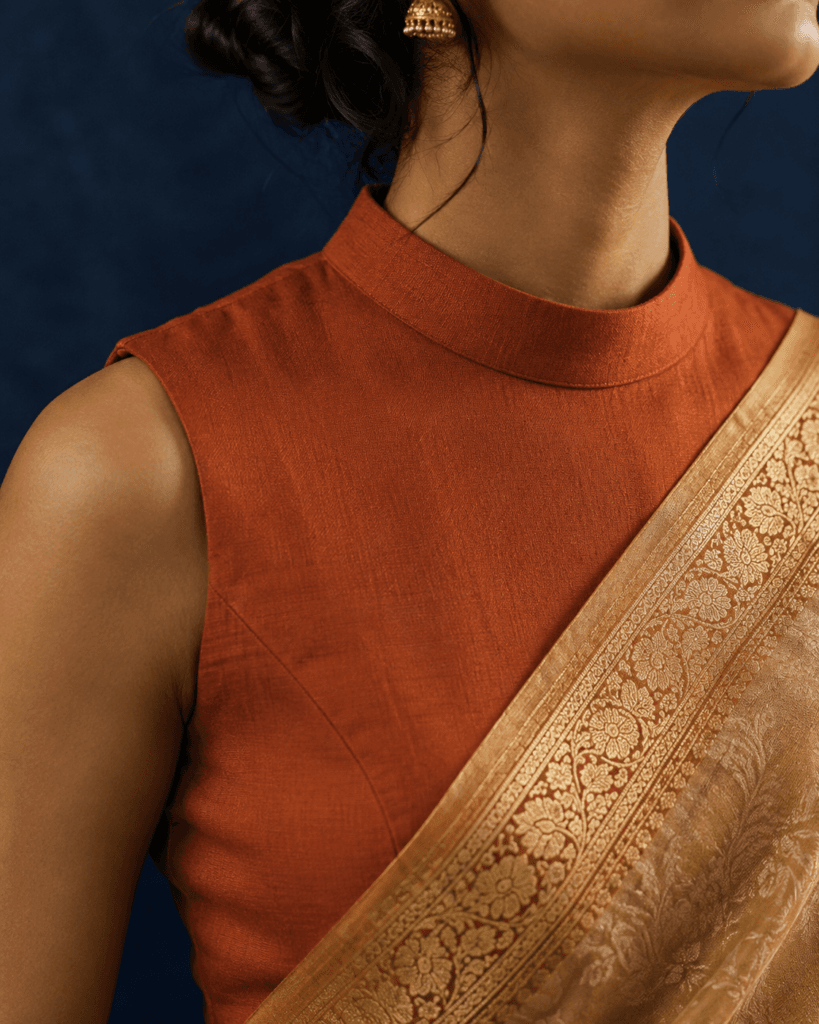
A close, collar-like neckline that sits at the base of the throat, often finished with a thin gold or contrast piping. Pairs exceptionally well with Banarasi and Kanjivaram, where you want the eye drawn to the pallu and border, not the neckline.
2. The Sweetheart Neck
A soft dip at the centre front, more romantic than the traditional round or boat neck. Suits Chanderi and Maheshwari sarees for daytime weddings and receptions — flattering without being dramatic.
3. The Deep U with a Back Hook
A moderate front dip finished with a visible hook-and-eye or button detail instead of a hidden zip — the fastening becomes part of the design. Popular for cotton and Jamdani sarees worn to festive daytime events.
4. The Boat Neck, Modernised
The classic wide, straight-across neckline, updated with a slightly raised back and structured shoulder seam so it doesn’t slip. Still the safest, most universally flattering choice.
5. The Halter-Style Neck
Ties or a fitted band at the back of the neck, leaving the shoulders and upper back bare. Best suited to lighter silks and cottons for evening events — too casual a silhouette for a heavy bridal Banarasi.
Sleeves — 4 Ideas
6. The Elbow-Length Fitted Sleeve
A longer, close-fitting sleeve that ends just past the elbow. A quiet but increasingly requested choice for Banarasi blouses — it reads as more considered than a standard cap sleeve.
7. The Structured Puff Sleeve
Short and voluminous at the shoulder, tapering to a fitted band. Works best on Chanderi, Maheshwari, and cotton sarees — the puff adds movement without competing with a busy silk weave.
8. The Bell Sleeve
Fitted at the shoulder, flaring out from the elbow to the wrist. A striking choice for festive daytime looks in lighter fabrics; avoid on heavily worked silks.
9. The Sleeveless with Piped Armhole
No sleeve, but the armhole is finished with a contrast piping or thin embroidered edge rather than left plain. The most versatile sleeveless option.
Backs — 4 Ideas
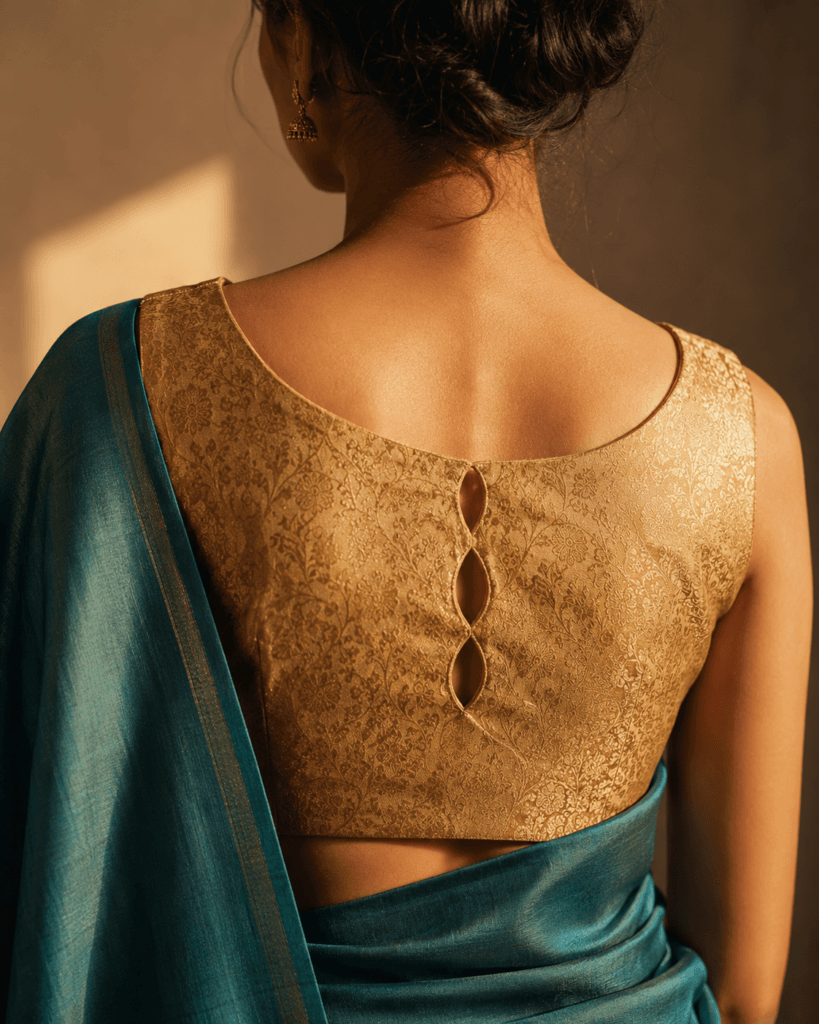
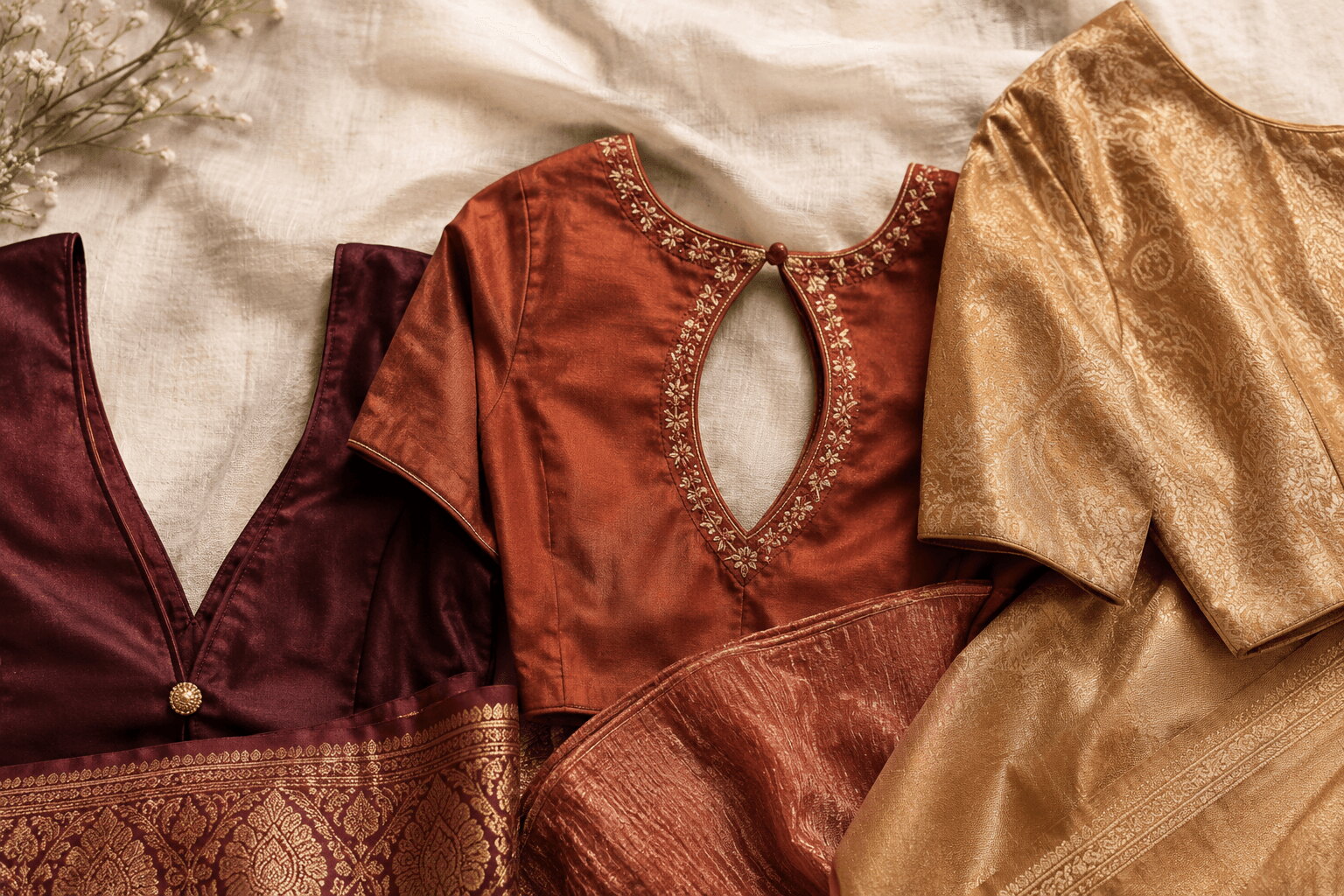
10. The Deep V-Back with a Single Button
A moderate-depth V at the back, closed with one decorative button at the top rather than a full row of hooks. A good middle ground for family functions where a fully open back may not be appropriate.
11. The Keyhole Back
A small cut-out at the centre back, often teardrop or diamond-shaped, edged with piping or a thread border. Suits Chanderi, Maheshwari, and lighter silks.
12. The Full Backless with Tie-Up
An open back gathered and secured with fabric ties or a single string of fabric-covered buttons. Best reserved for evening and reception wear in silks that hold their shape.
13. The Contrast Cutwork Back
The back panel done in a contrasting fabric or colour, sometimes with cutwork or a small motif embroidered at the centre. Works beautifully with plain-bodied sarees like a solid Maheshwari or Tussar.
Fabric and Cut — 2 Ideas
14. The Brocade Blouse from the Saree’s Own Piece
Many Banarasi sarees are sold with an unstitched blouse piece woven to go with them. Cutting the blouse from that piece — in a simple boat or high neck — gives the most coherent look with the least effort, and the fabric is already matched to the saree’s zari. Keep the cut plain; the brocade is the detail.
15. The Angrakha (Wrap-Front) Blouse
Overlapping front panels that cross and tie or fasten at the side, in the manner of the traditional angrakha garment. It adds structure without adding embellishment, and suits plain-bodied Chanderi, Maheshwari and cotton sarees. Skip it under a heavy zari pallu, where the crossed panels add bulk at the shoulder.
A Fit Note Before You Go to the Tailor
No blouse design works if the fit is wrong, and this is where most people lose money. A few things worth saying plainly to your tailor, regardless of which of the fifteen designs you choose:
- Get measured in the innerwear you’ll actually wear on the day — not a regular bra, if you’re wearing shapewear or a different fit underneath.
- Ask for a fitting, not a final stitch, if it’s a first-time tailor. A ₹150 alteration is cheaper than a blouse you can’t wear.
- For heavy zari sarees, tell the tailor which saree the blouse is for — a dense-zari Banarasi katan saree can weigh 500–700 grams or more, and a blouse cut for a lighter saree will sit differently once a heavy pallu is pinned to the shoulder.
If you’re pairing a new blouse with an heirloom Banarasi or Kanjivaram, our handloom saree care guide also covers how to store both pieces together without the zari catching on blouse hooks — a small detail that ruins more sarees than people expect.
FAQ
A plain or single-detail blouse in a solid colour — a structured high neck or a deep V-back with a single button — works best. Banarasi silk already carries dense zari work on the border and pallu; a busy blouse competes with it rather than complementing it. See our complete Banarasi saree guide for how zari density should guide your choices elsewhere too.
It depends on the function. A full backless tie-up blouse suits evening receptions and sangeet functions well, but for daytime rituals or more conservative family gatherings, a deep V-back with a single button or a keyhole back gives a similar elegance without being fully open.
The modernised boat neck remains the safest, most universally flattering option — it suits nearly every saree category, from cotton to bridal silk, and photographs well from most angles. If you’re building a blouse wardrobe with limited pieces, start here.
Contrast is the stronger choice for handloom sarees. Picking a blouse colour from within the saree’s border — rather than matching the body fabric exactly — makes the outfit look styled rather than default-matched.
Roughly 0.8 to 1 metre of fabric covers most blouse designs, though full-sleeve or high-neck styles with extra panelling can need up to 1.2 metres. Always confirm with your tailor before cutting, especially if you’re using a contrast or brocade fabric with a directional print.
About these recommendations: the pairings are styling judgement from Nakshapatta’s editors, not sourced facts, and fabric quantities are typical tailoring ranges that vary by tailor and design. Nakshapatta does not accept payment for recommendations.
Wearing a saree to work? See how to wear a saree to the office. Join the Nakshapatta Edit — one textile fact, one styling tip, one honest recommendation, once a week. No spam, no sponsored placements. Join the Edit →