

Key Takeaways
- A genuine bridal Banarasi saree costs between ₹25,000 and ₹1,00,000, while cheaper options are likely not real silk.
- To verify silk authenticity, check for a Silk Mark tag, feel for warmth and softness, and perform a burn test on a thread.
- Buy your main bridal saree three to five months before the wedding to allow for custom weaving and stitching.
- A GI tag indicates authentic regional production, providing protection from imitations.
- Banarasi sarees are lighter with floral motifs, while Kanjivaram sarees are heavier and more structured; brides may choose one for the wedding and another for the reception.
There is a moment every bride knows. The shopkeeper unfolds saree after saree, the reds blur into one another, the zari glints, and somewhere between the fourth and the fourteenth piece you stop being able to tell what is genuinely worth its price and what is simply well-lit. If you have felt that quiet panic, you are exactly the person this checklist is for.
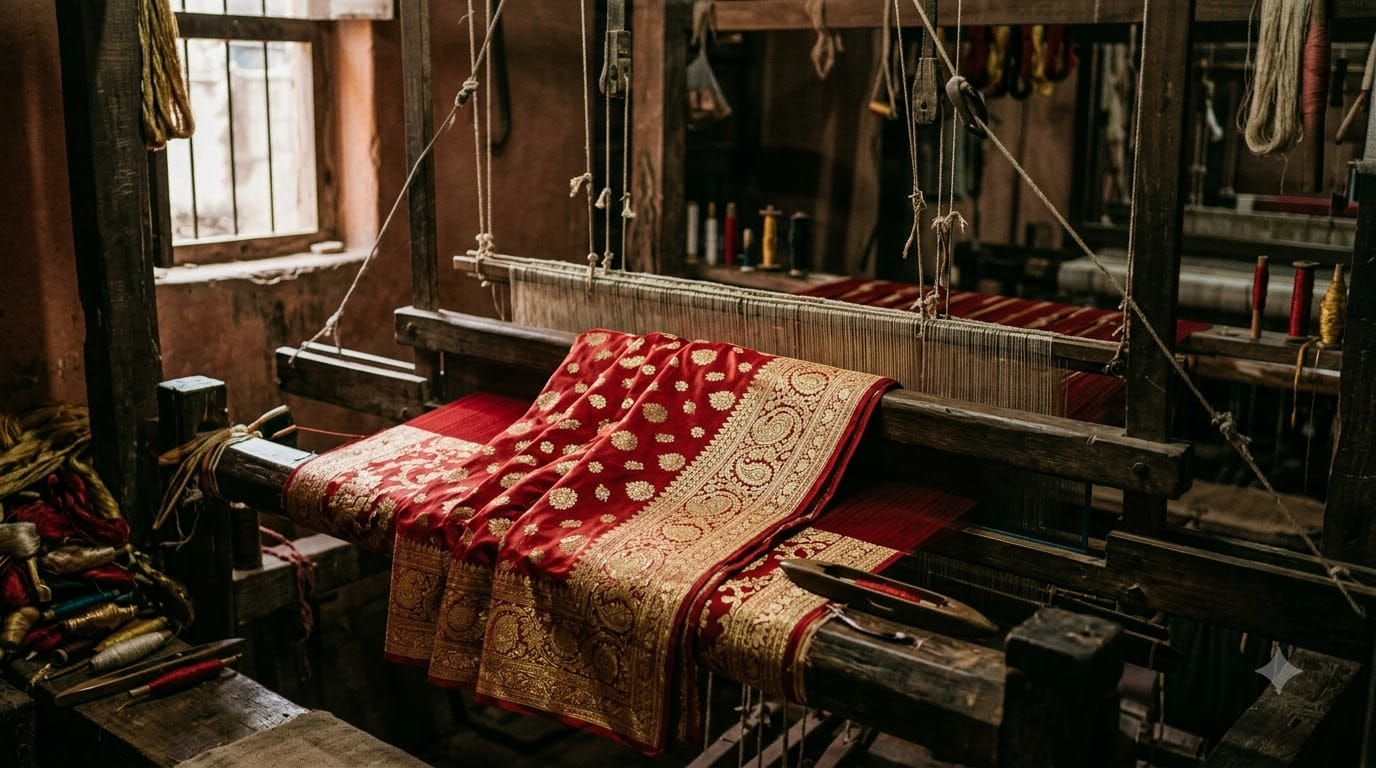
I write this from Varanasi, where the bridal Banarasi begins its life — not in a showroom, but on a pit loom in the lanes of Madanpura and Lallapura, where a karigar can spend forty days lifting real gold-tested zari into silk by hand. Standing in those sheds teaches you what a good bridal saree actually is, and how to tell it apart from a convincing copy.
1. Start with the fabric, not the design
The single most expensive mistake is falling for a motif before confirming what it is woven on. A bridal saree is worn for hours, photographed endlessly, and kept for decades — the base fabric decides how it drapes, how it ages, and how honestly it is priced.
The three fabrics worth your money
- Banarasi katan silk — the classic North Indian bridal choice. Pure, tightly twisted silk warp and weft, cool to the hand, weighing roughly 500–700 grams for a full saree. Best for the shaadi and reception.
- Kanjivaram (Kanchipuram) silk — the South Indian standard. Heavier, denser silk with a korvai border woven on a separate shuttle so the border and body are interlocked, not stitched.
- Lighter handloom silks — georgette-Banarasi, khaddi silk, or organza for engagements and morning functions where you want movement over weight.
What to avoid unknowingly buying: art silk (viscose or polyester dressed up as silk) and powerloom “Banarasi”. Neither is shameful for a lighter function — but neither should be sold to you at handloom prices. Our handloom vs powerloom guide walks through the back-of-saree test in detail.
2. Verify the zari — this is where money hides
Zari is the metallic thread that makes a bridal saree glitter, and it is where value quietly concentrates. There are three grades, and the difference between them can be tens of thousands of rupees.
| Zari type | What it is | How it behaves |
|---|---|---|
| Real / pure zari | Silver thread electroplated with gold, wound on silk | Warm, dense, does not flake; ages to a soft patina |
| Tested / half-fine | Silver with reduced gold, or copper base | Bright, good value; may dull over years |
| Plastic / metallic (nakli) | Coated polyester film | Sharp shine, feels papery, can blacken and crack |
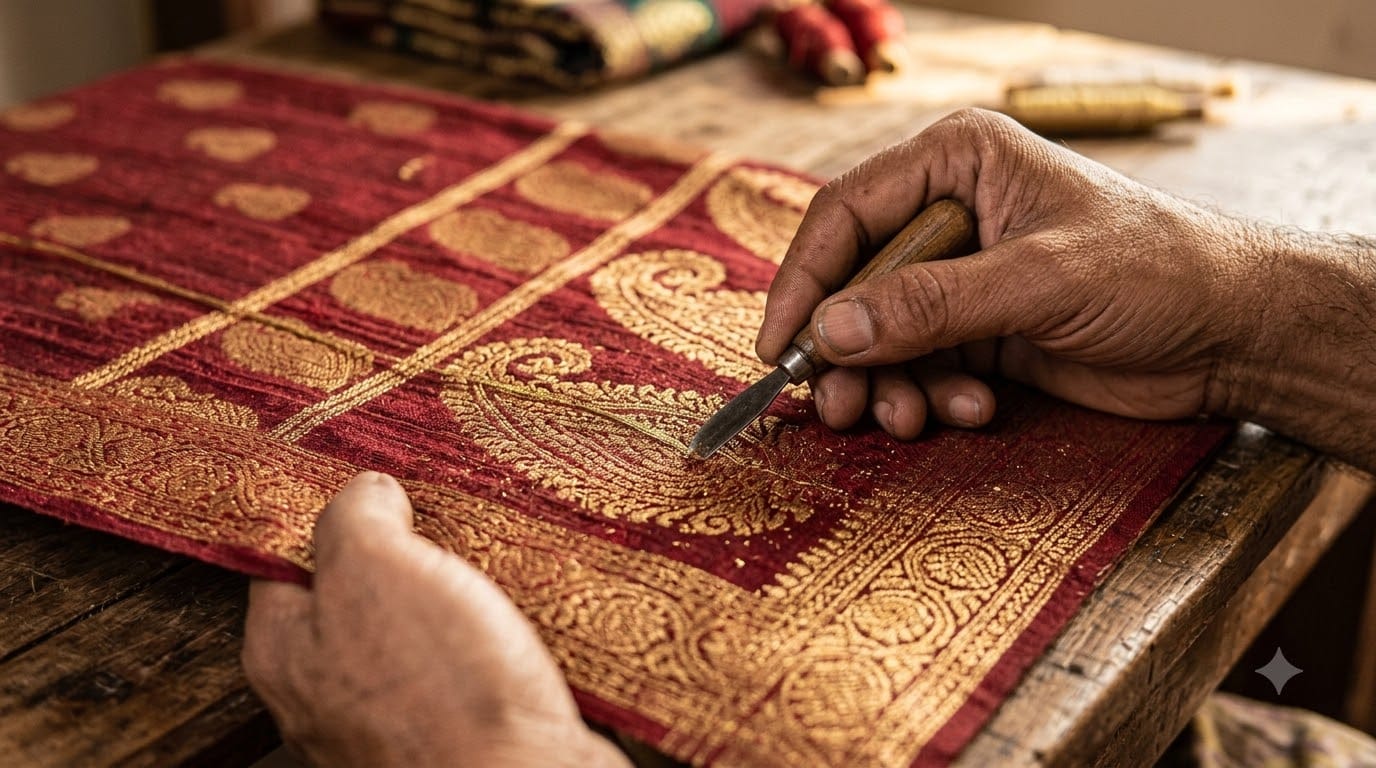
The old bazaar test still works: gently scrape a zari thread with your nail — real zari stays smooth and metallic, while plastic zari flakes or reveals a white core. Ask the seller directly whether the zari is real, tested, or metallic, and get the answer written on the bill.
3. Check the authenticity marks and the weave
You do not have to be an expert if you know what to ask for. Three official marks do most of the work.
- Silk Mark — a yarn-tag issued by the Silk Mark Organisation of India certifying pure natural silk.
- Handloom Mark — confirms the piece was woven on a handloom, not a powerloom.
- GI tag — the Geographical Indication mark proves genuine origin (Banaras, Kanchipuram, Chanderi). Your strongest protection against a heritage name being borrowed by a copy.
Then read the saree itself. Turn it over: on a genuine handloom the reverse shows the same motif with slightly loose floating threads and tiny, human irregularities. A powerloom back is machine-perfect and gridded. If you want to go further, our five tests to identify pure silk covers the burn test, the rustle, and the ring test. When in doubt about a term on the bill, keep our Indian Textile Glossary open on your phone.
4. Set a realistic budget before you shop
Deciding your number in advance is the best defence against a beautiful saree you cannot quite afford. Bridal pricing is genuinely wide because it tracks silk weight, zari grade, and hand-labour. Current 2026 ranges, loom-side:
| Tier | Banarasi katan | Kanjivaram silk |
|---|---|---|
| Entry handloom | ₹8,000 – ₹20,000 | ₹15,000 – ₹30,000 |
| Mid / heavy work | ₹25,000 – ₹60,000 | ₹35,000 – ₹80,000 |
| Bridal, pure zari, kadhua | ₹75,000 – ₹2,50,000+ | ₹80,000 – ₹2,00,000+ |
A genuine handloom Kanjivaram in 2026 realistically starts around ₹15,000 and a full pure-zari bridal piece with three-shuttle korvai borders climbs past ₹1,00,000; a bridal Banarasi in kadhua sits in the same league. If a saree at a bridal price cannot tell you why it costs what it does, treat that as missing information, not a bargain.
Build your budget in three envelopes
- The main saree — the shaadi or reception piece. Spend the majority here.
- Function sarees — lighter pieces for mehendi, haldi, and sangeet.
- Finishing costs — blouse fabric and stitching, fall and pico, pre-draping. Budget ₹2,000–₹15,000+; almost always underestimated.
5. Confirm colour, motif, and how it photographs
Red still leads 2026 bridal wardrobes, but in more considered shades — sindoori red, velvet red, wine, and brick alongside temple gold, emerald, and plum. For daytime and engagement functions, pastels are having a genuine moment: ivory, rose pink, champagne, and lavender with fine handwork.
Two practical checks brides forget: first, see the saree in natural light and under warm indoor light, because bridal photography happens in both and some reds shift dramatically. Second, hold it against your skin tone and your jewellery. For draping once the saree is chosen, our styling section has ceremony-by-ceremony guides.
6. Fittings, timeline, and care
- Blouse — decide fabric, sleeve, and back design early; heavy hand-embroidery needs weeks.
- Fall & pico — always get these done on a silk bridal saree so the pleats hold and the edges are protected.
- Pre-draping / safety pins — a heavy Kanjivaram or kadhua Banarasi can weigh several kilos; plan how it will be draped and pinned.
- Trial run — drape the full look at least once before the wedding day.
- Care — never wash silk at home; dry-clean sparingly, store in muslin (not plastic), and re-fold along new lines each year to prevent zari cracking.
The one-page checklist to carry with you
- Fabric confirmed — pure katan / Kanjivaram silk, verified by feel and Silk Mark
- Zari graded — real, tested, or metallic — stated on the bill
- Marks present — Silk Mark, Handloom Mark, GI tag seen in person
- Reverse read — handloom irregularities, not a machine-perfect grid
- Budget set — main saree, function sarees, and finishing costs separated
- Colour tested — checked in natural and warm light, against skin and jewellery
- Fittings planned — blouse, fall, pico, pre-drape, and a trial booked
- Timeline safe — ordered 3–5 months before the wedding
- Bill itemised — fabric, zari type, and origin written down
Frequently asked questions
A genuine handwoven bridal Banarasi in pure katan silk with real zari typically starts around ₹25,000 and rises well past ₹1,00,000 for heavy kadhua work. Anything sold as “pure Banarasi silk” under ₹3,000 is almost certainly powerloom or art silk.
Ask for the Silk Mark yarn-tag first. Then trust your hands: real silk feels warm, has a soft rustle, and springs back when crushed. If the seller permits, burn a stray thread from the pallu fringe — real silk curls, smells of burnt hair, and leaves crushable black ash. Synthetic melts into a hard bead and smells of plastic.
Buy the main bridal saree three to five months before the wedding. A bespoke kadhua Banarasi or custom-colour Kanjivaram can take 30–90 days on the loom, plus time for blouse stitching and a draping trial. For trustworthy places to buy, see our guide to the best handloom sarees online in India.
A Geographical Indication (GI) tag certifies that a saree was genuinely woven in its named region — Banaras, Kanchipuram, Chanderi. It is your strongest proof of origin and best protection against a powerloom imitation sold under a heritage name.
Both are exceptional; it is a question of drape and tradition. Banarasi katan is lighter, softer, and floral-Mughal in its motifs. Kanjivaram is heavier, more structured, with temple borders and famously durable silk. Many brides choose one for the wedding and the other for the reception.
Editorial independence: Nakshapatta does not accept payment for recommendations. Prices are indicative 2026 loom-side ranges and vary by weaver, zari grade, and technique.