



Key Takeaways
- To verify a Silk Mark, enter the label’s series letter and serial number on the Silk Mark Organisation of India’s Label Authentication page; a genuine label returns the seller it was issued to.
- The name on screen must match the shop that sold you the saree. A valid number under a different name is a red flag.
- The Silk Mark proves pure natural silk only. It says nothing about handloom, and the scheme is voluntary, so a missing label is inconclusive.
- “GI number” can mean three different things. Only the seller’s authorised-user registration is specific to the saree in your hand.
- The Banaras Brocades and Sarees GI (Application No. 99) covers five districts: Varanasi, Mirzapur, Chandauli, Sant Ravidas Nagar (Bhadohi) and Azamgarh.
- Run both checks, then burn-test a spare thread from an inner seam before you pay festive-season prices.
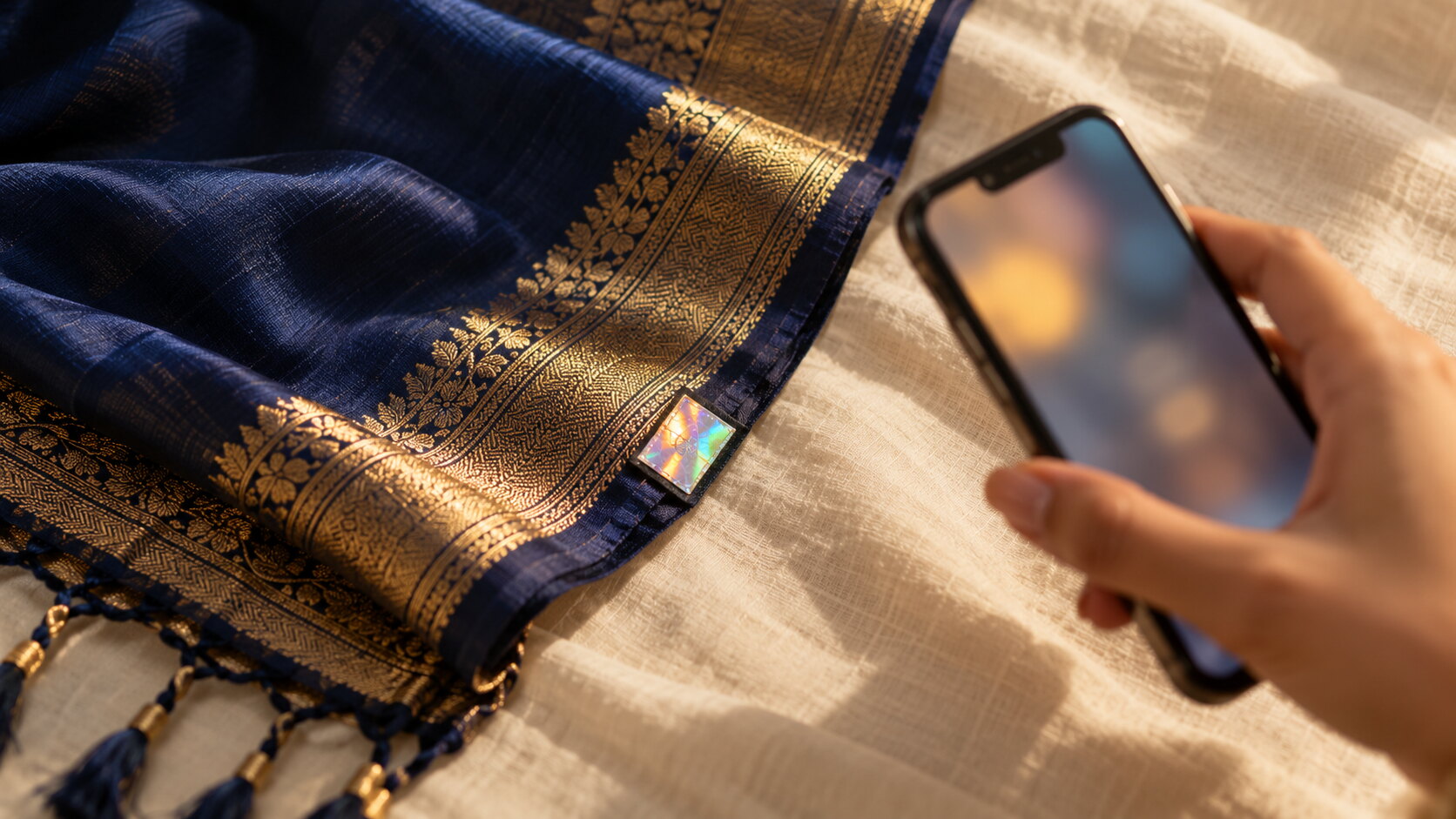
To verify a Silk Mark, find the hologram label and note its series letter and serial number. Type silkmarkindia.com into your own browser, open Consumer, then Label Authentication, choose the series and enter the number. A genuine label returns the name of the authorised seller it was issued to, and that name should match the shop that sold you the saree. A GI claim is checked differently: ask for the seller’s GI authorised-user certificate. The Silk Mark settles the fibre. The GI settles the place. Neither settles handloom.
If a seller has ever turned a saree over, shown you a small hologram label and said “Silk Mark certified, madam”, and you nodded because it sounded official, this piece is for you. The label is a claim. Checking it takes about two minutes on your phone, and most buyers never do.
Our guide to Handloom Mark vs Silk Mark vs GI tag explains what each mark means. This is the practical companion: what to do at the counter, in what order, and what each result does and does not tell you.
Before you start: what a label can and cannot prove
A label is a claim made by the seller and backed by a body. Verifying it means asking that body whether the claim is real. Two different bodies, two different questions:
- Silk Mark Organisation of India (SMOI), a society sponsored by the Central Silk Board, runs the Silk Mark. Its question is is this pure natural silk, sold by a registered seller?
- The Geographical Indications Registry in Chennai holds the GI register. Its question is does this come from the protected region, and is this seller entitled to use the name?
Neither one tells you whether the saree was woven by hand. For that you need the Handloom Mark or the checks in our handloom vs powerloom guide.
How to verify a Silk Mark, step by step
- Find the label. Silk Mark labels are paper hangtags or sew-in labels, attached only by SMOI’s registered authorised users. Look for a hologram and a printed unique number. Note the series letter that goes with the number, and copy both exactly.
- Open the site yourself. Type silkmarkindia.com into your browser. Do not follow a link a seller sends you on WhatsApp. Newer labels also carry a QR code that opens the same site; if you scan one, check that the address bar reads silkmarkindia.com before you trust the page.
- Go to Label Authentication. It sits under the Consumer menu. Choose the series from the dropdown, enter the serial number and press Search.
- Read the name that comes back. A genuine label traces to the authorised user it was issued to. That name should match the shop or brand on your invoice.
- If anything fails, stop. Do not pay yet. Ask for a free test: SMOI says marked products can be tested at its accredited Silk Mark chapters if you have doubts.
When you verify a Silk Mark, check the digits twice before you decide anything. A mistyped number is the most common reason for a “no result”, and it is worth ruling out before you accuse a seller.
What a clean Silk Mark result still does not tell you
Three limits, all worth holding in your head at the counter.
It proves fibre, not loom. A powerloom saree in pure silk can legitimately carry a Silk Mark. So can a handloom one.
It is voluntary. The scheme is advisory, not a legal requirement, so a weaver who never registered is not automatically selling fakes. A verified label is a strong signal. A missing one is inconclusive.
It verifies the label, not the cloth in your hand. A valid number shows the label was issued to that seller. Tags have been reused on other fabrics in the past, which is why SMOI has talked about moving to labels that are harder to lift. So run the old test as well: pull two or three threads from an inner seam and burn them. Real silk burns slowly, smells like burning hair and leaves a fine, crushable ash. The full method is in how to identify a pure silk saree.
How to verify a GI claim on a Banarasi saree
This is where buyers get quietly misled, because “GI number” sounds like one thing and is really three.
The three things people call a “GI number”
- The application number. Banaras Brocades and Sarees is registered with the Geographical Indications Registry under Application No. 99. That number belongs to the GI itself. Any seller can quote it, and it says nothing about the saree in your hand.
- The authorised-user registration. Under the Geographical Indications of Goods (Registration and Protection) Act, 1999, a producer applies to the Registry to become an authorised user of the GI. The registration is valid for ten years and must be renewed. This is the claim that ties a particular seller or weaving unit to the GI.
- A tag or sticker that says “GI”. By itself, it is a printed sticker. It proves nothing until the certificate behind it is shown.
What to ask the seller
Ask to see the authorised-user certificate, or a clear photo of it. Then check three things: the name matches the seller or weaving unit on your invoice, the registered goods are Banaras Brocades and Sarees, and the validity period has not lapsed. If the seller is a shop rather than a weaver, ask whose certificate covers this saree. The Registry’s own page for application 99 is the place to confirm the GI itself.
Which districts count
Per the GI Journal (No. 29, 19 March 2009), the Banaras Brocades and Sarees GI covers five districts: Varanasi, Azamgarh, Mirzapur, Sant Ravidas Nagar (Bhadohi) and Chandauli. A saree woven in Surat, or anywhere else, cannot lawfully be sold as a Banarasi. The application also names Madanpura as one of the two most important brocade-weaving areas of Varanasi, which is why the lanes there matter so much when we talk about the Banarasi saree.
Remember what the GI protects: the name and the place. A saree can sit inside the GI region and still be powerloom or blended. Origin is one answer; fibre and loom are two more.
The five-minute counter check
Keep this on your phone. Run it before the payment screen, not after.
- Silk Mark label has a hologram and a printed number; not hand-written, not loose.
- You typed the number into silkmarkindia.com yourself, and it returned a seller name.
- The returned name matches the shop or brand on your invoice.
- If a GI is claimed: you have seen the authorised-user certificate, and name, goods and validity all match.
- The invoice states fibre (“pure katan silk”) and loom (“handloom”) in writing.
- Price clears the believable floor for the weave and zari you were told you are getting.
- You burn-tested a spare thread, or asked for a free test at a Silk Mark chapter.
SMOI lists a Varanasi office on the Central Silk Board’s IIHT campus at Chowkaghat. If you are buying in Varanasi and a label does not check out, it is worth asking there how to get a piece tested.
What each check settles
| Check | What it settles | What it cannot settle | Where to check |
|---|---|---|---|
| Silk Mark label | Pure natural silk, traced to a registered seller | Handloom or powerloom; origin; that the label stayed on the right piece | silkmarkindia.com, Label Authentication |
| GI authorised-user certificate | That this seller is entitled to use the GI name | Fibre; handloom or powerloom | The certificate itself; Registry page for the GI |
| Handloom Mark | Handwoven, not powerloom | Fibre; origin | See our Handloom Mark guide |
| Burn test on a spare thread | Natural silk versus synthetic | Loom; origin; who sold it | Your own hands, an inner seam |
Only the first three are paperwork. Together they answer the three questions a serious buyer is asking: what is it made of, how was it made, and where does it come from. The terms are all defined in our Indian textile glossary.
Sources and what we could not verify
Label process and Silk Mark facts: Silk Mark Organisation of India, Label Authentication and the SMOI home page. GI facts: the Geographical Indications of Goods (Registration and Protection) Act, 1999, the Registry’s application 99 page, and GI Journal No. 29 (19 March 2009). We have not confirmed whether the Registry’s public portal lets a buyer look up an individual authorised user by name, so this guide tells you to ask for the certificate. How we work: our editorial standards.
Frequently asked questions
Note the series letter and serial number on the hologram label, open silkmarkindia.com in your own browser, and go to Consumer, then Label Authentication. Choose the series, enter the number and search. A genuine label returns the name of the authorised user it was issued to, which should match the seller.
No. The Silk Mark certifies pure natural silk and nothing about how the cloth was woven. A powerloom saree in pure silk can legitimately carry one, so pair it with the Handloom Mark or the checks in our handloom vs powerloom guide.
Not necessarily. The scheme is voluntary, and some genuine weavers never register. A missing label is inconclusive, so rely on a burn test of a spare thread and a written fibre description on the invoice.
The only fixed number is Application No. 99, which belongs to the Banaras Brocades and Sarees GI itself and says nothing about one saree. What matters for your saree is the seller’s authorised-user registration, so ask to see the certificate.
Ask for the authorised-user certificate and check the name, the registered goods and the validity date. Registrations run for ten years and need renewing. If the seller cannot produce one, treat the GI claim as unproven: the saree may still be genuine, but you would be taking it on trust.
Re-check the series letter and every digit first, because typing errors are common. If it still fails, do not buy on the strength of that label. Ask for a free test at a Silk Mark chapter, or contact the Silk Mark Organisation of India.
Want the counter checklist in your inbox before festive season? Join The Nakshapatta Edit: one textile fact, one tip, one recommendation, one reader pick.
Nakshapatta does not accept payment for recommendations. Prices and figures are indicative; check labels and certificates yourself before you buy.