




Key Takeaways
- Verify the seller before you verify the saree: a genuine label can still come from a dishonest shop.
- Run the seller’s GSTIN free at services.gst.gov.in and match the legal name, status and state to the brand’s story.
- The first two digits of a GSTIN give the state of registration (09 is Uttar Pradesh): use it to test the seller’s story, not to prove where a saree was woven.
- Handloom Mark QR labels can be scanned with the HLM Customer app; India Handloom Brand numbers trace only to producers, never traders.
- A “pure Banarasi silk” saree under ₹3,000 is a reason to check hard against genuinely comparable plain katan, not a verdict on its own.
- Pay only where the payee can be linked to the business you checked, and get the return terms in writing before you pay.
To verify a handloom seller online, run seven checks before you pay: (1) find the legal business behind the brand name, (2) confirm its GSTIN is active and matches the name and state, (3) trace any Handloom Mark or India Handloom Brand label to a registered producer, (4) check Silk Mark and GI claims separately, (5) make the photographs prove something, (6) test the price against the weave, and (7) pay only on terms that protect you. Passing all seven does not guarantee honesty, and the checks do not weigh equally: an identity contradiction matters more than a missing photo.
In the lanes of Madanpura, a buyer can sit on the white sheets of a gaddi, run a pallu between her fingers and turn the saree over to read its back. Online, all of that collapses into a phone screen and a seller’s word. This guide shows you how to verify a handloom seller before money leaves your account, using free government lookups, a few pointed questions, and what we have learned from Varanasi, where a saree usually moves from karigar to master weaver to gaddidar (wholesale trader) before it ever reaches a website.
That chain is not a scandal. Most honest Banarasi sellers are traders, not weavers. The problem is the seller who hides the chain, borrows the language of the loom and charges handloom prices for something else. Our guide to handloom vs powerloom sarees tells you how to read the fabric. This one tells you how to read the person selling it.
Why verify a handloom seller, not just the saree
Product checks and seller checks answer different questions. A Silk Mark number tells you about the silk. A GSTIN tells you who is legally answerable if the silk turns out to be something else. Fraud lives in the gap between the two: a real label stitched onto a substitute, a genuine saree photographed once and sold forty times, a “weaver’s own page” run from a city that has never had a pit loom.
If you have already read how to verify a Silk Mark and GI number, treat this as its companion. That article checks the tag. This one checks the hand that holds out the tag.
Check 1: Find the legal business behind the brand name
An Instagram handle, a logo and a WhatsApp number are not a business. You are looking for a legal name, a physical address and a person answerable for complaints.
On marketplaces, the law already does part of this for you. Under the Consumer Protection (E-Commerce) Rules, 2020, marketplaces must show buyers each seller’s business name, address and customer care number (rule 5(3)(a)), and sellers must give the platform their legal name, address, and GSTIN and PAN where applicable (rule 6(4)(d)). Tap the seller name on the product page and read what comes up.
On a brand website, look at the footer, the About page, the Contact page and the returns policy. On Instagram or WhatsApp, simply ask: “What is the registered name of your business, and where is it located?” Most honest sellers answer it readily.
Check 2: Run the GSTIN on the GST portal
This is the single most useful free check, and it takes about a minute.
- Ask the seller for their GSTIN, or find it on the invoice, website footer or marketplace seller page. It is a 15-character code.
- Go to the government portal at services.gst.gov.in. A basic search does not need a login.
- Choose Search Taxpayer, then Search by GSTIN/UIN. Enter the number and the captcha.
- Read the result: legal name, trade name, registration status, date of registration and principal place of business.
- Match each field to what the seller told you. The legal or trade name should connect to the brand. Status should read Active.
Read the state code before anything else
The first two digits of every GSTIN identify the state of registration, and characters three to twelve are the business’s PAN. That gives you a quick consistency test against the seller’s story.
| GSTIN starts with | State | Weaves the seller might claim |
|---|---|---|
| 09 | Uttar Pradesh | Banarasi |
| 23 | Madhya Pradesh | Chanderi, Maheshwari |
| 33 | Tamil Nadu | Kanjivaram |
| 36 | Telangana | Pochampally Ikat |
| 27 | Maharashtra | Paithani |
| 19 | West Bengal | Jamdani, Baluchari |
| 24 | Gujarat | Ajrakh, Patola |
Treat the state code as an identity check, not an origin test. A GSTIN records where a business is registered and has its principal place of business; it says nothing about where its suppliers’ looms are. A Delhi boutique registered under 07 can stock genuine Banarasi. What matters is whether the story holds together. If a seller registered in another state describes its sarees as “woven on our own looms in Varanasi”, ask how the business is connected to those looms, and expect a specific answer: a workshop, a cluster, a master weaver it buys from.
If there is no GSTIN at all
Do not jump to conclusions. A small independent weaver selling a handful of sarees a month may legitimately operate below the GST registration threshold. Ask instead whether they hold an Udyam (MSME) registration, which you can confirm free on the Udyam Registration portal using its Verify option and the registration number. A seller with a polished website, paid ads and “factory” claims but no GSTIN is a different matter.
Check 3: Trace the Handloom Mark or India Handloom Brand label
These two government labels are the closest thing handloom has to a passport. Each can be traced, and each works differently.
Handloom Mark
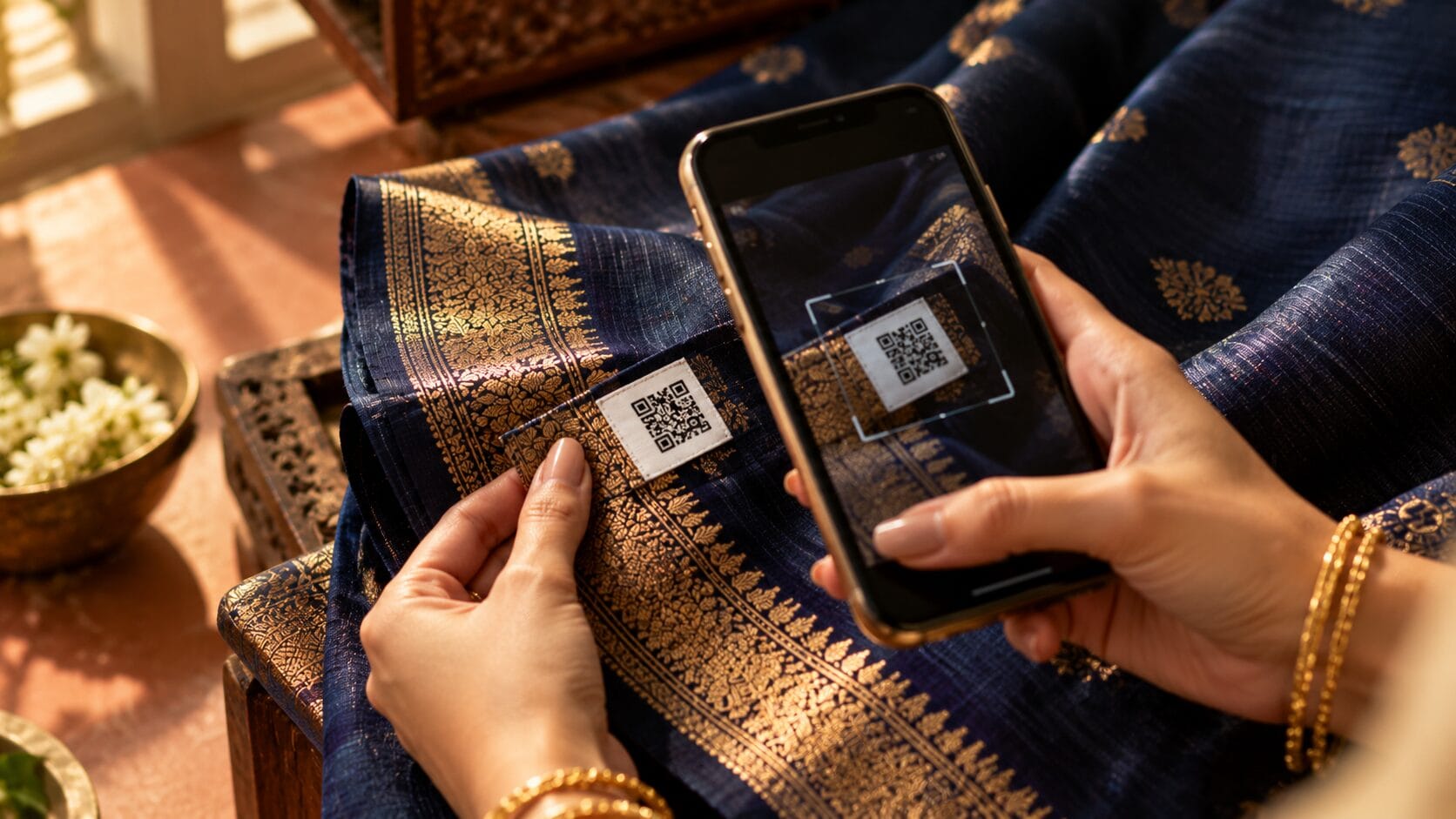
The Handloom Mark Scheme is run by the Textiles Committee under the Ministry of Textiles. Newer labels carry a QR code, and the Textiles Committee’s HLM Customer app is described as confirming a genuine label and showing details of its weaver, while flagging a fake one. We have not tested the app ourselves, so treat its result as one signal among several. Before you buy, ask for a sharp close-up of the label, front and back, and scan the QR from the photo.
India Handloom Brand
An India Handloom Brand label carries the logo and a registration number. The government’s own product manual says that the label can be checked against the list of registered users on indiahandloombrand.gov.in, and that no traders are registered for the brand. That last line matters. The number should always lead to a producer, a weaver, society or manufacturer, and to a product category that matches what you are buying. A reseller may sell India Handloom Brand sarees honestly, but the number on the tag is never theirs.
For what each certification proves, and what it does not, see Handloom Mark vs Silk Mark vs GI Tag.
Check 4: Check Silk Mark and GI claims separately
A seller can be perfectly legitimate and still overclaim. Silk Mark labels speak to the silk; GI status speaks to where a saree was made. Neither is the seller’s personal credential. Banarasi sarees carry a GI covering Varanasi and four neighbouring districts, so “GI-certified seller” really means “authorised user of the GI”, which the seller should be able to show with a registration number from the GI Registry. Our five-minute Silk Mark and GI check walks through both lookups.
Check 5: Make the photographs prove something
Catalogue photos are the easiest thing on the internet to steal. Make the seller show you something only the person holding the saree could show.
- Reverse-image search the main photo with Google Lens. If it appears on five other stores at five different prices, it is probably a shared catalogue image. That is common among resellers, so ask for the seller’s own photos of the piece you will receive.
- Ask for a short video of the reverse side, the selvedge and the end-piece, with a handwritten note carrying your name and today’s date in frame.
- Ask for the weight of this specific saree in grams, and whether that includes the blouse piece. A full plain katan Banarasi typically weighs 500 to 700 grams; heavy brocades weigh more, light organzas less. A figure far outside the usual range for the weave deserves a follow-up question. No figure at all is simply missing information.
- Ask a loom question. Who wove it, in which mohalla or village, on what kind of loom, and roughly how many days it took. Many genuine traders will not know the weaver’s name. A cluster or mohalla is a reasonable answer; a vague one is a reason to ask more.
Our handloom vs powerloom guide shows what the reverse side should look like in that video.
Check 6: Test the price against the weave
Price is the check most buyers skip because a bargain feels like luck. In handloom, it is usually information. Our working floor: a “pure Banarasi silk” saree offered under ₹3,000 deserves a hard second look. The figure reflects loom-side prices for plain katan in Varanasi, and it is a prompt to check the silk, the zari and the loom, not a verdict on the seller by itself. Compare like with like (plain katan with plain katan, the same length and zari type) before you decide. A perpetual “70% off” banner is the same prompt in different clothes.
Before you pay, compare the asking price against our Banarasi saree price guide, which sets out what each type should realistically cost.
Check 7: Pay and return on terms that protect you
This is where good verification usually falls apart: the buyer is convinced, the seller asks for UPI, and the money goes before any of the above is on paper.
- Match the payee. Before you confirm a UPI or bank transfer, read the account name your app displays. It should match the legal or trade name from Check 2, or a proprietor or partner the seller can show is connected to that business; a sole proprietor’s own name is common. An unexplained third party is the problem.
- Know what each route protects. Cash on delivery removes the risk of losing an advance, but it does not prove the saree is genuine. Card payments and marketplace orders come with dispute processes run by the bank or platform. UPI has a complaint route through NPCI and your bank, though the outcome depends on the transaction and your evidence. A full advance to an unconnected personal account is the weakest position.
- Get the return policy in writing. It should cover a saree that turns out to be misdescribed, not only change-of-mind returns. Before you do anything that alters the saree, such as pulling a fringe thread for a burn test, get the seller’s agreement in writing, or ask for an independent test instead.
- Ask for a proper invoice that names the seller’s GSTIN and describes the item specifically, for example handloom, pure silk, tested zari. Vague invoices protect sellers, not buyers.
- Note the grievance officer. Under the e-commerce rules, a grievance officer must acknowledge a complaint within 48 hours and resolve it within a month (rules 4(5) and 6(4)(b)).
When to stop, and when to look closer
The seven checks are not a score. Some findings should end the conversation; others only mean you need more information. This is our editorial judgement, not a formal fraud test.
Reasons to look closer: catalogue photos instead of the seller’s own, no weight given, a label you could not scan, a vague answer about the weaving cluster, or a price well below comparable pieces. Each deserves a follow-up question before you pay.
The seven checks at a glance
- Legal business name and physical address found and noted
- GSTIN active, legal name matches, state code fits the story
- Handloom Mark QR or India Handloom Brand number traced to a registered producer
- Silk Mark and GI claims checked separately, not taken as seller credentials
- Original video of the reverse side and selvedge, with your name and date in frame
- Price consistent with the weave and type
- Payee linked to the business; return terms and invoice in writing
What a good answer sounds like
| What you ask | A good answer | A red flag |
|---|---|---|
| Where is your business registered? | A named firm, a mohalla or street, a GSTIN | “We are online only” |
| Who wove this saree? | A cluster, a loom type, sometimes a name | “Our own weavers” with no detail |
| Can you show me the reverse side on video? | A video within a day | Another catalogue photo |
| Can I return it if it is not as described? | Yes, in writing | “No returns, no exceptions” |
| Whose name will the UPI show? | The business, or its named proprietor | Someone with no stated link to the business |
For sellers we have already looked at, see our list of the best handloom sarees to buy online in India. For terms like katan, kadhua and zari, keep the Indian Textile Glossary open in another tab, and browse every weave from the Weave Guide.
Frequently asked questions
No. A small independent weaver selling a few sarees a month may legitimately sit below the GST registration threshold. Ask for an Udyam registration number instead and verify it on the Udyam portal. A seller with a large website, ads and “factory” claims but no GSTIN deserves far more caution.
Ask for the registered business name, address and GSTIN, then check the GSTIN on services.gst.gov.in. Reverse-search the photos with Google Lens and ask for a short video of the saree’s reverse side with your name and the date in frame. Pay only to an account you can link to the business you checked.
The Textiles Committee describes its HLM Customer app as scanning the QR code on newer Handloom Mark labels, showing details of the weaver for a genuine label and flagging a fake one. We have not tested it ourselves. Older labels without a QR code carry a code number instead, which the Textiles Committee can check if you raise a complaint with your bill.
Not by itself. A GI belongs to a product and a region, not to a shop. A seller who claims GI authorisation should be able to give you an authorised-user registration number from the GI Registry, and that claim is separate from whether the saree itself was made inside the GI area.
Write to the seller and the platform’s grievance officer first, with photos, the invoice and the listing. If a Handloom Mark label was used, report it to the Textiles Committee with the bill and label code. If the dispute stays unresolved, file a complaint with the National Consumer Helpline on 1915 or at consumerhelpline.gov.in.
Want more buying checks like this in your inbox? Join The Nakshapatta Edit, our newsletter on reading, buying and wearing handloom.
Nakshapatta does not accept payment for recommendations, and no seller or platform named or linked here has paid to appear. Government portals and procedures change; we checked the official sources cited above on 27 October 2026. Images are illustrative. Read our editorial standards.