


Key Takeaways
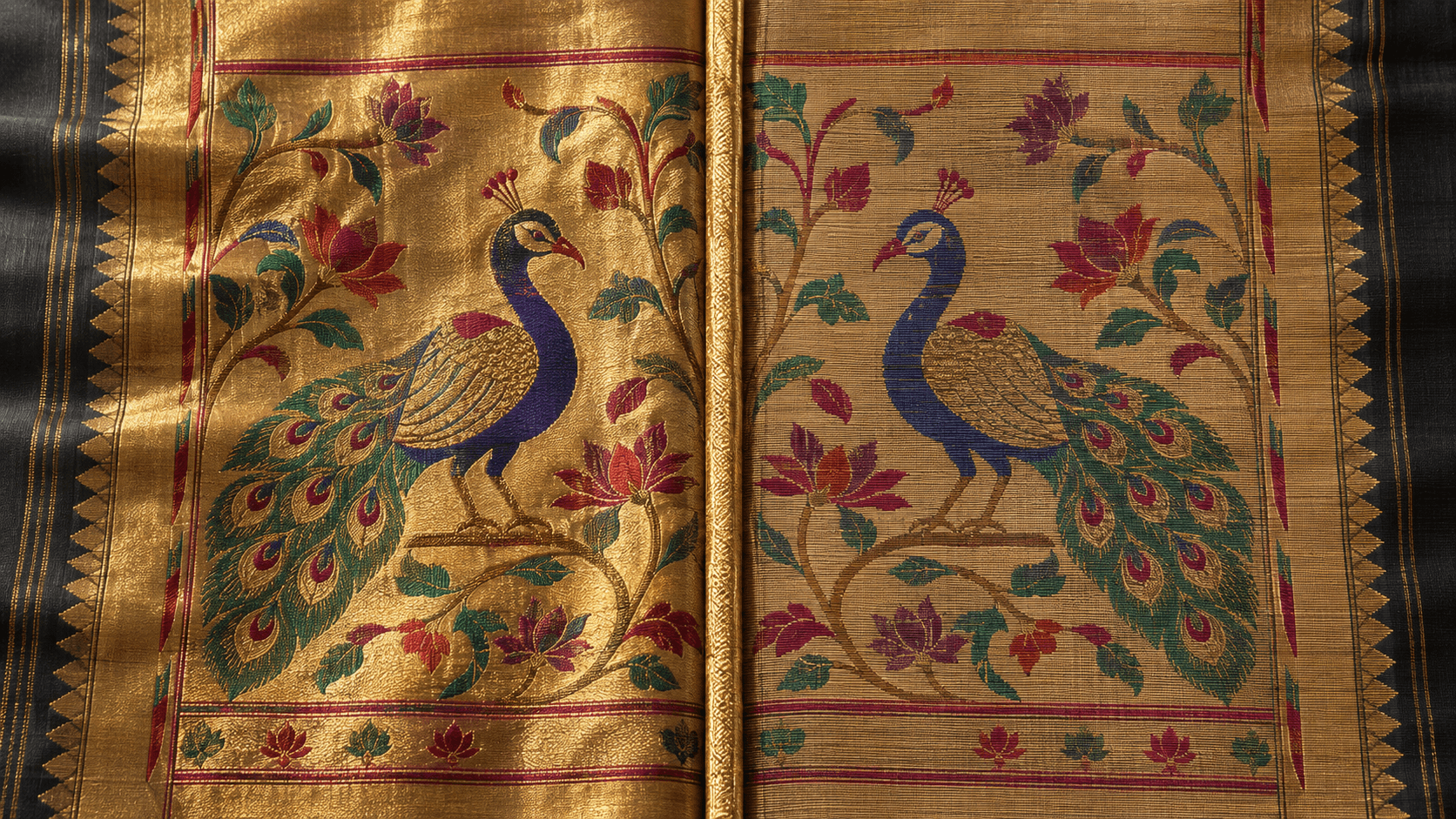
- Paithani is a tapestry-weave silk saree from Maharashtra, woven by interlocking the weft thread-by-thread so the peacock pallu and border look identical on both sides.
- It carries a Geographical Indication (GI Reg. No. 150 & 153) and is woven mainly in Yeola, in Nashik district, and the original town of Paithan on the Godavari.
- The clearest authenticity test is the reverse: a genuine handloom Paithani has no loose floating threads behind the motifs; a powerloom copy shows a tangle.
- Real pure-silk handloom Paithani starts around ₹10,000 for a single-motif border and crosses ₹1,00,000 for a full bangdi-mor pallu in pure zari.
- Signature motifs — mor (peacock), bangdi mor, muniya (parrot), asawali vine, lotus — each carry meaning, not just decoration.
- Anything sold as “pure silk Paithani” under ₹6,000 is almost certainly powerloom or semi-silk with imitation zari.
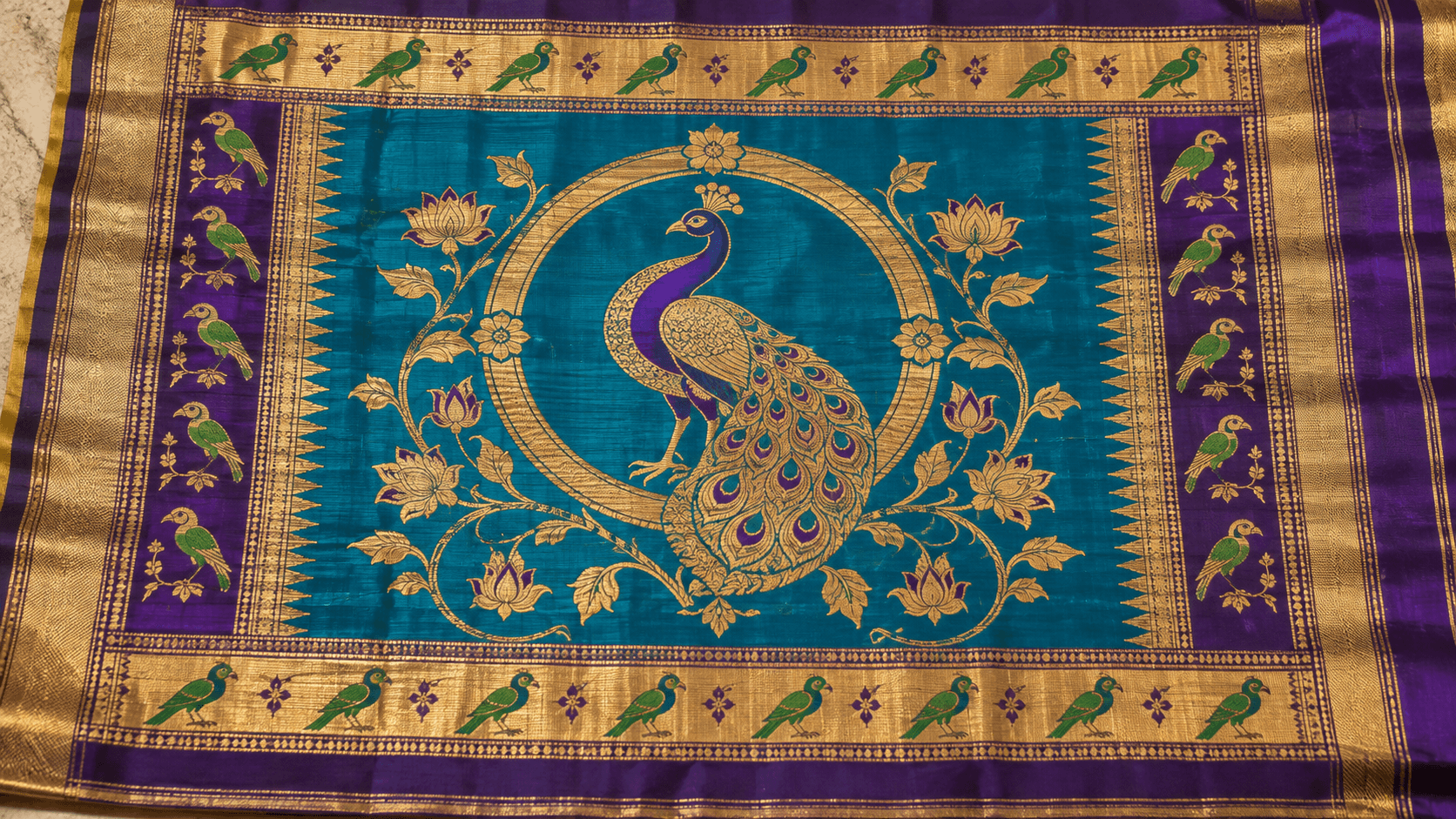
The peacock on a Paithani pallu is not printed, embroidered, or floated across the silk and cut off behind. It is woven into the fabric, one interlocked patch of colour and gold at a time, until the front and the back are the same. That single fact explains everything else about the saree — why it takes months, why it costs what it does, and why, of all India’s great silks, it is one of the easiest to authenticate once you know where to look.
What is a Paithani saree?
A Paithani saree is a handwoven pure-silk saree from Maharashtra, defined not by its colour or its motifs but by a single method: the tapestry weave. Instead of running a continuous coloured or metallic thread across the full width and letting it float on the back where it is not needed, the weaver interlocks each patch of colour and zari with the ground weave, thread by thread, by hand. The result is a border and pallu that read the same on the front and the back — no reverse, no wrong side.
The weave is named for Paithan, an ancient trading town on the Godavari river (historically Pratishthan). Today most Paithani is woven in Yeola, in Nashik district, with Paithan continuing as the heritage centre. The saree carries a Geographical Indication tag — Paithani Saree & Fabrics, GI Registration No. 150 & 153 — which legally ties the name to its Maharashtra origin, as recorded by the Textiles Committee.
The tapestry weave — why a Paithani is different
Most brocade sarees carry their extra-weft patterns as floats: the design thread runs across the back and is cut or tucked where it is not needed. Turn such a saree over and you see the working — loose threads, a shadow of the motif, a clear front and back.
A Paithani does not work this way. Its borders and pallu are woven in the interlocked-weft (kadiyal) tapestry method, where the weaver builds each colour and each gold patch as a discrete area, locking it into the neighbouring threads so there is nothing to float and nothing to hide. This is closer to how a fine wall tapestry is made than to ordinary saree brocade. If you have ever read the reverse of a handloom to judge it — the instinct behind our handloom vs powerloom guide — the Paithani is the weave where that test is most decisive.
The trade-off is time. A plain body with a single-motif border can come off the loom in a couple of weeks. A bangdi mor pallu — a peacock rendered inside a bangle, in graded zari — can take a skilled weaver several weeks alone. A fully brocaded piece with an all-over asawali body and a rich pallu can hold a loom for six months to well over a year. There is no shortcut, which is exactly why the powerloom imitation exists.
The motifs — and the peacock pallu
Paithani motifs are drawn from the Deccan’s temple and courtly vocabulary, and each has a name and a meaning rather than being generic ornament.
| Motif | Where it sits | What it signifies |
|---|---|---|
| Mor / Bangdi Mor (peacock) | Pallu | Grace and beauty; the peacock woven inside a bangle is the signature Paithani pallu |
| Muniya / Tota (parrot) | Border rows | Love and speech; often woven in leaf-green with a red beak |
| Asawali (flowering vine) | Body, all-over | Abundance and the cycle of life; the most labour-intensive body |
| Kamal (lotus) | Border, pallu | Purity and prosperity; auspicious for weddings |
| Narali (coconut) | Border edge | A classic running border motif |
| Akruti / Asharfi (coin) | Body buttis | Small repeat motifs scattered across the ground |
The peacock pallu is the piece most people picture when they hear “Paithani,” and the bangdi mor — peacocks arranged within circular bangle forms — is the most prized version of it.
Colour is its own language here. The traditional palette carries old Marathi names for very specific shades: pophali (a warm yellow), firozi (turquoise), neeligunj (deep blue), motiya (pearl-pink), pasila (a shot green-and-red that changes with the light), and kusumbi (a purple-red). Many classic Paithanis are woven as dhoop-chhaanv — two-tone “sunlight-and-shade” silk where the warp is one colour and the weft another, so the body shifts hue as you move.
Yeola and Paithan — where it is woven today
Two centres matter. Paithan, the town that gives the weave its name, is the historic seat and still produces heirloom-grade, often museum-quality pieces. Yeola, in Nashik district, is the largest working cluster today and where most Paithani sold across India is woven — the practical answer to “where do I buy a real Paithani.” Both received formal recognition when the weave was granted GI protection, which is why origin, not just appearance, is part of what you are paying for. Buying loom-side or from a Yeola weaver-seller usually gets you closer to real pricing — but it also puts the burden of authentication on you.
How to spot an authentic Paithani saree
You do not need to be an expert. You need to check five things, in order.
- Read the reverse first — turn the pallu over. On a real handloom Paithani the peacock or lotus looks the same on the back as the front, with clean interlocked edges and no loose floating threads. A powerloom copy shows a tangle of threads or a faint, gridded ghost of the motif.
- Test the zari — genuine zari is fine silk wrapped in gold- or silver-toned metal; it feels warm, stays smooth when folded, and ages to a soft patina. Imitation zari is plastic-coated film that looks brassy, feels stiff, and flakes or blackens at the fold.
- Confirm the silk — a Paithani should be pure mulberry silk: warm to the hand, with a soft rustle, springing back when crushed.
- Look for the marks — a Silk Mark tag certifies pure silk, a Handloom Mark confirms it was not powerloom-woven, and the GI tag proves genuine Maharashtra origin. Ask to see them in person.
- Sanity-check the price — the weave is slow and the silk is real; the price cannot be cheap. Treat an implausibly low “pure Paithani” as your loudest warning.
Your quickest cross-checks are our real vs fake zari guide and the five pure-silk tests. If a term on the bill confuses you — kadiyal, asawali, dhoop-chhaanv — keep our Indian Textile Glossary open on your phone while you shop.
Paithani price guide — 2026
Paithani pricing tracks three things: whether the silk and zari are real, how much of the saree is patterned (a single border versus an all-over brocade), and who wove it. These are indicative 2026 ranges.
| Tier | What it is | Price (indicative) |
|---|---|---|
| Semi-silk / powerloom “Paithani-style” | Machine weave, imitation zari | ₹2,000 – ₹6,000 |
| Pure silk, single-motif border | Handloom, tested/semi-pure zari, small pallu | ₹10,000 – ₹25,000 |
| Rich border + brocade pallu | Pure silk, denser motifs, part pure zari | ₹30,000 – ₹80,000 |
| Bridal — full bangdi mor, pure zari | Full peacock pallu, all-over asawali body | ₹1,00,000 – ₹4,00,000+ |
Master-weaver pieces in real gold-tested zari, and heirloom Paithan work, climb well beyond the top tier. As with any handloom, the honest signal is not the number itself but whether the seller can tell you why it costs what it does — the silk, the zari grade, the loom-time. If they cannot, treat the price as missing information rather than a bargain. For where a Paithani sits among India’s great silks, our Kanjivaram guide is a useful comparison — another pure-silk weave where the border is interlocked, not stitched — and the full weave guide maps the rest.
How to wear and care for a Paithani
A Paithani is heavier and more structured than a Chanderi or a Maheshwari, and it drapes with body rather than fluidity — which is why it holds pleats and a pallu so well for weddings, receptions, and Maharashtrian ceremonies. The classic nauvari (nine-yard) Paithani exists alongside the standard six-yard; for most wardrobes the six-yard is the versatile choice.

Care is the same discipline as any pure-silk, real-zari saree: never wash it at home, dry-clean sparingly and only with someone who knows silk, and store it in a muslin cloth rather than plastic so the zari can breathe. Re-fold it along fresh lines once a year — zari cracks along a permanent crease. A well-kept Paithani is genuinely a saree you can pass down, which is part of why it is bought the way it is.
Frequently asked questions
Two things: pure silk and the tapestry weave. The border and pallu are woven by interlocking each colour and zari patch by hand, thread by thread, with nothing floating on the back. A rich bangdi mor pallu alone can take a weaver weeks, and a fully brocaded piece can hold a loom for months — that labour, in real silk and real zari, is what you are paying for.
Turn the pallu over. On a genuine handloom Paithani the motif looks identical on both sides with no loose floating threads, because it is a true tapestry weave. A powerloom copy shows a tangle of threads or a faint gridded shadow on the reverse. Then check that the zari is metal-wrapped — warm, smooth, and it does not flake — and ask for the Silk Mark, Handloom Mark, and GI tag.
In Maharashtra — historically in Paithan, the town on the Godavari that gives the weave its name, and today mostly in Yeola in Nashik district, the largest working weaving cluster. Both are covered by the weave’s Geographical Indication, so a genuine Paithani comes from this region.
Both are heavy pure-silk sarees where the border is woven into the body rather than stitched on. A Paithani is a tapestry weave from Maharashtra, known for its peacock pallu, and it looks the same on both sides. A Kanjivaram is from Tamil Nadu, uses the korvai three-shuttle border technique, and is typically even denser and more structured, with temple borders.
A genuine pure-silk handloom Paithani with a single-motif border realistically starts around ₹10,000. Prices rise with the amount of pattern and the zari grade — a rich brocade pallu runs ₹30,000–₹80,000, and a full bangdi-mor bridal Paithani in pure zari crosses ₹1,00,000. Anything under ₹6,000 sold as “pure Paithani” is almost certainly semi-silk or powerloom.
Enjoyed this? Join The Nakshapatta Edit — one weave, one styling tip, one honest buying note in your inbox each week.
Editorial independence: Nakshapatta does not accept payment for recommendations. Prices are indicative 2026 loom-side ranges and vary by weaver, zari grade, and technique.