

What you will know after reading this
- The ten-second rub test — and what the mark it leaves (or doesn’t leave) on your wrist actually tells you.
- Four more checks: the burn test on a spare thread, the weight-and-patina test, how to ask for a composition reading, and price as a floor.
- The three real grades of zari in the market — asli, tested, and imitation — and why “tested zari” isn’t a euphemism for fake.
- How the real vs fake zari question is different from the pure-silk question — and why a saree can pass one test and fail the other.
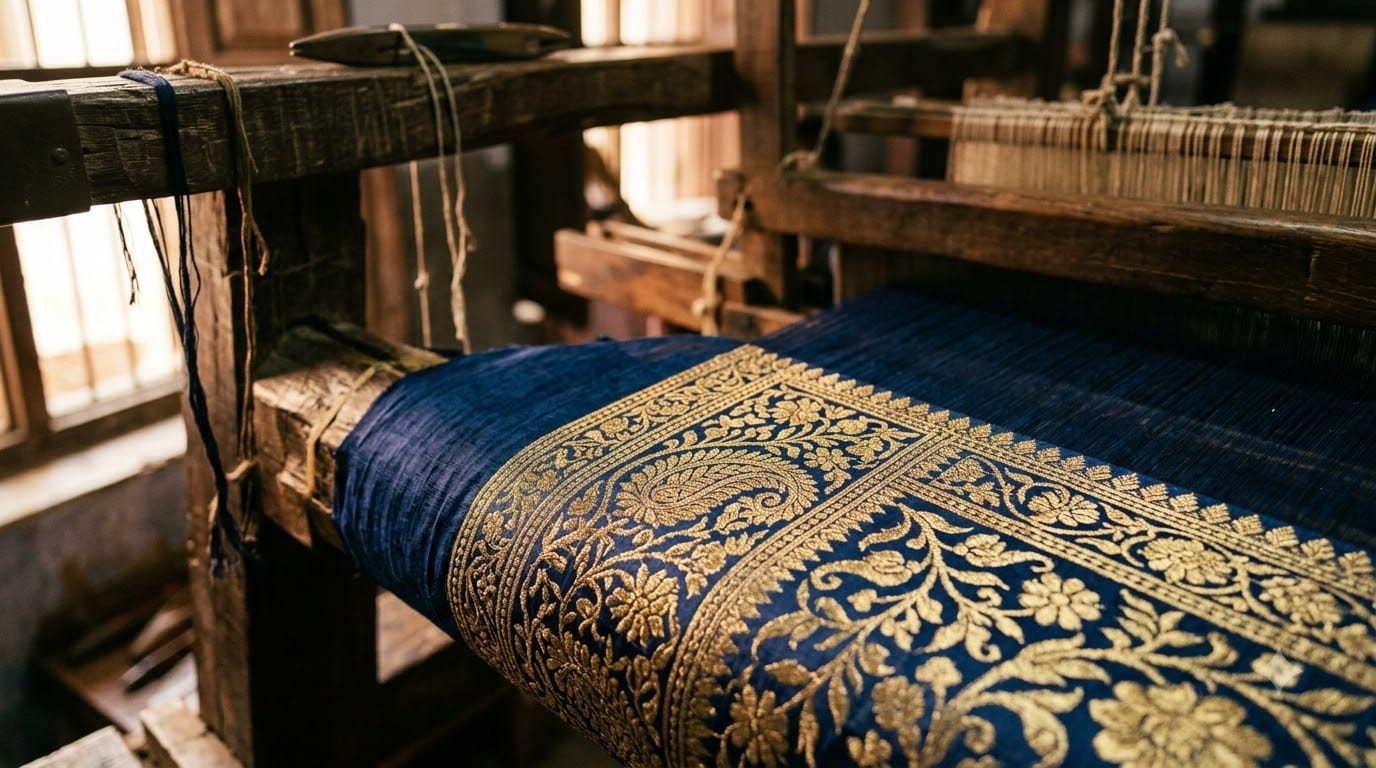
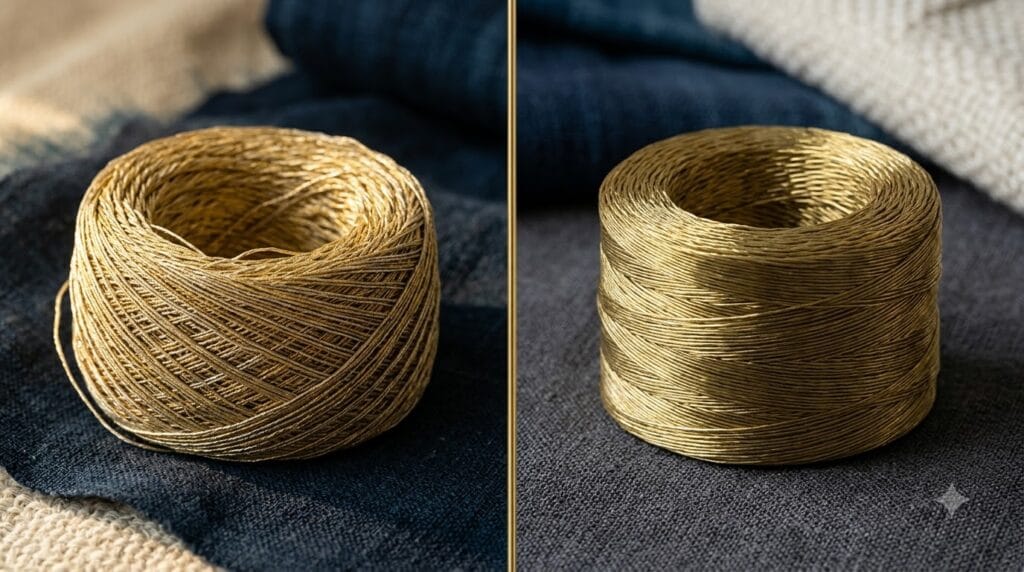
Zari is the metallic thread woven into a saree’s border, pallu, and motifs. Real zari is a fine silver wire — drawn thinner than a human hair through a process weavers call taarkashi — gilded in gold and wound around a silk core into what the trade calls kalabattu. Fake zari is a different material altogether: polyester or plastic film coated in metallic paint, with no silver and no gold in it at all. The real vs fake zari question matters because the two can look identical under shop lighting and cost twenty times apart.
In Madanpura, where a good part of Varanasi’s zari-heavy Banarasi work still gets woven, karigars test a reel of kalabattu before it’s ever threaded onto the loom — not out of suspicion of every supplier, but because the difference between real and fake zari isn’t something you can catch once it’s already brocaded into a jangla border. Most of India’s zari, real and fake both, is actually manufactured in Surat; what arrives in Varanasi’s weaving lanes gets checked on delivery, the same way a jeweller checks a delivery of gold wire before it goes into a setting.
Real vs fake zari — the three grades you’ll actually meet in the market
Almost nothing sold as “zari” today is simply real or fake. There are three grades in active trade, and knowing the middle one changes how you read a listing.
| Grade | What it actually is | How it ages |
|---|---|---|
| Asli / real zari (kalabattu) | Pure silver wire, taarkashi-drawn, gilded in 24-carat gold, wound onto a silk thread | Darkens to a soft, warm patina over years — not a flaw, a sign of age |
| Tested zari | A copper wire base, electroplated with silver and then a thin layer of gold | Honest mid-tier if disclosed as such; can dull faster in humidity |
| Imitation / plastic zari | Polyester or plastic film coated in metallic paint — no silver, no gold | Cracks, flakes, and dulls within a few wears or washes |
Tested zari is not a scam. It’s a real, functioning category of the market, priced below asli zari and above imitation, and an honest seller will say so without being asked twice. The problem is never tested zari sold as tested zari — it’s tested or imitation zari sold as “pure” or “real” at asli prices.
Test 1 — The rub test (ten seconds, nothing needed)
This is the fastest of the five, and the one you can run in a shop without anyone raising an eyebrow. Rub a section of the zari — ideally on the border, where the thread sits most exposed — firmly against the inside of your wrist for about ten seconds.
✓ Asli and tested zari leave no mark, or at most a faint metallic sheen that wipes away to nothing.
✗ Imitation zari leaves a visible grey, green, or coppery smudge — the metallic paint transferring straight onto your skin, the same way cheap costume jewellery blackens a finger.
It’s the same check we mention for zari borders in How to Identify Pure Silk Saree, run here on its own — because a saree can have genuinely handwoven silk and still carry painted-plastic zari. Fibre and metal are two separate claims.
Test 2 — The burn test (a spare thread only, never the saree itself)
Pull one loose zari thread from an inner selvage or a stray end near the border — never from the visible pattern. Hold it with tweezers or a clip, away from the fabric, and touch a flame to the tip for two to three seconds.
✓ Real and tested zari: the silk core at the centre of the thread chars and gives off that same faint burnt-hair smell you’d get from testing pure silk — because kalabattu is silk with metal wound around it. The metal itself doesn’t catch; it darkens, and you can still see the wire once the ash cools.
✗ Imitation zari: shrivels away from the flame, melts, and gives off a sharp chemical smell — plastic burning, not protein. This is the easiest of the five tests to read; there’s no ambiguity in what melting plastic smells like.
If a seller won’t let you test even one stray thread from an inner seam, treat the refusal itself as information.
Test 3 — Weight, glow, and the patina test
Real zari carries actual metal along its length, so a heavily worked border feels distinctly heavier in the hand than the same width of printed or plastic-threaded fabric. New asli zari has a soft, warm gold glow rather than a loud, bright-yellow shine — it looks rich without looking like it’s trying to. Imitation zari is the opposite: brassy and glaring straight out of the packet.
The real test is what happens over years, not days. Genuine silver-gilt zari darkens gracefully — older Varanasi households treat a saree’s zari going from bright to muted gold as a sign the piece has been worn and loved, the textile equivalent of patina on old silver. Imitation zari doesn’t patina. It flakes, cracks along the fold lines, and loses its shine within a handful of wears, because there’s no metal underneath the paint to age.
Test 4 — Ask for the composition, the way testing houses measure it
Zari testing houses — most rigorously documented around Kanchipuram’s silk trade, where zari purity testing has been formalised with non-destructive XRF (X-ray fluorescence) analysis developed with TIFAC and IGCAR — measure zari purity by the marc, a trade unit of 242 grams. One published composition standard for genuine zari puts silver at roughly 55–57%, silk at 22–24%, copper at 20–22%, and gold at 0.59–0.60% by weight — a composition range independent zari testing houses such as OldZari publish openly as their own quality-report standard. Varanasi’s larger zari traders don’t all run XRF on-site, but the underlying principle — weigh it, test it, don’t just look at it — is how any serious trader in this city checks a reel before it goes anywhere near a loom.
You won’t get a lab certificate at a saree counter, but you can still ask the direct question a testing house would answer with numbers: “Is this asli zari, tested zari, or metallic thread?” An honest seller answers without hesitation. A vague answer, or a pivot to how beautiful the pattern is, is itself a data point.
Worth knowing separately: Banaras Brocades and Sarees carry a Geographical Indication (GI) tag, registered with the GI Registry of India, protecting the name and the traditional weaving method. It’s a real and useful certification — but it protects the Banarasi weave itself, not any specific spool of zari inside it, so it isn’t a substitute for the tests above.
Test 5 — Read the price as a floor, not a guarantee
Real zari’s price floor moves with the silver market, because silver is the bulk of what you’re paying for — a saree’s zari cost isn’t fixed the way a printed pattern’s cost is. That alone should make you suspicious of a “heavy real zari” Banarasi priced identically to a plain, unworked piece.
| On a Banarasi border or pallu | What it typically adds to the price | Signal below this |
|---|---|---|
| Asli / real zari (silver-gilt) | Meaningfully more than the ground fabric alone — often a third or more of a heavily worked piece’s total price | “Real zari” priced with no visible zari premium at all |
| Tested zari | A modest premium over the ground fabric, well below asli pricing | Should still be disclosed as “tested,” never sold as “pure” |
| Imitation / plastic zari | Next to nothing — it’s paint, not metal | Marketed with “zari,” “gold,” or “silver” language at asli-adjacent prices |
These are directional ranges, not a price list — zari cost shifts with silver rates, the weight of thread used, and how densely it’s worked into the pattern. Use it to sense-check a listing, not to negotiate to the rupee. For the fuller price-floor breakdown by weave type, see the Banarasi saree guide.
What the label actually means — real, tested, and the words in between
Zari listings use language loosely, and the words matter more than they sound like they should.
- “Asli zari” / “real zari” / “pure zari” — should mean silver-gilt kalabattu. Verify with the rub and burn tests regardless of what the tag says.
- “Tested zari” — an honest, lower-cost grade, not a euphemism for fake, as long as it’s priced and disclosed as tested.
- “Zari work” / “zari embroidery” with no grade stated — the most common ambiguous listing on marketplaces. Ask directly which grade it is.
- “Antique zari” / “oxidised finish” — usually a deliberately dulled look applied to tested or imitation thread to mimic age, not actual age. Don’t mistake artificial ageing for the real patina described in Test 3.
Run this alongside the silk and loom tests, not instead of them
A saree can be genuinely hand-loomed, genuinely pure silk, and still carry painted-plastic zari — fibre, loom, and metal are three separate claims, and a seller can be honest about two of them and wrong about the third. See Handloom vs Powerloom for the loom question and How to Identify Pure Silk Saree for the fibre question — this guide is the third leg of the same stool. For the full trade vocabulary, the Indian Textile Glossary defines kalabattu, taarkashi, and the other terms used here.
FAQ
Traditionally, zari is a fine silver wire — drawn thinner than a hair through a process called taarkashi — gilded in gold and wound around a silk thread, what weavers call kalabattu. What’s sold as “zari” today ranges from that genuine silver-gilt thread, down to copper wire with a thin gold wash (“tested zari”), to plain plastic film coated in metallic paint, which contains no precious metal at all.
Start with the rub test — press the zari firmly against the inside of your wrist for about ten seconds. Genuine or tested zari leaves no mark; imitation leaves a grey or coppery smudge, because the metallic coating rubs off. It’s less conclusive than the burn test, but it works on a saree you already own and don’t want to touch with a flame.
No. Tested zari is a legitimate, lower grade — a copper wire base electroplated with silver and a thin layer of gold — sold at a lower price than asli zari. It becomes a problem only when it’s sold as “pure” or “real” zari at asli prices. Ask the seller directly which grade you’re buying.
No, it’s the opposite of a flaw. Genuine silver-gilt zari oxidises gently with age, taking on a soft, warm patina that older Varanasi families treat as a mark of authenticity — much like antique silver jewellery. Imitation zari doesn’t patina; it flakes, cracks, and loses its shine instead.
Not specifically. The India Handloom Mark certifies that a saree was woven on a handloom, and the Banarasi GI tag protects the Banaras Brocades and Sarees name and traditional weaving method — neither one tests the metal content of the zari thread itself. Combine either certification with the rub, burn, and price tests in this guide for the fullest picture.
Know the difference between silver and shine. Get the free Saree Care & Authenticity Checklist — five tests, one page, save it to your phone before your next saree shop. Join the Edit →