


Key Takeaways
- A genuine handwoven pure silk Banarasi saree starts around ₹7,000 at the loom; below ₹3,000, a “pure Banarasi silk” label is almost certainly false.
- Three things set the price: the base fabric, the weaving technique, and the grade of zari.
- Light georgette, organza and plain katan sit around ₹7,000–₹20,000; dense katan, organza and tissue sit around ₹20,000–₹50,000.
- Kadhua weaving costs more than cutwork because every motif is woven separately; on one seller’s like-for-like katan, it added about ₹10,000.
- Real silver-gold zari can add ₹5,000 to ₹50,000 or more over tested zari on the same design, so always ask which grade you are paying for.
Ask ten shops for the Banarasi saree price and you will get ten answers, from ₹1,999 on a marketplace to ₹2,50,000 in a heritage boutique. Both can be honest prices. They are simply prices for very different objects, and the label rarely tells you which one you are holding.
I write this from Varanasi, where the price of a Banarasi is settled long before it reaches a showroom: in the yarn a karigar buys, the technique he weaves, the grade of zari he lifts into the silk, and the number of days the saree spends on his loom in Madanpura, Lallapura or Bazardiha. Once you know those four things, a price tag stops being a mystery and becomes something you can check. This guide gives you the bands, then shows you exactly what moves a saree from one band to the next.
Why Banarasi saree prices range so widely
Every Banarasi price is the sum of three decisions, plus time.
- The base fabric. Pure katan silk, silk georgette, organza, tissue, or a blend. This sets the floor.
- The weaving technique. Cutwork, kadhua, jangla, tanchoi, meenakari, rangkat. This sets how many hours the weaver needs.
- The zari grade. Real silver-gold zari, tested zari, or imitation. This is the largest hidden cost, and the one sellers explain least.
- Loom time. A simple piece can come off the loom in about two weeks. A dense bridal piece can take months.
Change any one of these and the price moves, sometimes by tens of thousands of rupees, while the saree looks almost the same in a photograph.
Banarasi saree price bands at a glance
These are indicative 2026 ranges, drawn from loom-side prices in Varanasi and current listings from established Banarasi retailers. Treat them as a map, not a rate card.
| Price band | What you are usually buying | Best for |
|---|---|---|
| Under ₹3,000 | Powerloom, art silk or polyester with imitation zari. Not a pure silk handloom Banarasi. | Costume use only |
| ₹3,000–₹8,000 | Honest blends: semi-katan, silk-viscose, cotton-silk. Some handwoven, none pure silk. | Everyday festive wear, first Banarasi |
| ₹7,000–₹20,000 | Entry pure silk: plain or lightly worked katan, khaddi georgette, light organza and tissue, mostly tested zari. | Pujas, office occasions, gifting |
| ₹20,000–₹50,000 | Serious handloom: katan, organza or tissue with dense cutwork, kadhua buta, meenakari or rangkat jaal. | Family weddings, receptions |
| ₹50,000–₹1,00,000 | Heavy kadhua and jangla, shikargah, bridal katan, often weeks to months on the loom. | Bridal and trousseau |
| ₹1,00,000 and above | Real zari masterworks, heavy tissue, collector jamdani and commissioned pieces. | Heirlooms |
The bands overlap on purpose. A heavily worked silk-viscose saree can cost more than a plain pure katan. That overlap is exactly why you check the fabric before you look at the price.
Banarasi saree price by fabric type
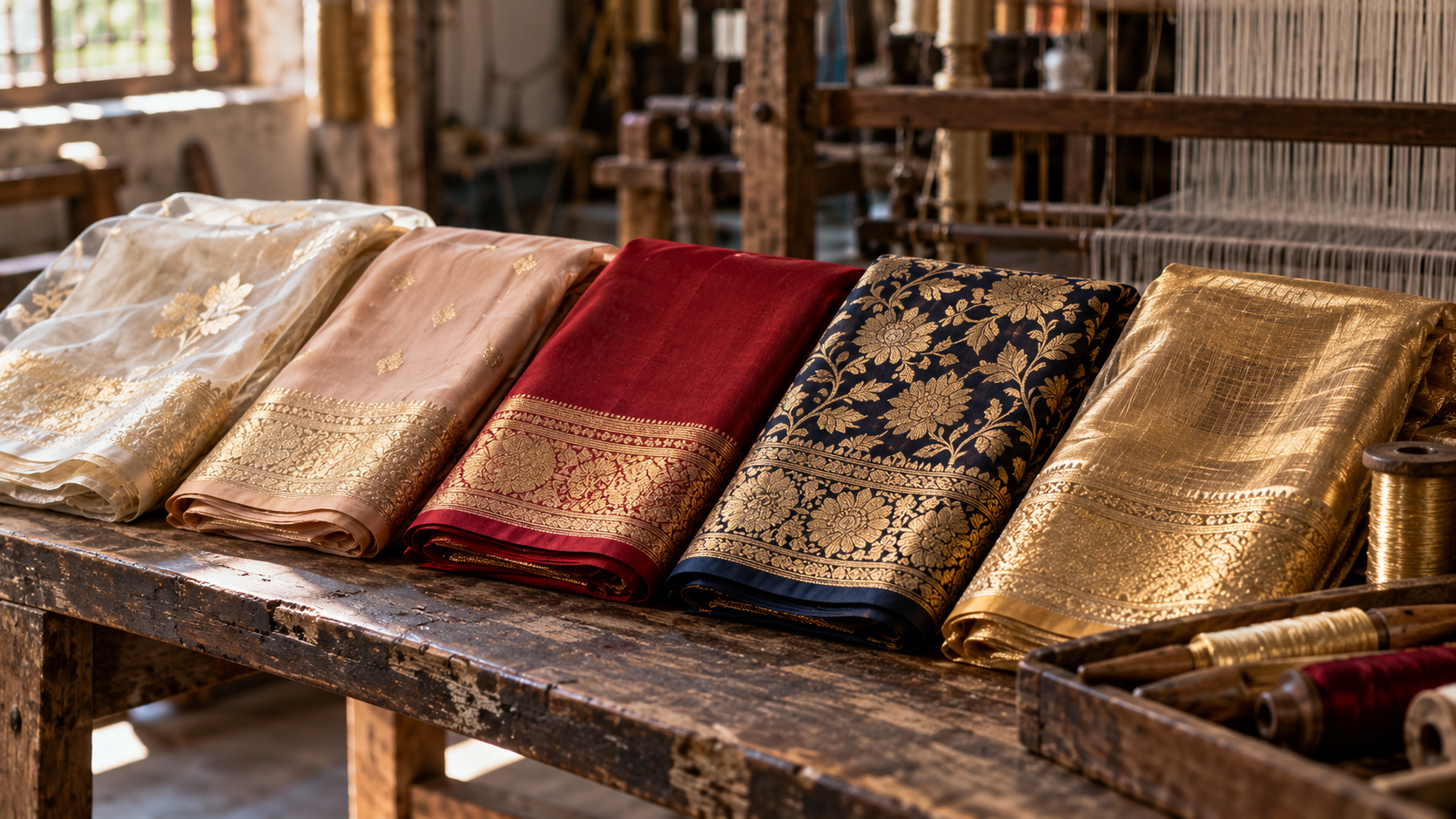
Fabric sets the floor. For a full explanation of each weave, see our complete Banarasi saree guide; here we focus on what each one costs.
| Fabric | What it is | Feel | Typical 2026 price |
|---|---|---|---|
| Katan | Pure silk in both warp and weft, tightly twisted | Dense, lustrous, cool | ₹7,000–₹1,00,000+ |
| Khaddi georgette | Pure silk crepe-twist yarn | Light, matte, fluid | ₹8,000–₹35,000 |
| Organza (kora) | Barely twisted raw silk | Sheer, crisp, light | ₹12,000–₹1,00,000+ |
| Tissue | Zari woven into the ground itself | Metallic, luminous | ₹13,000–₹2,00,000 |
| Tanchoi | Flat satin weave with multi-coloured weft | Smooth, quiet | ₹6,000–₹40,000 |
| Blends | Semi-katan, silk-viscose, cotton-silk | Varies | ₹3,000–₹8,000 |
Katan: the widest range of all
Katan covers the whole price ladder because it carries every technique, from a plain body with a zari border to a full kadhua jangla. A plain katan with a simple border starts around ₹7,000 at the loom. Mid-range buta katan from established retailers sits roughly between ₹13,000 and ₹30,000. Premium handloom katan from heritage labels runs from about ₹35,000 to ₹70,000, and bridal pieces go further.
Khaddi georgette: the most wearable pure silk
Pure silk khaddi georgette is where many people buy their first real Banarasi. Varanasi trade listings with real silver zari start around ₹8,000, and good handloom georgette at retail sits mostly between ₹12,000 and ₹25,000. Be careful with “georgette Banarasi” under ₹5,000: the georgette is very often synthetic.
Organza and tissue: light fabrics, wide ranges
Organza and tissue look delicate, and their entry prices are modest, but they scale fast with weaving hours. One Banaras label prices a simple handwoven organza at ₹14,975 for 120 weaving hours and a denser one at ₹33,575 for 400 hours. The same label’s tissue starts near ₹13,500 and its top tissue and organza pieces reach close to ₹2,00,000. Tissue is also the hardest fabric to authenticate yourself, because the zari ground defeats the usual silk tests.
Banarasi saree price by technique: why kadhua costs more
Two sarees in the same katan silk, with similar motifs, can sit ₹10,000 apart. The difference is almost always how the pattern was woven.
Cutwork (phekwa) runs the pattern thread across the full width of the saree and trims the loose floats off the back afterwards. It is faster, and it is the backbone of the mid-range. Kadhua (kadwa) weaves each motif separately, interlocking it into the cloth with no floats to cut, which is slow, skilled work and leaves a clean reverse. A jangla is an all-over jaal woven entirely in kadhua, which is why it sits near the top of the market. If any of these terms are new, our Indian textile glossary explains each one.
Retail listings show the premium clearly. One Varanasi seller lists a pure katan uppada buta saree at ₹16,999 and a pure katan kadhwa buta saree at ₹26,999: same fabric, similar layout, roughly ₹10,000 more for the technique.
| Technique | What it is | Effect on price |
|---|---|---|
| Cutwork | Extra weft across the width, floats trimmed | The mid-range baseline |
| Tanchoi | Multiple coloured wefts, small all-over self-design | Moderate; rises with colour count |
| Meenakari | Coloured silk threads added to the zari pattern | Adds a step over plain zari |
| Kadiyal / rangkat | Contrast border, or abrupt colour changes in the body | Adds warp setup and shuttle changes |
| Kadhua | Each motif woven separately, clean reverse | A clear premium over cutwork |
| Jangla / shikargah | All-over kadhua jaal, or hunting-scene figures | Top of the market |
The quickest home check is to turn the saree over. Long trimmed floats behind each motif mean cutwork. A clean back with each motif closed off means kadhua. If a seller calls a saree kadhua and the reverse is full of cut threads, you have learnt everything you need to know about that seller.
Real zari, tested zari, imitation: the hidden price gap
Zari is the line item buyers see most and understand least. There are three grades.
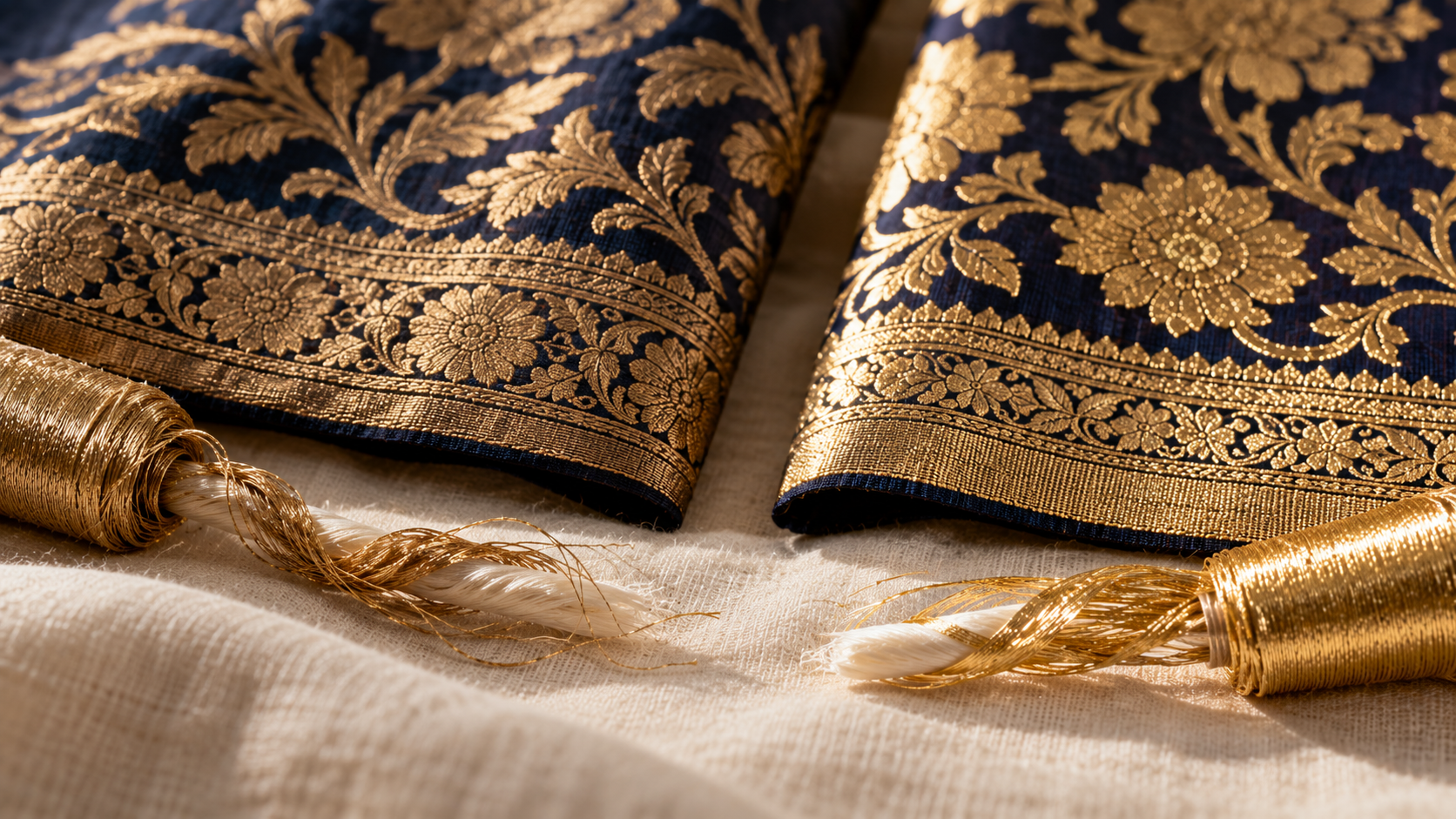
- Real (pure) zari: silver wire wrapped on a silk core, electroplated with gold. The most expensive by a wide margin, and it ages to a soft, warm glow.
- Tested (half-fine) zari: the same construction, but copper replaces the silver, with silver gilding and a gold plate on top. It is the working standard of the mid-market, and it is an honest material when sold as what it is.
- Imitation zari: copper or synthetic thread with a metallic finish. Cheapest, stiffest, and the first to tarnish.
The grade changes the price more than most people expect. One retailer estimates the gap between real and imitation zari on the same design at ₹5,000 to more than ₹50,000. Research on South Indian silk sarees puts zari at up to 60% of the raw-material cost, according to a study on zari testing published in Textile & Leather Review. The figure comes from Kanjivaram, but the logic carries straight to Banaras: on a heavily worked saree, you are paying for metal as much as for silk.
A real-zari saree should say so, in writing, on the bill. If you want to test zari yourself, our guide to real vs fake zari walks through each method.
What a Banarasi saree actually costs to make
The easiest way to judge a price is to work out what the saree cost to make.
- Silk yarn. Varanasi yarn dealers list mulberry raw silk at around ₹5,900–₹6,000 a kilogram. A full katan saree weighs roughly 500–700 grams, so the silk alone comes to about ₹3,000–₹4,200 before dyeing, twisting or wastage.
- Zari. Tested zari adds a meaningful sum; real zari adds many times more. On dense work, this can exceed the silk.
- Loom time. A handloom Banarasi takes from about 15 days to a month, and sometimes up to six months for the most intricate designs.
- Design and setup. The naksha, the jacquard cards and the warp setup are paid for before the first pick is woven.
Add those together and a pure silk handloom katan cannot honestly sell for ₹2,500. The weaver, meanwhile, keeps very little of what you pay. A Madanpura karigar told the International Women’s Media Foundation that on a pure silk Banarasi retailing at ₹40,000, weavers like him receive only ₹2,000–₹3,000 (IWMF reporting from Varanasi). A fair price is not only about protecting yourself from fakes. It decides whether the weaving survives.
Red-flag prices and what they really mean
A high price does not prove authenticity either. Powerloom brocades from Surat are regularly sold under the Banarasi name at handloom prices. Before you pay, ask the questions that force a specific answer.
- What is the warp, and what is the weft? “Silk” is not an answer; “pure silk warp and weft” is.
- Is it handloom or powerloom? Our guide to handloom vs powerloom sarees shows how to check the selvedge and reverse.
- Is the pattern kadhua or cutwork? Turn it over and confirm.
- Which zari grade is used: real, tested or imitation? Ask for it on the bill.
- Roughly how long was it on the loom? A seller who knows the saree knows this.
- Does it carry a Silk Mark, Handloom Mark or the Banaras GI logo? See what each certification actually proves.
Where you pay less: loom-side, boutique or online
Buying directly in Varanasi usually means a lower price, because fewer hands take a margin between the loom and you. The trade-off is that authentication is entirely your job, and the lanes have their share of powerloom stock too. Only sarees woven in the five districts covered by the Banaras Brocades and Sarees GI (application no. 99, GI Journal No. 29) can legally be sold as Banarasi: Varanasi, Azamgarh, Mirzapur, Sant Ravidas Nagar (Bhadohi) and Chandauli. The Varanasi district’s GI record describes the product.
Heritage boutiques and established online labels charge more, but you are paying for curation, clear zari disclosure and a return policy. Our shortlist of the best handloom sarees to buy online covers sellers we trust. For a bridal saree, our bridal saree checklist takes you through the full decision, step by step.
Whichever route you choose, the bands above hold. Know the fabric, the technique and the zari, and you will know whether the number on the tag is fair.
Frequently asked questions
A real handwoven Banarasi in pure silk starts at about ₹7,000 for plain katan or light georgette. Most good pieces for weddings and festivals cost ₹20,000–₹50,000, and bridal kadhua, jangla or real-zari sarees run from ₹50,000 to well over ₹1,00,000.
Most Banarasi sarees under ₹3,000 are powerloom copies in art silk or polyester with imitation zari, sold under the Banarasi name for search traffic. The silk yarn for a pure katan saree alone costs more than that, before any weaving or zari.
Real-zari tissue, heavy kadhua jangla and shikargah katan sit at the top, often above ₹1,00,000. They combine the most expensive materials with the slowest weaving, sometimes several months on the loom.
For an heirloom or bridal piece, usually yes: kadhua motifs are woven individually, leave a clean reverse and are more durable. For lighter, frequent wear, a well-woven cutwork saree is excellent value and not a lesser saree.
On the same design, real silver-gold zari can add anywhere from about ₹5,000 to more than ₹50,000, depending on how much zari the pattern uses. Ask the seller to write the zari grade on your bill.
Usually, because fewer intermediaries take a margin between the weaver and you. But you must authenticate the fabric, technique and zari yourself, since powerloom stock is sold in Varanasi too.
Enjoyed this? Join The Nakshapatta Edit — one textile fact, one buying tip and one weave worth knowing, straight from the looms of Banaras, in your inbox.
Nakshapatta does not accept payment for recommendations. Prices are indicative 2026 loom-side and retail ranges and vary by weaver, zari grade, technique and season; retailer prices cited were current at the time of writing.