


What you will know after reading this
- The single most reliable test — turn the saree over and look at the back. What you should see, and what you should not.
- Four more checks: the touch test, the drape test, the price signal, and how to read the Handloom Mark label.
- Why powerloom is sometimes sold as handloom — and the exact language sellers use that should make you pause.
- How to buy authentic handloom online safely, and which certifications actually mean something.
What is the difference between handloom and powerloom sarees?
A handloom saree is woven entirely by human hands on a manually operated loom — no electric motor, no mechanical automation. Every thread placement is a deliberate act by a weaver. A powerloom saree is produced on an electrically powered mechanical loom that can weave hundreds of metres per day. The key visible difference: turn the saree over. A handloom saree shows floating weft threads on the reverse; a powerloom saree has a flat, clean, uniform back.
What is handloom? What is powerloom?
A handloom saree is woven entirely by human hands on a manually operated loom — a pit loom, frame loom, or jacquard-fitted handloom. No electric motor drives the process. The speed is determined entirely by the weaver’s hands and the complexity of the pattern. A skilled weaver producing a heavily brocaded Banarasi katan saree might complete 1–2 metres in a full working day.
A powerloom saree is produced on an electrically powered mechanical loom. It can weave hundreds of metres of fabric per day. Powerloom production is not inherently dishonest — it makes textile affordable and widely available, and many excellent sarees are powerloom-made. The problem arises only when powerloom fabric is sold as handloom at handloom prices.
“The difference between handloom and powerloom is the difference between a signature and a photocopy. One is irreplaceable. The other is useful — but it is not the same thing.”
This distinction matters to buyers for three reasons. First, price: a genuine handloom saree represents weeks of skilled human labour, and its price should reflect that. When you pay ₹8,000 for a saree that turns out to be powerloom, you have overpaid significantly for what you received. Second, durability and hand: handloom fabric has a different structure, drape, and longevity than its machine-made equivalent. Third, the artisan: when you buy genuine handloom, the price reaches the karigar who wove it. When you buy powerloom misrepresented as handloom, it does not.
Must read: The Complete Banarasi Saree Guide — Weave Types, Price Tiers & How to Identify Authentic
Test 1 — The reverse-side visual check
This is the single most reliable test, requires no equipment, and works in any shop. Ask to see the reverse side of the saree.
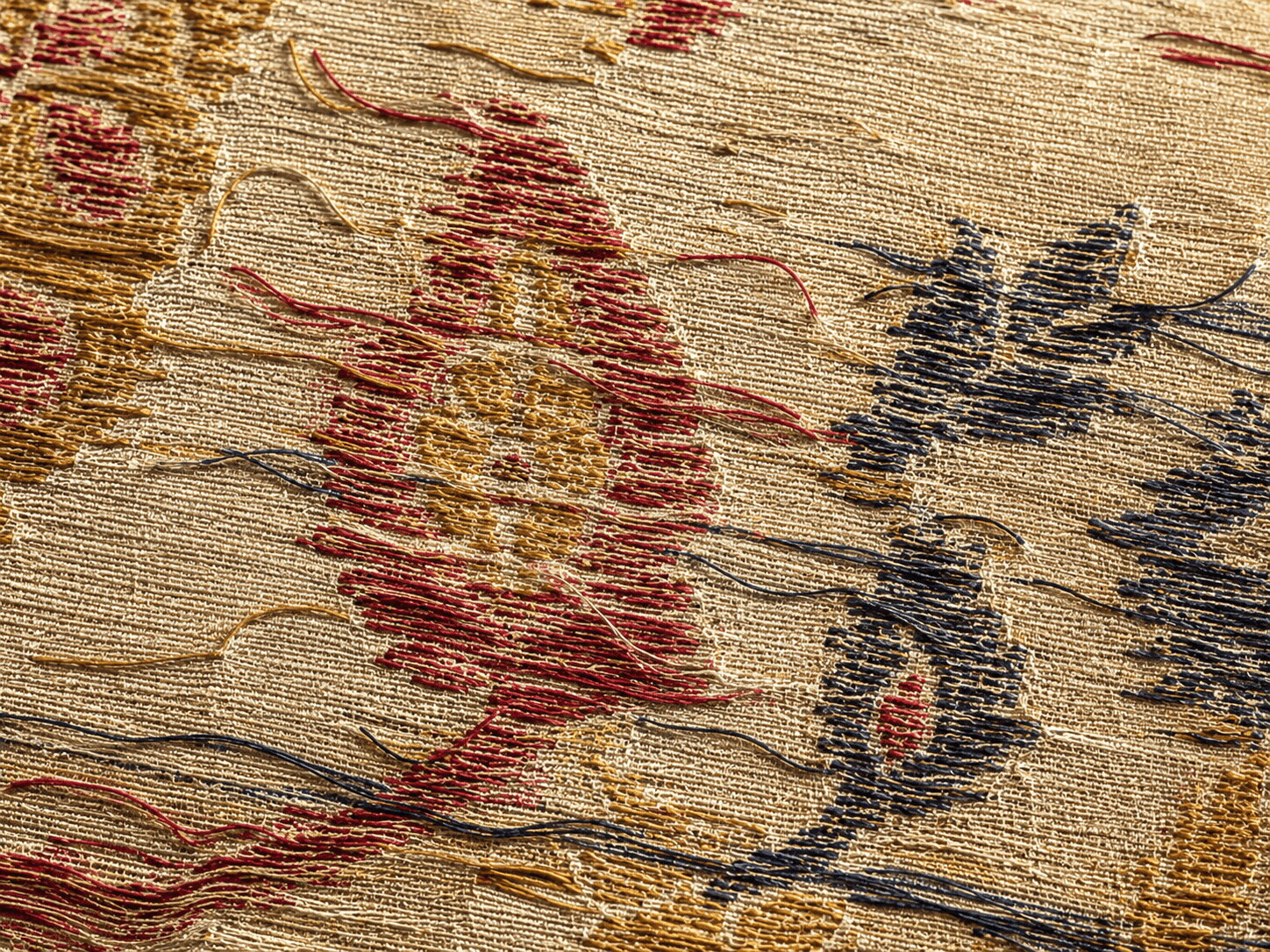
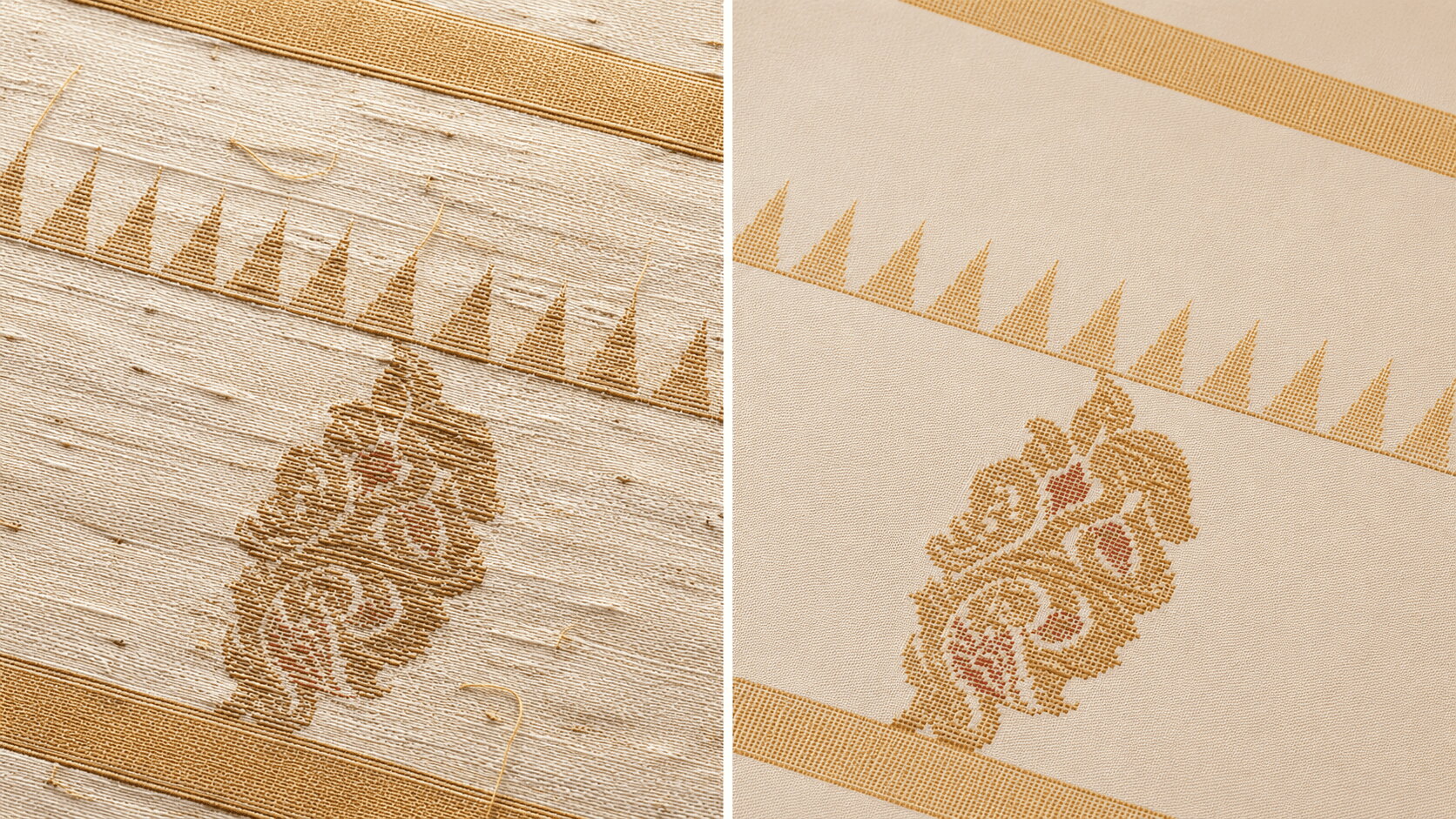
On the reverse of an authentic handloom saree — specifically one with brocade or zari work — you will see floating extra weft threads. These are the threads that create the pattern on the face side. They lie across the back in loose floats, slightly raised, visible and touchable. In cutwork (fekwa), the floats are trimmed by hand, leaving soft clipped ends. In a kadhua (kadwa) weave, each motif is woven separately, so the reverse is clean and dense with no long floats. In a jangla, the floats are long and clearly visible on the reverse.
A powerloom saree has a flat, clean reverse. The pattern is either screen-printed (not woven through at all), or created by a machine-controlled jacquard that produces a far more uniform, mechanical structure with no loose floats.
✓ Handloom reverse — what to look for
Floating threads, slight unevenness in thread spacing, occasional small imperfections, a texture you can feel with your fingertip. In a zari-border saree, the back of the border will have visible thread floats in multiple colours.
✗ Powerloom reverse — red flags
A completely flat, uniform back with no floating threads. If the saree has a “brocade” pattern on the face but a clean flat reverse, the pattern is machine-made or printed — not handwoven. Also watch for a plastic-smooth texture and perfectly even thread spacing throughout.
Handloom vs powerloom — the full comparison
| Feature | ✓ Handloom | ✗ Powerloom |
|---|---|---|
| Reverse side | Floating threads visible, slight texture | Flat, clean, perfectly uniform |
| Thread spacing | Slight natural variation — a feature, not a flaw | Mechanically perfect spacing throughout |
| Drape | Falls with authority and body, holds a fold | Often too fluid or too stiff — lacks character |
| Weight | Substantial for silk, light for cotton — consistent with fibre | Often lighter than genuine silk should feel |
| Selvage (edge) | Slightly irregular, woven in by hand | Perfectly straight, mechanically cut or woven |
| Pattern repeat | Slight natural variation in pattern placement | Perfectly identical repeats, machine precision |
| Price (silk) | ₹5,000 minimum for simple pieces, ₹15,000+ for brocade | Under ₹3,000 for “brocade” is a clear signal |
| Production time | Days to months per saree | Minutes to hours per saree |
Test 2 — The touch and drape test
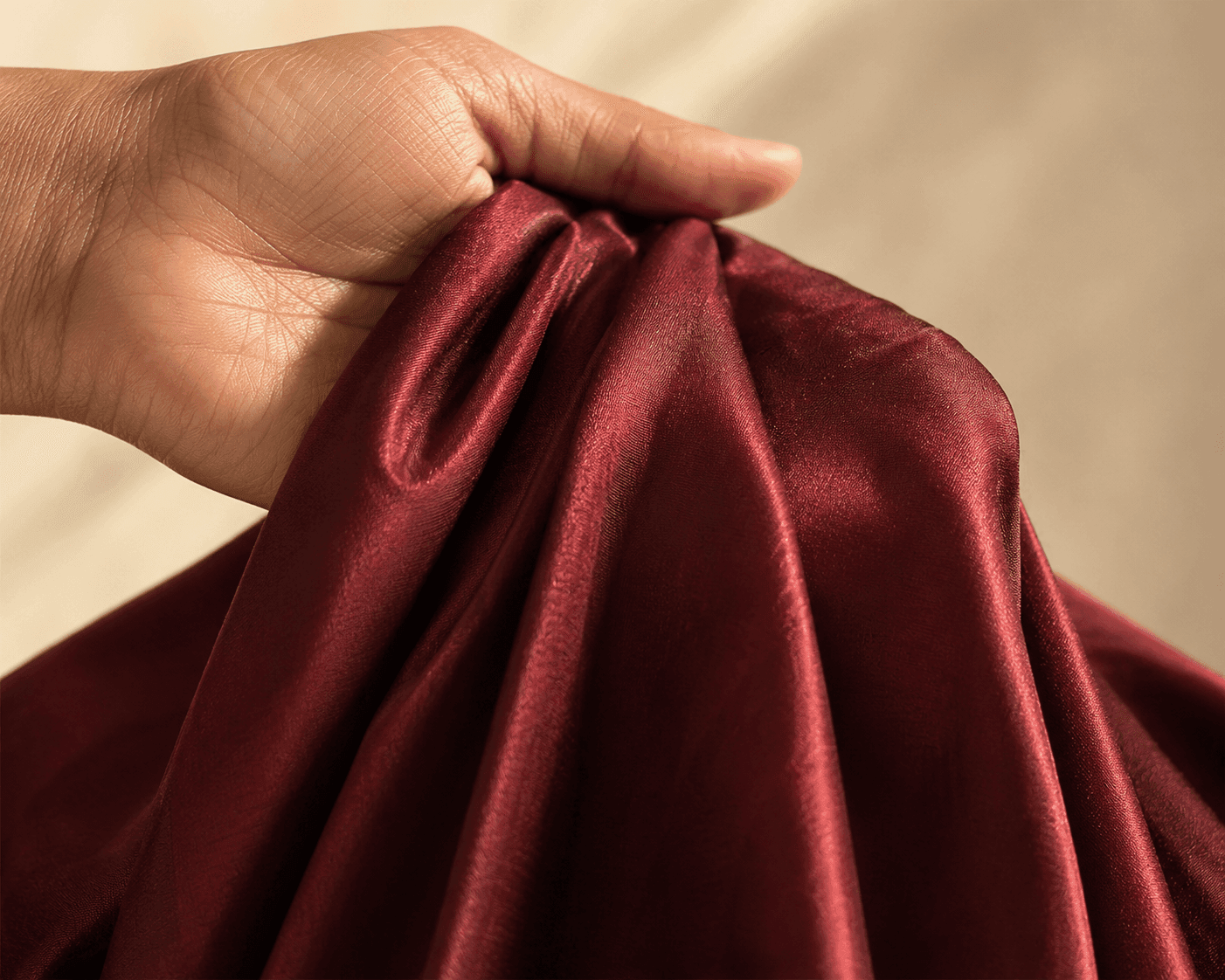
Pick the saree up and let it fall from your hand. Genuine handloom fabric falls with a specific character — it has body, it holds its drape without being stiff, and it moves with what weavers describe as a “life” that machine-made fabric cannot replicate.
For silk handloom specifically: hold it loosely in your palm. Real silk feels cool and substantial. Now run a length of it through your closed fist. Genuine katan silk has a slight resistance — a friction — that synthetic or thin powerloom silk does not. Artificial silk (art silk, viscose) feels too smooth, almost frictionless, and warmer than it should.
Test 3 — Read the price as a signal
Price is not the only test, but it is the first filter. The economics of handloom production have a floor. Below a certain price point, genuine handloom simply cannot exist — the cost of silk, the weaver’s time, the loom, the intermediate trader’s margin, and the retailer’s margin all have to be covered. Understanding this floor makes you an immediately more confident buyer.
| Saree type | Genuine handloom starts at | If priced under this |
|---|---|---|
| Cotton handloom (plain) | ₹800–₹2,000 | Usually powerloom or blended |
| Chanderi silk-cotton | ₹2,500–₹5,000 | Very likely machine-made or print |
| Banarasi silk (plain katan) | ₹6,000–₹10,000 | Almost certainly not genuine |
| Banarasi with zari border | ₹10,000–₹20,000 | Synthetic zari, powerloom ground, or both |
| Kanjivaram pure silk | ₹8,000–₹15,000 | Not genuine Kanjivaram silk |
| Maheshwari silk-cotton | ₹3,000–₹7,000 | Machine-made imitation |
⚠ The language to watch for
“Banarasi-style” is honest. “Banarasi look” is honest. “Pure Banarasi handloom silk” under ₹4,000 is not. The specific combination of “pure,” “handloom,” and a low price is the red flag — not any one word alone.
Test 4 — The India Handloom Silk Mark
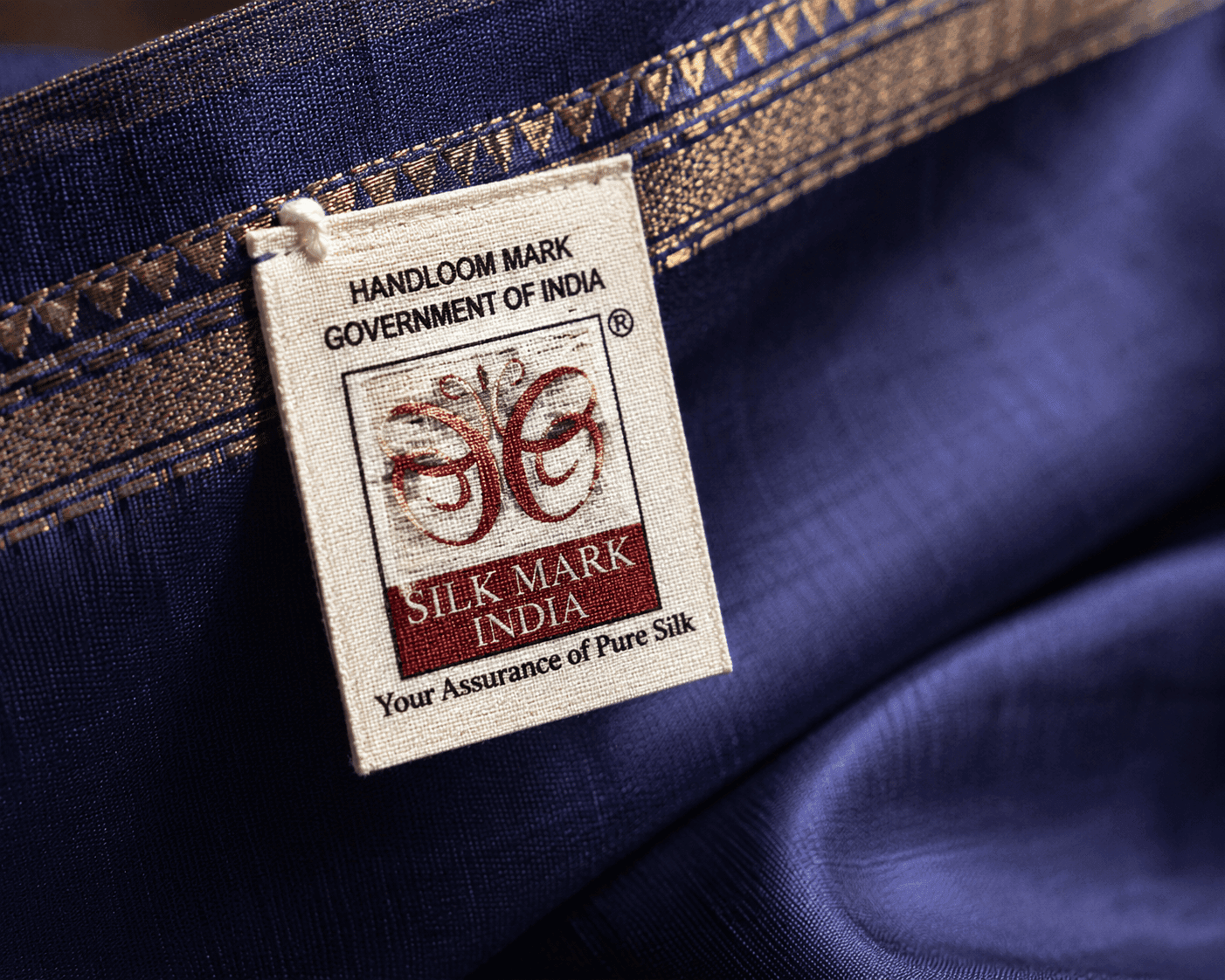
The India Handloom Mark is an official government certification administered by the Ministry of Textiles. It certifies that a saree was woven on a handloom and that the yarn used meets quality standards. When present, it is a significant trust signal.
The mark appears as a small woven or printed tag attached to the saree, typically at the inner border or pallav end. Look for it specifically when buying from shops that claim government certification or sell through government emporiums.
Important caveat: many genuine handloom sarees do not carry the Handloom Mark, particularly those sold directly by weavers or small cooperatives who have not registered for certification. The mark’s absence does not prove a saree is powerloom. The mark’s presence, combined with your other checks, is the most reliable confirmation of authenticity.
A tag on its own is not proof, because labels can be copied. Here is how to verify a Silk Mark and a GI claim before you pay.
Test 5 — Buying handloom online safely
Online purchases remove your ability to touch, reverse-check, and drape test. This makes digital buying higher risk — but not impossible if you know what to look for in photographs and listings.
1 – Look for reverse-side photos
Any seller confident in their handloom should be able to provide a photo of the saree’s reverse side. If a listing has 12 photos of the face and none of the back, ask.
✓ Floating threads visible in back photo
✗ No back photos offered or available
2 – Read the product description carefully
Legitimate handloom sellers name the specific weave (kadwa, cutwork, tanchoi), the silk type (katan, organza), and often the weaver’s district or cluster.
✓ “Katan silk, kadwa weave, Varanasi”
✗ “Pure Banarasi handloom silk saree” with no further detail
3 – Check the seller’s address
Banarasi sarees should come from Varanasi. Kanjivaram from Tamil Nadu. A seller based in Surat selling “authentic Kanjivaram handloom” warrants scrutiny.
✓ Seller based in producing district
✗ No address, or address in unrelated city
4 – Check the price against the floor
Use the price table above. If the price is significantly below the floor for genuine handloom of that type, the economics do not work — it cannot be what it claims.
✓ Price consistent with handloom economics
✗ “Pure silk handloom” priced 60% below market
5 – Look for imperfection
Genuine handloom has character — slight variations in thread spacing, occasional small irregularities in pattern repeat. In photographs, perfect mechanical uniformity throughout is a powerloom signal.
✓ Slight natural variation visible in close-ups
✗ Every detail perfectly, mechanically identical
Where to buy authentic handloom — trusted sources
The safest purchase is always directly from the weaver or a weaver cooperative. The second safest is a government-certified source. Both exist online and offline.
- State handloom development corporations — UP Handloom, Karnataka Handlooms, Tamil Nadu Handicrafts Development Corporation. Government-backed, GI-certified, reliable.
- National Handloom Development Corporation (NHDC) — operates Handloom Haat in New Delhi and an online platform. All pieces carry verification.
- Government emporiums — Cauvery (Karnataka), Lepakshi (Andhra), Ganges (UP) in major cities. Prices are fixed and fair.
Weaver cooperatives directly — Rehwa Society (Maheshwar), Dastkar (various clusters), Craft clusters listed on the Office of the Development Commissioner for Handlooms website. - Certified online sellers — Look for sellers whose products carry the Handloom Mark, who provide reverse-side photographs, and who name the specific weave type and producing district.
“The most dangerous saree is not the one sold honestly as powerloom. It is the powerloom saree sold as handloom, to someone who wanted to support a karigar.”
FAQ
Powerloom sarees can be beautiful, well-made, and excellent value — and they are honest when sold as what they are. The problem is not powerloom production itself; it is misrepresentation. A powerloom saree at an honest powerloom price is a fair transaction. A powerloom saree at a handloom price, described as handloom, is not.
Semi-handloom (also called “semi-powerloom”) refers to sarees where the ground fabric is machine-woven but the border or zari work is added by hand. It is a legitimate category — not fully handloom, not fully machine-made. It should be priced and labelled accordingly. When a semi-handloom saree is sold as “pure handloom,” that is misrepresentation. Ask specifically: is the ground fabric handwoven?
The reverse-side test works best for brocade and zari sarees — Banarasi, Kanjivaram, Paithani. For plain-weave handloom sarees (plain cotton or silk with no pattern), the reverse will be flat even for genuine handloom, because there are no extra weft threads to float. For plain weaves, rely more on the touch test, the drape, the selvage check, and the price signal.
Art silk (artificial silk) is a marketing name for viscose, rayon, or polyester that has a silk-like sheen. It is not silk. It is significantly cheaper to produce and has a different hand, drape, and durability than real silk. The burn test immediately distinguishes art silk from real silk: art silk burns fast, smells of burning paper or plastic, and leaves a hard residue. Real silk burns slowly, smells like burning hair, and leaves a crushable grey ash.
You are not alone — this is extremely common. If you bought recently, check whether you can return it; consumer protection laws in India support returns for misrepresented goods. If the purchase was some time ago, the most useful thing is to use the experience to sharpen your testing skills for future purchases. The saree you have may still be beautiful and wearable — it is simply not the thing it was sold as.