

What you will know after reading this
- 60 essential Indian handloom and weaving terms explained in plain, buyer-focused language.
- Covers fibres (mulberry, tussar, eri silk), techniques (ikat, jamdani, kadwa), and certifications (GI tag, silk mark, tested zari).
- Each term links back to the relevant Nakshapatta weave guide where one exists.
- Organised alphabetically for quick reference while reading product listings.
Ask a shopkeeper in Madanpura what “kadwa” means and he will show you, not tell you — running a finger along the reverse of a Banarasi saree to prove each motif was tied off by hand. That is the problem with most textile glossaries: they define words without context. This one is different. Every term below is explained the way it would be explained on the loom floor, with the buying implication spelled out plainly.
In short: this glossary covers 60 essential Indian handloom and weaving terms — from fibres (mulberry silk, tussar, eri) to techniques (ikat, jamdani, kadwa) to buyer-facing certifications (GI tag, silk mark, tested zari) — so you can read a product listing the way a weaver would.
A
Ajrakh
A traditional resist-dye block print from Kutch, Gujarat, built up in layers of natural indigo and madder dye through hand-carved wooden blocks. Read the full Ajrakh guide to see the process start to finish.
Art Silk
Short for “artificial silk” — usually rayon, or a silk blend. Despite the name, it is not silk. A “pure Banarasi” priced like art silk is almost always art silk.
B
Baluchari
A silk saree from Bishnupur, West Bengal, known for pallus that depict entire mythological scenes woven in contrasting silk thread — no zari involved at all.
Banarasi
Handwoven silk sarees and brocades from Varanasi and four neighbouring districts of Uttar Pradesh, protected by a GI tag since 2009. Known for zari brocade, Mughal-inspired motifs such as jangla and butta, and techniques like kadwa and cutwork; the main types are katan, organza, georgette and tissue. Read the full Banarasi saree guide, and see what each type costs in our Banarasi saree price guide.
Bandhani
A tie-and-dye technique from Gujarat and Rajasthan where fabric is tied into hundreds of tiny knots before dyeing, releasing a field of small dot patterns once untied.
Border (Zari Border)
The decorative edge running along the length of a saree, almost always in a contrasting colour and finished in zari or a wide woven pattern.
Brocade
A richly patterned, shuttle-woven fabric built using supplementary weft threads — typically zari or contrast silk — to raise a motif above the base weave.
Butta / Butti
A small, repeated motif scattered across the body of a saree — often a paisley, floral sprig, or geometric shape — distinct from the border and pallu.
C
Chanderi
A sheer silk-cotton or pure silk fabric from Chanderi, Madhya Pradesh, prized for its translucent, almost glass-like texture and fine zari borders. See the full Chanderi sarees guide.
Chikankari
Delicate, white-thread shadow embroidery from Lucknow, traditionally worked on fine cotton or georgette using a running “taipchi” stitch as its base.
Count (Thread Count)
The fineness of the yarn used in weaving. A higher count produces sheerer, lighter, more expensive fabric — this is why two Chanderi sarees can look identical but cost very differently.
D
Dabu Print
A mud-resist hand block printing technique from Rajasthan, where a clay-and-gum paste blocks dye from penetrating specific areas of the cloth before it is dipped.
Dobby
A small loom attachment — handloom or powerloom — used to weave simple repeating patterns like checks and stripes directly into the fabric structure.
Double Ikat
An ikat weave where both the warp and the weft yarns are separately tie-dyed and then aligned on the loom so their patterns interlock. Patola is the best-known example, and among the most technically demanding weaves in the world.
E
Eri Silk
A non-violent (“ahimsa”) silk from Assam, spun from cocoons only after the moth has emerged naturally, rather than boiling the cocoon with the pupa inside.
G
Gadwal
A saree from Telangana with a cotton body and a contrasting silk-and-zari border, joined using the interlocking “kumbham” technique so the two fabrics meet without a seam.
GI Tag (Geographical Indication)
A legal certification protecting textiles made only within a defined region — Banarasi sarees (Varanasi and four neighbouring districts, 2009) and Kanjivaram sarees (Kanchipuram) are two of India’s most well-known GI-tagged weaves. A GI tag is about origin, not quality alone. The full explainer covers what it does and does not guarantee.
Gota Patti
Rajasthani embroidery using metallic ribbon appliquéd onto the surface of fabric to build a pattern, rather than stitched through it entirely.
H
Handloom
Fabric woven manually on a loom operated by hand and foot, without electricity. The irregularities this leaves behind — slightly uneven picks, a heavier hand-feel — are proof of the process, not a flaw. Compare in detail: Handloom vs Powerloom.
Handloom Mark
A government certification mark applied to genuinely handwoven Indian textiles, distinct from the Silk Mark (which certifies fibre content, not weaving method). Our guide to Handloom Mark vs Silk Mark vs GI Tag shows what each one actually proves.
I
Ikat
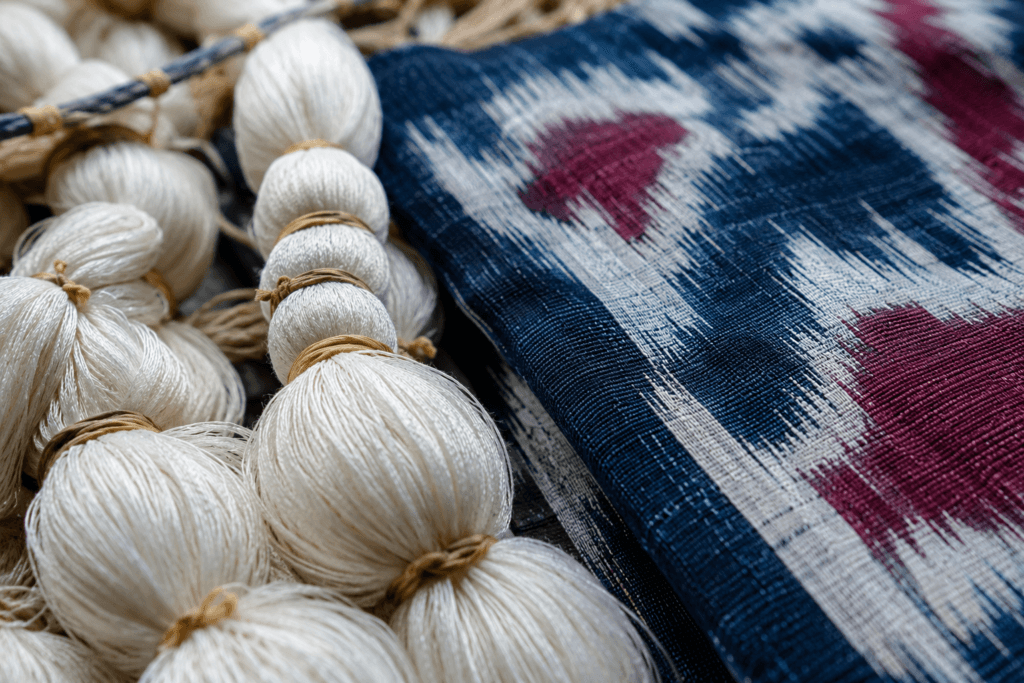
A resist-dye technique where yarn — not the woven fabric — is tied and dyed before it goes on the loom, producing the soft, slightly blurred pattern edge that is ikat’s signature.
J
Jacquard Loom
A loom fitted with a punched-card (or now digital) mechanism that automates complex pattern weaving — used in many modern Banarasi handlooms for intricate jangla and jaal designs.
Jamdani
A supplementary weft technique from Bengal where motifs are worked in by hand, thread by thread, so they appear inlaid into a sheer base fabric rather than printed or embroidered onto it.
Jangla
A dense, all-over floral-and-vine motif associated with Mughal-era Banarasi weaving, typically covering the entire body of the saree rather than sitting in isolated buttas. For how this motif logic differs from Kanjivaram’s, read Kanjivaram vs Banarasi.
K
Kadwa
A Banarasi weaving technique where each motif is woven and tied off individually, rather than carried across the fabric as a floating thread. Turn the saree over — a kadwa weave has a clean, tidy reverse with no loose threads between motifs. The full story is in our Banarasi saree guide.
Kalamkari
Hand-painted or block-printed textile art from Andhra Pradesh, using a kalam (pen) or carved blocks with natural dyes to render mythological and floral narratives.
Kanjivaram (Kanchipuram)
A heavyweight silk saree from Kanchipuram, Tamil Nadu, woven using the korvai technique with a body and border that are often two different colours entirely. Full details in the Kanjivaram saree guide.
Kantha
A running-stitch embroidery and quilting technique from West Bengal and Odisha, traditionally used to layer and reuse old cotton or silk sarees into new textiles.
Kasuti
Intricate hand embroidery from Karnataka in geometric and temple motifs, traditionally worked on Ilkal sarees using counted-thread techniques.
Katan Silk
Pure, tightly twisted mulberry silk yarn used as both warp and weft — the base fabric of a traditional Banarasi saree, prized for its dense, structured drape. See the price tiers and weave types in the Banarasi saree guide.
Korvai
The Kanjivaram weaving technique that interlocks a saree’s silk body with its (often contrast-coloured) border directly on the loom, rather than sewing the two together afterward.
Kota Doria
A lightweight, square-checked cotton-silk fabric from Kota, Rajasthan, woven in an open “khat” (checkered) structure that gives it its distinctive translucence.
L
Leheriya
A wave-pattern tie-dye technique from Rajasthan, created by diagonally rolling and tying fabric before dyeing — traditionally used on turbans and odhnis.
M
Maheshwari
A silk-cotton saree from Maheshwar, Madhya Pradesh, known for reversible borders and the stripes-and-checks patterns associated with the Holkar dynasty. Full guide: Maheshwari sarees.
Mashru
A satin-weave fabric with a silk face and cotton back, historically woven so the wearer’s skin touched only cotton — a workaround for religious restrictions on wearing pure silk.
Mordant
A substance, often mineral (like alum), used to fix a natural dye permanently to a fibre. Without a mordant, natural dyes wash out.
Motif
Any recurring decorative element in a textile’s design — a paisley, a peacock, a temple border — whether woven, printed, or embroidered.
Mukaish
A metallic wire embroidery technique from Lucknow that creates a field of tiny sparkling dots, frequently paired with chikankari on the same fabric.
Muga Silk
A rare, naturally golden wild silk from Assam. Unlike most silk, muga’s sheen actually improves with washing and age.
Mulberry Silk
The most common and finest silk variety, produced by silkworms fed exclusively on mulberry leaves — this is the silk used in katan and most premium sarees. See how to verify it: How to Identify Pure Silk.
N
Natural Dye
Dye sourced from plants, minerals, or insects — indigo, madder, and lac are common examples — used in Ajrakh, Kalamkari, Dabu, and most traditional resist-print textiles.
P
Paithani
A silk saree from Paithan, Maharashtra, recognised by its peacock and lotus motifs and a distinctive oblique-interlocking pallu weave found in few other textiles. Read the full Paithani saree guide.
Pallu
The decorative end-piece of a saree — typically the most elaborately woven or embroidered section — draped over the shoulder when worn. See how it falls in our step-by-step draping guide.
Patola
A double-ikat silk saree from Patan, Gujarat, and among the most labour-intensive handloom weaves anywhere; a single saree can take up to a year to complete.
Phulkari
A floral embroidery tradition from Punjab, traditionally worked in untwisted silk thread on hand-spun cotton khaddar fabric.
Pit Loom
A handloom set into a pit dug in the ground, letting the weaver operate foot pedals below floor level — the loom still used across most of Varanasi’s weaving lanes today.
Pochampally (Ikat)
A single- or double-ikat weave from Pochampally, Telangana, known for bold geometric and diamond patterns.
Powerloom
A mechanised, electrically powered loom that weaves far faster than a handloom — and without the small human irregularities that mark genuinely handwoven cloth.
R
Resist Dyeing
Any technique — tie-dye, block-resist, ikat — where part of the yarn or fabric is deliberately protected from dye to create a pattern once the rest is dyed.
S
Sambalpuri
An ikat-woven textile from Odisha, recognised by traditional motifs like the shankha (conch), chakra (wheel), and phula (flower).
Selvedge (Selvage)
The self-finished, non-fraying edge running along both long sides of woven fabric. Its texture is one of the fastest tells between handloom and powerloom cloth.
Shuttle
The tool that carries the weft thread back and forth across the warp on a loom — the source of the rhythmic clacking sound inside a working loom shed.
Silk Mark
A quality certification label issued by India’s Central Silk Board guaranteeing 100% natural silk content. It certifies fibre, not weaving method — a powerloom saree can still carry a Silk Mark. To check a label is genuine, see how to verify a Silk Mark and GI number.
Single Ikat
An ikat weave where only the warp or only the weft threads are tie-dyed before weaving — not both, as in double ikat.
T
Tanchoi
A silk weaving technique, originally from China and adapted in Surat and Varanasi, producing intricate satin-like patterns with almost no floating threads visible on the reverse.
Temple Border
A zigzag, triangular border motif inspired by South Indian temple architecture, most commonly seen on Kanjivaram sarees.
Tested Zari
Zari made with a copper core in place of silver: the copper wire is silver-gilded, then electroplated with gold. It looks close to real zari at a fraction of the price and is the working standard in mid-range sarees. Real (pure) zari uses silver wire plated with gold; imitation zari is copper or synthetic thread with a metallic finish and tarnishes fastest. Test it yourself with our real vs fake zari guide.
Tussar Silk
A wild silk variety, coarser and more textured than mulberry silk, with a natural golden-beige tone that takes dye differently from cultivated silk.
W
Warp
The lengthwise threads held stationary and under tension on a loom — the “skeleton” through which the weft is woven.
Weft
The crosswise threads woven over and under the warp, carried by the shuttle, to build the fabric.
Z
Zari
Metallic thread — traditionally silver wire electroplated with gold — woven into fabric to create borders, motifs, and pallus. Nearly every term above eventually comes back to this one.
Bookmark this page — it’s updated as new terms come up across our Weave Guide and Buy Smart articles, and it’s the fastest way to read a saree listing the way a weaver would. Ready to put the vocabulary to work? Check what a fair price looks like in our Banarasi saree price guide, shop with the best handloom sarees to buy online and the bridal saree checklist, look after them with the saree care guide, and style them with our office looks, blouse ideas and Gen Z Banarasi guide.
Frequently Asked Questions
Zari is the general term for the metallic thread woven into a saree. Real (pure) zari is silver wire electroplated with gold. Tested zari replaces the silver with copper, which is silver-gilded and then gold-plated, so it looks similar at a much lower price. Imitation zari is copper or synthetic thread with a metallic finish, and it tarnishes fastest.
A Geographical Indication (GI) tag is a legal certification that a textile was made only within a defined region — Banarasi sarees must come from Varanasi and four neighbouring districts of Uttar Pradesh, Kanjivaram from Kanchipuram. It protects origin and traditional technique, not overall quality on its own.
Handloom fabric is woven manually on a hand-and-foot-operated loom, leaving small human irregularities in the weave. Powerloom fabric is woven on an electrically powered machine, producing a more uniform but less individually crafted result. See our full comparison for how to tell them apart by touch and price.
In single ikat, only the warp or only the weft threads are tie-dyed before weaving. In double ikat — as in Patola — both warp and weft are separately tie-dyed and aligned on the loom so their patterns interlock, making it far more technically demanding and expensive.
This glossary is reviewed and expanded quarterly as new terms come up across our Weave Guide and Buy Smart articles, so bookmark it rather than saving a screenshot.