



Key Takeaways
- Sarees can convey quiet confidence when worn intentionally, yet many women reserve them for special occasions.
- Handloom sarees are ideal for office wear due to their lightweight, breathable fabrics and professional look.
- Five recommended looks include Chanderi for meetings, Maheshwari for client days, linen for creatives, Mangalagiri for everyday, and Kota Doria for formal presentations.
- Building an office saree wardrobe starts with key pieces like a Chanderi cotton-silk and well-fitted blouses for versatility.
- Draping confidence is key; practice at home, secure pleats with safety pins, and the saree becomes easier to wear at work.
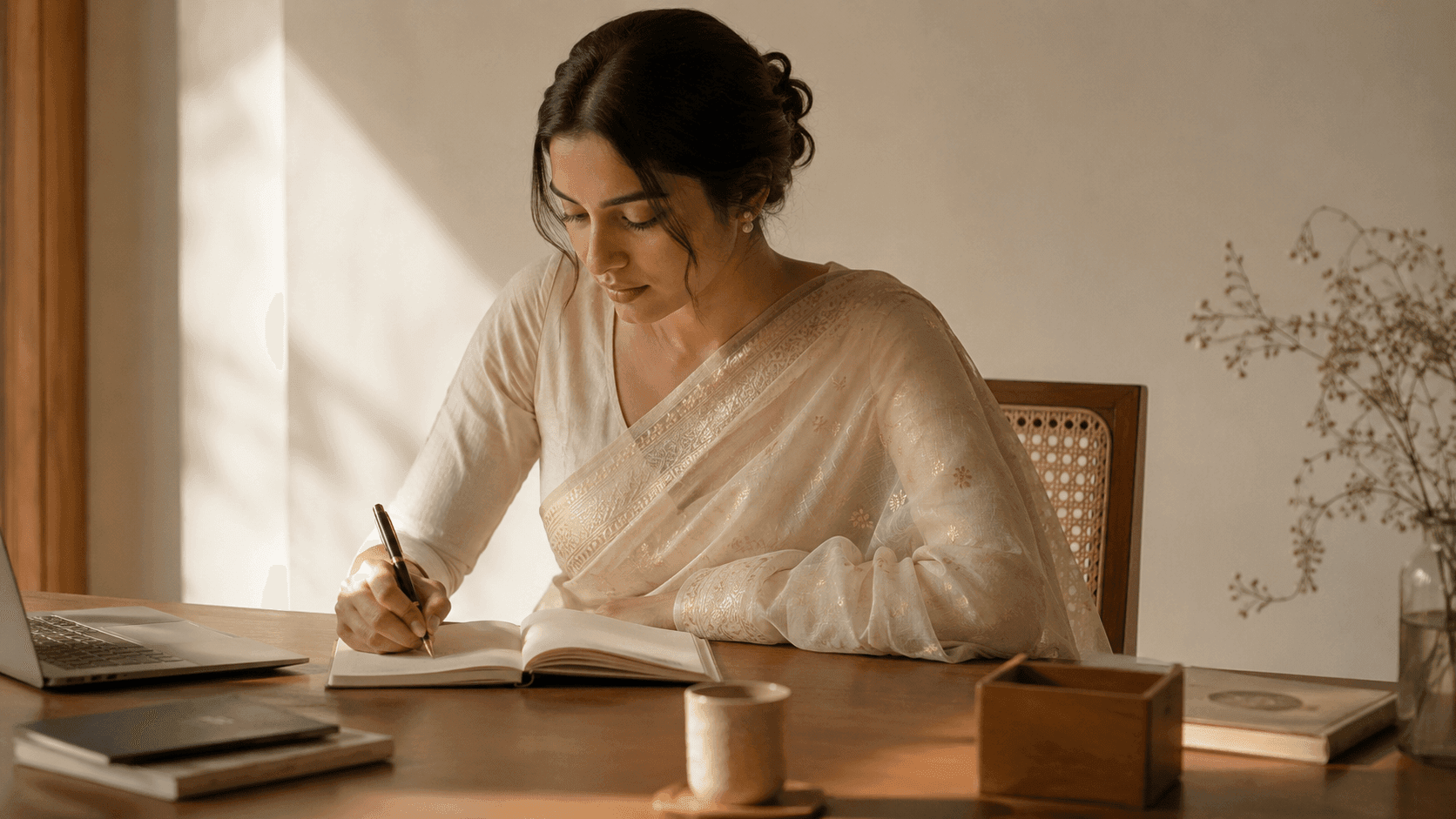
There is a particular kind of confidence that walks into a room when a woman is wearing a saree she knows how to carry. Not performance confidence — the quiet, grounded kind. The kind that says: I chose this intentionally.
And yet, for most working women, the saree still lives in the “occasion” box — reserved for pujas, weddings, and office Diwali parties. The daily desk, the 10 AM meeting, the Friday presentation? That’s still kurti country.
We think it is time to change that.
This guide is not about making the saree convenient. It is about making it wearable — with full looks, real fabric recommendations, practical draping tips, and zero compromise on professionalism.
Here are five complete handloom saree looks built specifically for the office.
Why Handloom Sarees Work Better for Office Wear
Before the looks — a quick word on fabric.
Heavy silks, zari-heavy Banarasis, and embellished georgettes are festive for a reason. They carry visual weight that belongs at a wedding, not a boardroom.
Handloom sarees — Chanderi, Maheshwari, linen, Mangalagiri cotton, Kota Doria — are different. They are:
- Lightweight and breathable, which means you can wear them comfortably through a full workday
- Muted or subtly textured, which reads as professional and intentional
- Easy to drape and re-drape, particularly those with a natural body and softer fall
- Versatile across seasons, especially cotton-silk blends
They also carry a quiet cultural fluency that no fast-fashion outfit can replicate. When you know what you are wearing and why it was made the way it was, it shows.
Look 1: The Chanderi Cotton-Silk for the Monday Meeting
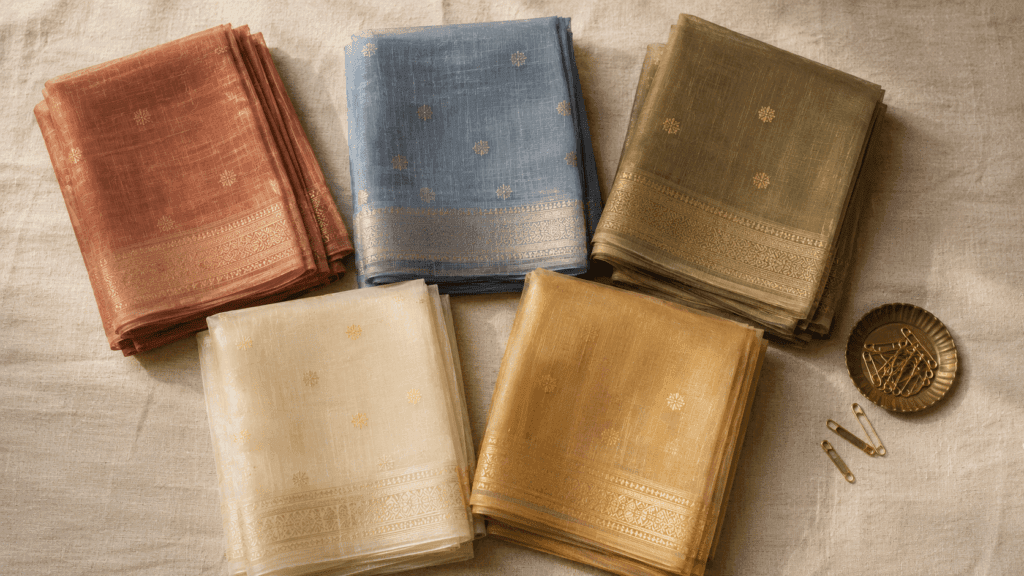
The Saree: A pale ivory or warm beige Chanderi cotton-silk with a minimal woven border — small butis or a single-colour zari stripe at the pallu edge.
Why it works: Chanderi has a luminous, semi-sheer quality that looks elevated without being flashy. The cotton-silk blend keeps it structured enough to drape cleanly but light enough to not weigh you down through a long day.
The Blouse: Fitted full-sleeve blouse in the same fabric, or a tonal cotton in ivory. Keep it tailored — a well-fitted blouse does half the work of making a saree look office-appropriate.
Drape style: Standard Nivi drape. Keep the pleats tight and pinned. Use a saree pin or a small brooch at the shoulder seam — it prevents the pallu from slipping during movement.
Accessories: Gold stud earrings, a slim bangle or two, a structured leather tote in tan or cognac.
Footwear: Block-heeled sandals or leather mules. Avoid stilettos — they shift your centre of gravity and make walking in a saree harder than it needs to be.
Tip: If you are nervous about draping at work, drape at home and safety-pin the pleats the night before. A well-pinned Chanderi will hold through a full office day without needing adjustment.
Look 2: The Maheshwari Stripe for Client-Facing Days
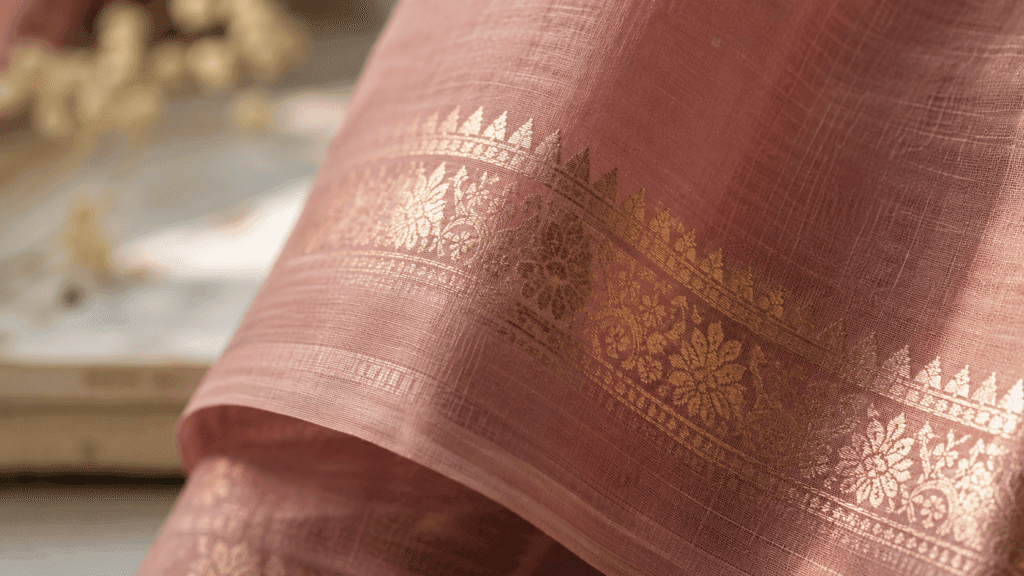
The Saree: A soft rose, dusty blue, or warm terracotta Maheshwari with its signature reversible border and subtle self-stripe body.
Why it works: Maheshwari sarees from Maheshwar, Madhya Pradesh have a distinctive crisp-yet-soft hand. They drape with precision and hold their shape through the day. The woven stripe gives visual structure without pattern overwhelm — it reads as tailored.
The Blouse: Contrast blouse in a complementary deep tone — navy with dusty blue, forest green with terracotta, burgundy with rose. Experiment with a mandarin collar or a boat neck for a modern cut.
Drape style: Standard Nivi. You can also try a slightly higher waistband placement (using a petticoat tied higher at the waist) if you want the look to feel more streamlined.
Accessories: Minimal. A single statement ring, small jhumkas or flat gold drops. No stacking required.
Footwear: Pointed-toe flats or low kitten heels in black or nude.
Tip: Maheshwari sarees are reversible along the border — worth noting if you want to flip the pallu styling for variety without buying a new saree.
Look 3: The Linen Saree for the Creative Professional
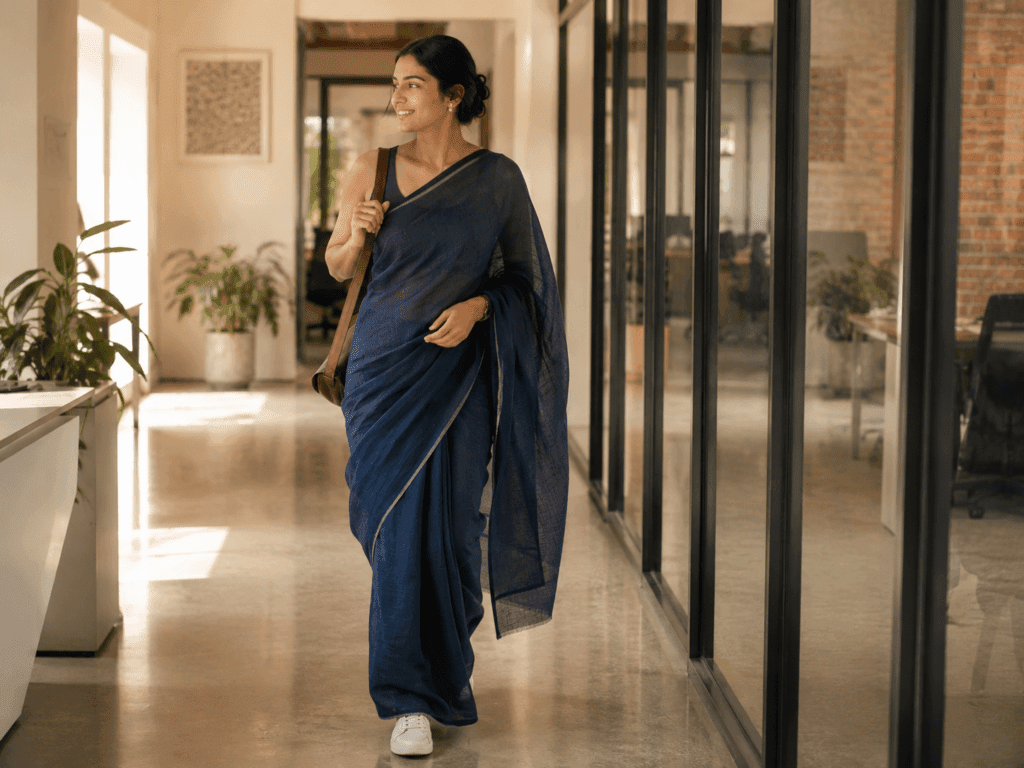
The Saree: A steel grey, olive, or deep indigo handloom linen saree — solid or with a self-textured weave. No zari. No embroidery. Just the linen.
Why it works: Linen sarees are the most Western-wardrobe-adjacent handloom option. They have a casual-luxe quality that is immediately legible as modern and intentional. For anyone working in design, media, architecture, or creative industries — linen is a natural fit.
The Blouse: This is where you can be creative. A structured crop blouse in cotton with interesting button details, or a collared blouse that borrows from shirt-dressing. A denim blouse works surprisingly well with a neutral linen saree.
Drape style: Try a more relaxed, slightly off-shoulder pallu placement — not dramatically, but with a bit more ease than a formal drape. This gives the look an editorial quality that works well for creative offices.
Accessories: Oxidised silver, handmade ceramic jewellery, or bold resin pieces. Linen is a natural base for unconventional accessories.
Footwear: White sneakers. Yes, genuinely. Chunky leather sneakers with a linen saree worn well is one of the most effortless contemporary looks available right now.
Tip: Linen wrinkles — this is part of its charm, not a flaw. But if you prefer a crisper look, lightly steam the saree before wearing and avoid sitting with the pallu bunched under you.
Look 4: The Mangalagiri Cotton for the Everyday Desk Day
The Saree: A bright but earthy Mangalagiri cotton — turmeric yellow, peacock green, or brick red — with its characteristic nizam border in a contrasting colour.
Why it works: Mangalagiri cotton from Andhra Pradesh is among the most underrated office fabrics in an Indian wardrobe. It is crisp, cool, extremely durable, and comes in colours that are vibrant without being loud. The nizam border gives every Mangalagiri a natural graphic edge.
The Blouse: A clean, fitted blouse in the border colour. So if your saree body is turmeric with a red border, your blouse picks up the red. This creates a cohesive, put-together look with minimal styling thought.
Drape style: Standard Nivi, with the pallu pinned neatly. Mangalagiri holds well through the day.
Accessories: Terracotta jewellery, wooden bangles, or simple gold hoops. Keep it earthy and artisan-adjacent.
Footwear: Kolhapuris, juttis, or simple block-heel sandals. This look is grounded — footwear should match that energy.
Tip: Mangalagiri cotton is machine-washable. This matters enormously for everyday office wear. Wash in cold water, dry in shade, and lightly iron while slightly damp for best results.
Look 5: The Kota Doria for Formal Presentations
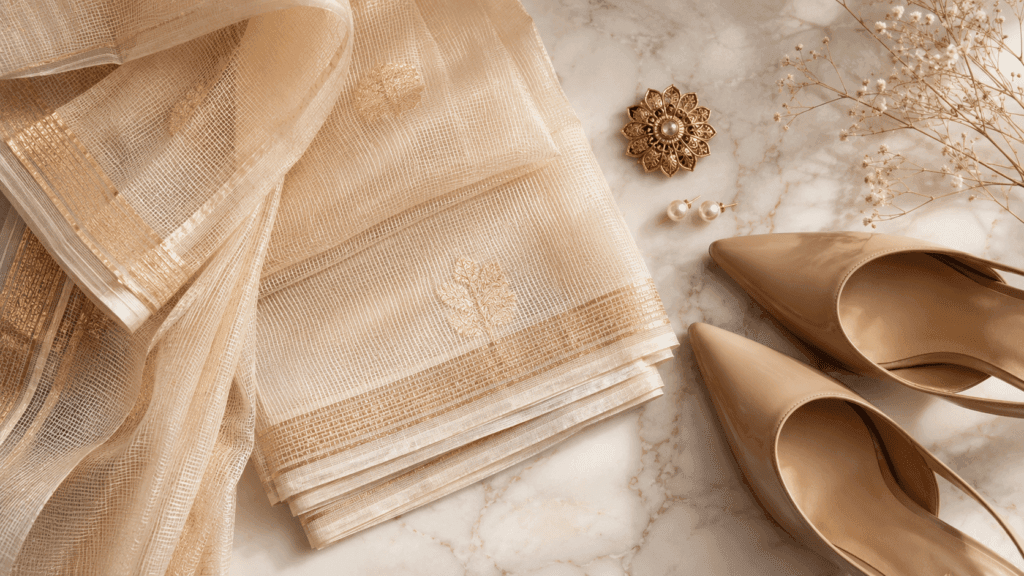
The Saree: A soft white, champagne, or pale gold Kota Doria — the signature fine checks of this Rajasthani weave give it a quiet texture that reads beautifully under office lighting.
Why it works: Kota Doria is featherlight and semi-transparent, which makes it feel formal and delicate without being heavy or hot. For high-stakes days — presentations, board meetings, important client visits — it is the handloom equivalent of a perfectly cut blazer.
The Blouse: A well-fitted blouse in ivory silk or a pale champagne raw silk. Full sleeves or a three-quarter sleeve for a formal cut. Consider a small decorative button row at the back for detail that is subtle but considered.
Drape style: Crisp Nivi with neatly pressed pleats. Pin the pallu at the shoulder with a small gold brooch — it adds an intentional accessory and keeps everything exactly where it should be through a long, active day.
Accessories: Simple gold earrings, a slim gold chain, a neat watch. Nothing that competes with the delicacy of the fabric.
Footwear: Nude or blush pointed-toe heels. Block or tapered — choose based on your comfort over the day.
Tip: Kota Doria can be difficult to drape for beginners because of its lightness — it slips more than cotton. Use an inner petticoat with a slightly rougher texture (cotton works well) to give the pleats something to grip. And always safety-pin your pleats at the waist.
The Office Saree Starter Kit
If you are building an office saree wardrobe from scratch, start here:
- 1 Chanderi cotton-silk in a neutral — ivory, beige, or pale grey
- 1 Maheshwari in a colour you love and wear often
- 1 Mangalagiri cotton in a bright-but-earthy tone for everyday rotation
- Blouses: 3–4 tailored, well-fitted blouses in tonal and contrast options
- Safety pins: Always. Non-negotiable.
- A brooch or saree pin for shoulder draping
Total investment in quality handlooms? Under ₹8,000–12,000 for the full starter wardrobe — and pieces that will outlast any fast fashion kurti by years.
Read also:
A Note on Draping Confidence
The most common reason women do not wear sarees to work is not the fabric, not the blouse, not even the drape. It is the fear of something going wrong in the middle of a meeting.
This is solvable. Drape at home first. Practice on a weekend. Pin everything you are not confident about. Walk around for twenty minutes before going out. The muscle memory builds faster than you expect.
A saree you have worn twice already is a saree you can wear anywhere.
FAQ: Office Saree Styling
Mangalagiri cotton is the most forgiving for beginners — it is crisp, holds its shape, does not slip, and requires minimal pinning. Chanderi cotton-silk is a close second.
Absolutely. The key is in the styling — clean drape, fitted blouse, minimal accessories, structured footwear. A well-draped Kota Doria or Maheshwari reads as completely professional in any corporate environment.
Fitted full-sleeve or three-quarter sleeve blouses in a matching or complementary fabric. Avoid heavy embellishment, deep necklines, or very short cropped lengths for office wear.
Pin it at the shoulder with a safety pin or a small brooch. You can also pin the inner edge of the pallu to your blouse at the back. Most experienced saree wearers use 3–5 pins across a workday.
A good quality handloom saree ranges from ₹800 to ₹4,000 for everyday cotton weaves — comparable to or less than a well-made readymade outfit. And it lasts significantly longer with basic care.