
What you will know after reading this
- How Ahilya Bai Holkar’s patronage in late-18th-century Maheshwar gave this weave its court identity — and what is legend versus record.
- The reversible border — the single technical detail that separates a genuine Maheshwari from every imitation.
- The three fabric types, an honest comparison with Chanderi, and what to actually pay for each.
- Where to buy with confidence — from the Rehwa Society cooperative to trustworthy online sources.
Born in the court of Ahilya Bai Holkar, woven on the banks of the Narmada. The saree that is both everyday and royal — and why the reversible border is the cleverest piece of engineering in Indian handloom.
What is a Maheshwari saree?
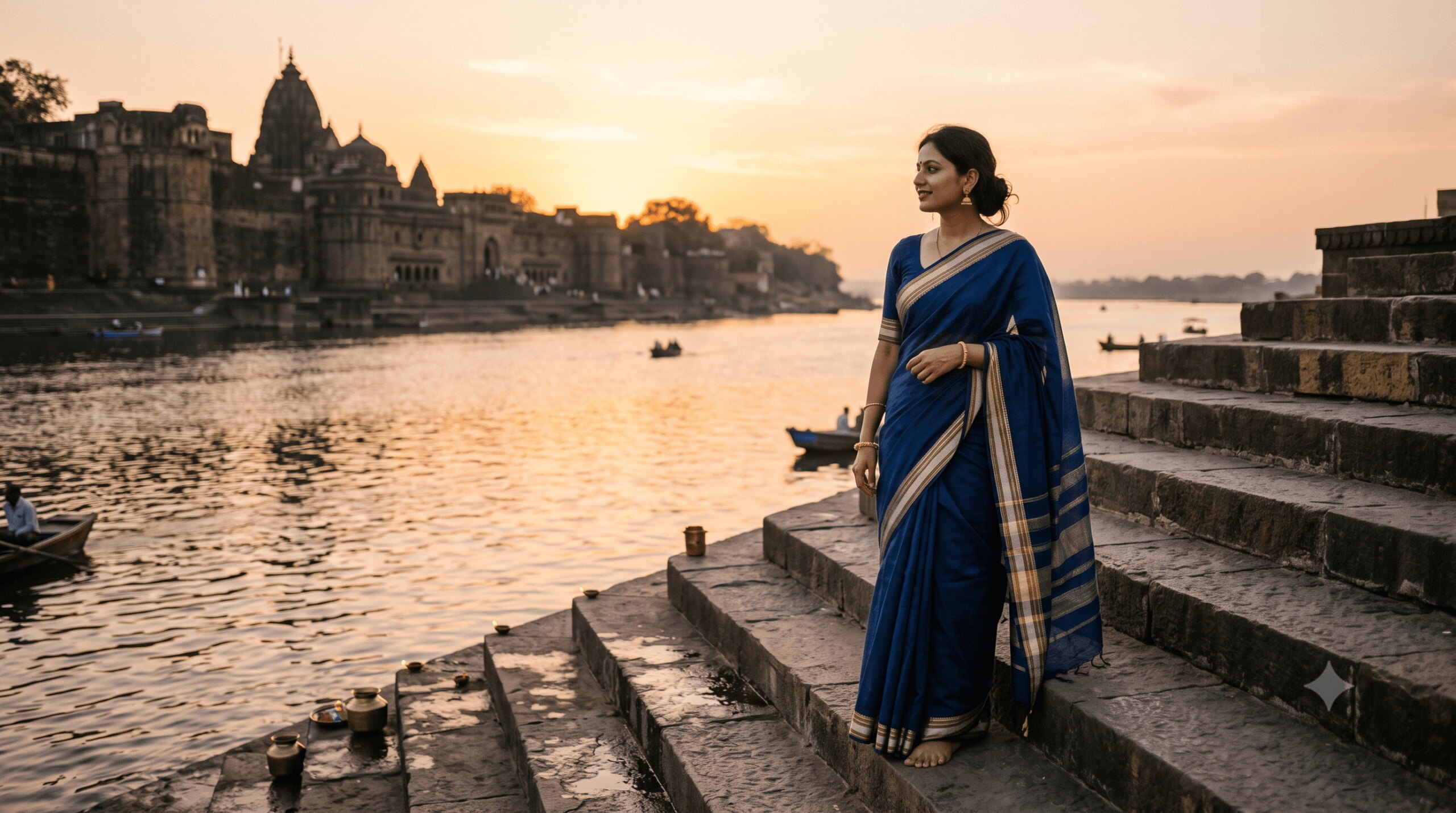
A Maheshwari saree is a handloom silk-cotton saree woven in Maheshwar, a small town on the banks of the Narmada river in Madhya Pradesh. It is defined by a distinctive reversible border — an identical woven stripe pattern on both the front and the back — and traditional motifs like the chatai (mat) and chameli bel (jasmine vine). The saree as a court textile is credited to Ahilya Bai Holkar, who ruled from Maheshwar from 1767 to 1795 and patronised its weavers.
Maheshwar — the fort city on the Narmada
Maheshwar is a small town in Madhya Pradesh, built on a bend of the Narmada river where wide stone ghats step down into the water and a fort — Ahilya Fort — looks out over the current. It has been a place of pilgrimage and administration for centuries. It is also, without much fanfare, the origin point of one of India’s most technically distinctive handloom sarees.
Unlike Banaras or Kanchipuram, Maheshwar is not remembered first as a weaving city; it is remembered as a Holkar capital and a pilgrimage town. What made its cloth famous was royal patronage: a queen who wanted her court and her guests clothed in something that belonged to her own kingdom. Cotton weaving in the Malwa–Nimar region is older than the Holkars, so the honest way to say it is that Ahilya Bai did not invent weaving in Maheshwar — she built the workshop tradition that became the Maheshwari saree.
The Ahilya Bai Holkar connection — a queen who saved a weave
Ahilya Bai Holkar took charge of the Holkar state in 1767 and ruled from Maheshwar until 1795 — one of the most consequential women rulers in Indian history. The account most often told, by local weavers and the cooperative that works here today, is that she brought weavers from Surat and Malwa to Maheshwar and set them up to make sarees for gifting to guests and for the court. Treat the details as tradition rather than a dated document: the patronage is widely credited, but we have not seen a primary record of the exact year or of who drew the first patterns.
Whatever the precise chronology, the pattern is clear: patronage of a workshop, not the slow accretion of a village craft. The result was a saree that combined the practicality of cotton with the sheen of silk, worn daily by court women and eventually by the wider region — a working textile with royal origins, which is part of why it still feels both grounded and special today.
“Most handloom traditions in India are centuries older than any single name attached to them. Maheshwari is the rare exception — a weave you can trace to one queen and one court.”
Ahilya Bai ruled for nearly three decades and is remembered for public works, temple building and support for local crafts. The weave outlived her by more than two centuries, though it nearly did not survive the 20th — by the 1970s, Maheshwari weaving had declined sharply, undercut by mill cloth and changing markets. Its modern revival is its own story, and a large part of that story is the Rehwa Society, covered later in this guide.
What makes Maheshwari different — the reversible border
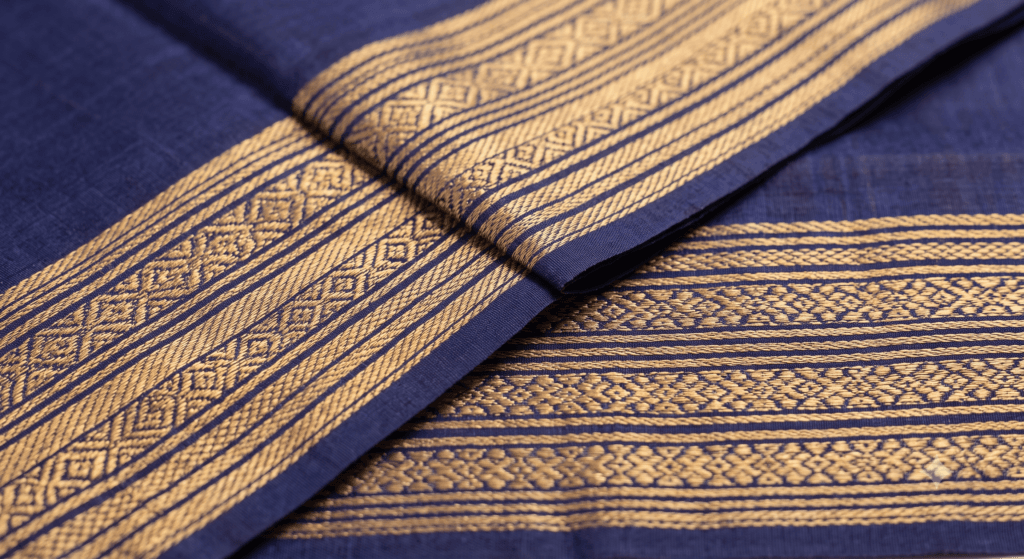
If you learn to identify one thing about Maheshwari sarees, make it this: the reversible border. On a genuine Maheshwari saree, the woven stripe-and-motif border is identical in structure on both the face side and the reverse side. Turn the border inside out and it reads the same way.
This is a real technical achievement, not a marketing phrase. It requires a specific interlocking of the warp and weft at the border edge — traditionally a five-stripe (or sometimes three- or nine-stripe) structure with small woven motifs set between the stripes — constructed so that no single side “hosts” the pattern while the other shows only its underside. Most bordered sarees, including many otherwise excellent handlooms such as the Banarasi saree, have an obvious front and back at the border. Maheshwari does not.
✓ Genuine Maheshwari border — what to look for: Fold the border back on itself. The stripe pattern and any small woven motifs should read identically on both sides — same colours, same placement, same clarity. This is the single fastest authenticity check for the weave.
✗ Printed or powerloom imitation — red flags: If the reverse of the border is faded, blurred, or structurally different from the face, the border was printed or machine-finished rather than handwoven reversible — a common shortcut in cheaper “Maheshwari-style” sarees. For a deeper walkthrough of spotting machine-made imitations generally, see Handloom vs Powerloom — How to Tell the Difference.
Three types of Maheshwari fabric
Not every Maheshwari saree is made of the same fibre blend. Three types are commonly sold, and knowing which one you are buying changes both the price and how the saree should be worn and cared for.
Silk-cotton (the classic)
Silk in the warp, cotton in the weft — the blend most people mean today when they say “Maheshwari”. (Early Maheshwar cloth was cotton; silk came in later, so do not let a seller tell you silk-cotton is the “original” version.) Crisp yet soft, holds its shape, breathable enough for daily Madhya Pradesh heat. Most widely available and most affordable of the three.
Pure silk Maheshwari
Both warp and weft in silk. Richer sheen, heavier drape, more suited to festive and evening wear than the everyday cotton-silk version. Rarer, priced closer to a mid-tier silk saree.
Cotton Maheshwari
All cotton, lightest of the three, most breathable. Popular as an everyday office saree — similar in spirit to how a Chanderi is styled for the office — or summer saree where the silk sheen is not the priority. The most budget-accessible entry point into the weave.
Traditional motifs — butti, chatai, chameli bel
Maheshwari sarees carry a small, recognisable vocabulary of motifs, most drawn from the architecture and gardens of the Maheshwar fort itself.
- Butti — small, evenly scattered dot or floral motifs across the body of the saree, understated and repeated in a grid.
- Chatai — a mat-weave or basket-weave pattern, usually along the border, named for its resemblance to a woven floor mat.
- Chameli bel — a jasmine-vine motif, a flowing floral border design associated with the fort’s gardens.
These motifs are typically woven in extra-warp or extra-weft technique — not printed — which is part of why a genuine Maheshwari saree has a slightly raised, tactile quality to its border and pallu even before you check the reversibility.
Maheshwari vs Chanderi — an honest comparison
Maheshwari is constantly confused with Chanderi, its Madhya Pradesh neighbour — both are silk-cotton weaves from the same state, both have devoted followings, and both are frequently mislabelled as each other by sellers who have not looked closely. Here is the practical difference for a buyer choosing between them.
| Feature | Maheshwari | Chanderi |
|---|---|---|
| Texture & weight | Slightly heavier, more pronounced texture | Sheerer, lighter — often called “woven air” |
| Border | Reversible border is the signature detail | Border is single-sided, often with fine zari |
| Best for | Evenings, structured occasions, richer palette | Summer, daytime, casual-to-semi-formal |
| Origin town | Maheshwar, on the Narmada | Chanderi, near the Betwa river |
| Typical price (silk-cotton) | ₹2,500 – ₹6,000 | ₹2,000 – ₹6,500 |
Both are beautiful. Own one of each — they are different enough in hand and occasion that they do not compete for the same place in a wardrobe.
Price guide by type
| Type | Entry price | What you’re paying for |
|---|---|---|
| Cotton Maheshwari | ₹1,500 – ₹3,000 | All-cotton weave, everyday wear, lightest of the three |
| Silk-cotton Maheshwari | ₹2,500 – ₹6,000 | The classic modern blend — silk warp, cotton weft, most versatile |
| Pure silk Maheshwari | ₹6,000 – ₹15,000+ | Full silk warp and weft, richer drape, festive-grade |
| Rehwa Society pieces | Varies by type, fair-trade priced | Direct cooperative pricing, wages reach the weaver |
✗ Price red flag: A “pure silk Maheshwari” priced under ₹4,000 is very unlikely to be genuine handwoven silk. Check the reversible border and ask directly about the warp-weft composition before paying — the same discipline covered in How to Identify Pure Silk — 5 Tests.
Five questions to ask before you pay
Most Maheshwari confusion is resolved by a seller who answers plainly. Ask these, and treat vague answers as answers.
- What is the warp and what is the weft? A genuine seller says “silk warp, cotton weft” or “pure silk” without hesitation. “Silk blend” is not an answer.
- Can you show me the back of the border? It should match the front. Ask for a photo in daylight if you are buying online.
- Is it handloom or powerloom? Ask which weaver or cluster wove it. Our handloom vs powerloom guide lists the physical checks.
- Is there a Handloom Mark or a weaver tag? The Handloom Mark is issued by the Government of India’s textile ministry; a tag naming the weaver or society is a good sign. Neither is proof on its own, so pair it with the border check.
- What is the return policy if the border is not reversible? Honest sellers accept returns on misdescribed fabric.
Where to buy — Rehwa Society and beyond
The most reliable source for authentic Maheshwari is the Rehwa Society, a weavers’ cooperative set up in the late 1970s by Sally Holkar, together with Richard Holkar, the head of the Holkar family, to revive the craft when it was fading. Rehwa works with a large number of local weavers, pays fair wages, and produces sarees that carry the full technical integrity of the tradition — including the reversible border done properly.
- Rehwa Society, Maheshwar — the most trusted cooperative source, sells directly and through select retail partners.
- Maheshwar town — visiting in person lets you meet weavers and see the loom process directly, if you’re planning a Madhya Pradesh trip.
- Government emporiums — MP state handloom outlets in major cities carry certified Maheshwari stock at fixed, fair prices.
- Certified online sellers — look for sellers who name the fabric composition specifically and photograph the reverse of the border.
Note: Nakshapatta does not accept payment for recommendations. Rehwa Society and other sources above are named for their reputation and craft integrity, not as paid placements.
Sources and what we could not verify
The history above follows the accounts published by the Rehwa Society and by Madhya Pradesh tourism and handloom bodies, cross-read against general histories of the Holkar state. The date and details of Ahilya Bai’s patronage of weavers are told as tradition; we have not seen a primary court record. The price ranges are indicative market ranges for 2026, not quotes, and will vary by weave density, zari use and seller. If you weave, sell or study Maheshwari cloth and can correct or add detail, write to us — we update this guide when we learn something better.
Frequently Asked Questions
Its reversible border — an identical woven stripe-and-motif pattern on both the face and the reverse of the border — is the weave’s defining technical feature, alongside its origin in the court patronage of Queen Ahilya Bai Holkar in Maheshwar, Madhya Pradesh.
It can be either, or both. The classic and most common Maheshwari is silk-cotton — a silk warp with a cotton weft. Pure silk and all-cotton versions also exist; each has a different price and best-use occasion, covered in the fabric-types section above.
Fold the border back on itself and check the reverse — a genuine Maheshwari has the identical stripe-and-motif pattern on both sides. Also check for slight raised texture in the extra-warp motifs (butti, chatai, chameli bel), which should feel woven, not printed.
If you want a lighter, sheerer everyday summer saree, start with Chanderi. If you want something with more structure and a richer palette suited to evenings and slightly more formal settings, start with Maheshwari. Most serious handloom wardrobes eventually include both.
Silk-cotton and pure silk Maheshwari sarees should be dry-cleaned or gently hand-washed in cold water with a mild detergent, then dried flat in shade — never wrung or hung by the pallu. Cotton Maheshwari can be hand-washed at home more casually. See our full Saree Care Guide for the complete washing, drying, and storage process.
Join the Nakshapatta Edit — one textile fact, one styling tip, one honest recommendation, straight from Varanasi, once a week. No spam, no sponsored placements. Join the Edit →