



Key Takeaways
- The three marks answer three different questions: Handloom Mark = how it was made (handwoven), Silk Mark = what it is made of (pure natural silk), GI tag = where it is from (genuine regional origin).
- No single mark proves all three. A saree can be pure silk yet powerloom, or handwoven yet not from Banaras.
- Handloom Mark is issued by the Textiles Committee (Ministry of Textiles); Silk Mark by the Silk Mark Organisation of India under the Central Silk Board.
- The GI tag is the only one that is a legal right — “Banaras Brocades and Sarees” has been GI-protected since 2009, and only registered producers in five Uttar Pradesh districts may sell under the name.
- Every genuine label carries a unique number and, increasingly, a QR code you can verify online — the presence of a tag is a start, not proof; verify it.
If you have ever turned a saree over in your hands, found a small government-looking tag near the pallu, and quietly assumed it meant “this is the real thing” — you are in good company, and you are also half-wrong. That tag proves something. It rarely proves everything you think it does.
I spend a fair amount of time in the weaving lanes of Banaras — Madanpura, Lallapura, the by-lanes off Peeli Kothi where the pit looms actually sit. The gap between what a mark certifies and what a shopper believes it certifies is where most saree money goes wrong. So here is the honest, ground-level version of Handloom Mark vs Silk Mark and the GI tag: what each one is, who stands behind it, what it quietly does not say, and how to check that the tag on your saree is real. For the step-by-step version of that last part, see how to verify a Silk Mark and GI number in five minutes.
The three marks at a glance
Read this table once and you will already be ahead of most buyers. Each mark answers a single, separate question.
| Mark | What it proves | Who issues it | What it does NOT prove |
|---|---|---|---|
| Handloom Mark | The fabric was genuinely woven by hand on a non-powered loom | Textiles Committee, Ministry of Textiles | Fibre content or regional origin |
| Silk Mark | The fabric is 100% pure natural silk | Silk Mark Organisation of India (SMOI), under the Central Silk Board | Whether it was handwoven, or where it was made |
| GI tag | The product genuinely originates from the named region | Geographical Indications Registry, Chennai (a legal, statutory right) | Whether it was handwoven, or made of pure silk |
Handloom Mark — proof of how it was made
The Handloom Mark is the Government of India’s answer to the single most common saree lie: a powerloom piece sold as handloom. It was launched on 28 June 2006 and is administered by the Textiles Committee, a statutory body under the Ministry of Textiles. Legally it is a certification trade mark under the Trade Marks Act, 1999 — a voluntary quality mark rather than a compulsory one.
What it certifies is narrow and precise: the product was genuinely hand-woven, not produced on a powerloom. That is the whole promise. It says nothing about the fibre — a Handloom Mark can sit on a cotton, silk, wool or blended saree — and nothing about where the loom stood.
How to read the label
The mark shows a stylised hand cradling yarn with the words “Handloom Mark.” The domestic label carries the word Handloom; the export version reads Handwoven in India. Each label has security features, a unique coded number on the reverse, and — on newer issues — a QR code. The code classifies the product (fabric or made-up, domestic or export) and links it to a registered weaver, cluster or organisation.
Silk Mark — proof of what it is made of
The Silk Mark exists to solve the other half of the problem: is this actually silk, or art silk (viscose/polyester) sold at silk rates? Launched on 17 June 2004, it is run by the Silk Mark Organisation of India (SMOI), a society sponsored by the Central Silk Board under the Ministry of Textiles. Think of it as the BIS hallmark, but for silk instead of gold.
Its promise is equally single-minded: the fabric is 100% pure natural silk — no blending, no synthetic substitution. Crucially, it says nothing about how the silk was woven. A powerloom-woven pure-silk saree can legitimately carry a Silk Mark. So can a handloom one. The mark speaks only to the fibre.
How to read the label
Silk Mark labels are paper hangtags or sew-in labels, affixed only by SMOI’s registered “Authorised Users.” Each label carries a hologram, a QR code and a unique number; scanning the QR reveals the authorised user’s details. The newest labels are tamper-proof, self-destruct stickers designed to break apart if peeled off, so they cannot be reused on a fake. If you are ever in doubt, SMOI offers free testing of marked products at its accredited Silk Mark chapters.
One honest caveat: the Silk Mark is advisory. It is a voluntary scheme, not a legal requirement, so its absence does not automatically mean a saree is fake — it may simply mean the weaver never registered. Its presence, verified, is a strong signal; its absence is inconclusive.
GI tag — proof of where it is from
The GI tag is the odd one out, and the most misunderstood. A Geographical Indication is not a quality stamp a seller buys — it is an intellectual-property right under the Geographical Indications of Goods (Registration and Protection) Act, 1999, which came into force in September 2003. It is administered by the Geographical Indications Registry in Chennai, under the Controller General of Patents, Designs and Trade Marks.
A GI certifies that a product genuinely originates from a defined region and carries the qualities or reputation attached to that place. For sarees, the roll-call is familiar: Kanchipuram silk, Pochampally Ikat, Chanderi, Paithani — and, closest to home for us, the Banarasi.
How the Banarasi GI actually works
“Banaras Brocades and Sarees” was granted GI protection on 4 September 2009 under Application No. 99. It restricts the legal use of the Banaras/Banarasi name to sarees and brocades produced in five Uttar Pradesh districts — Varanasi, Mirzapur, Chandauli, Bhadohi and Azamgarh. A saree woven in Surat cannot lawfully be sold as a “Banarasi.”
Here is the mechanism most shoppers miss. The GI register has two parts: a registered proprietor (the weaver associations who hold the GI collectively) and authorised users (the actual on-the-ground producers). Only a registered authorised user — a genuine weaver or organisation inside the region — may lawfully affix the GI tag to a saree. That is what gives the tag its weight, and also why it is comparatively rare on the shop floor: the individual karigar in Madanpura who wove your saree may never have registered as an authorised user, even though the piece is entirely genuine.
The trap: why no single mark is enough
Put the three together and the whole game becomes visible. Each mark closes one door and leaves two open:
- A Silk Mark saree can be pure silk — and powerloom.
- A Handloom Mark saree can be handwoven — and cotton, or blended, or woven far from the region it is styled after.
- A GI-tagged saree can genuinely be from Banaras — and still be powerloom, or not pure silk.
This is precisely how a good salesperson works. Faced with a powerloom pure-silk piece, they will show you the Silk Mark and stay quiet about the loom. Faced with a handwoven cotton-silk blend, they will point to the Handloom Mark and let you assume “silk.” The marks are not the con — selective storytelling around them is. Understanding handloom versus powerloom and testing the fibre yourself is what turns three tags into one confident decision.
What a genuine handwoven, pure-silk Banarasi should carry
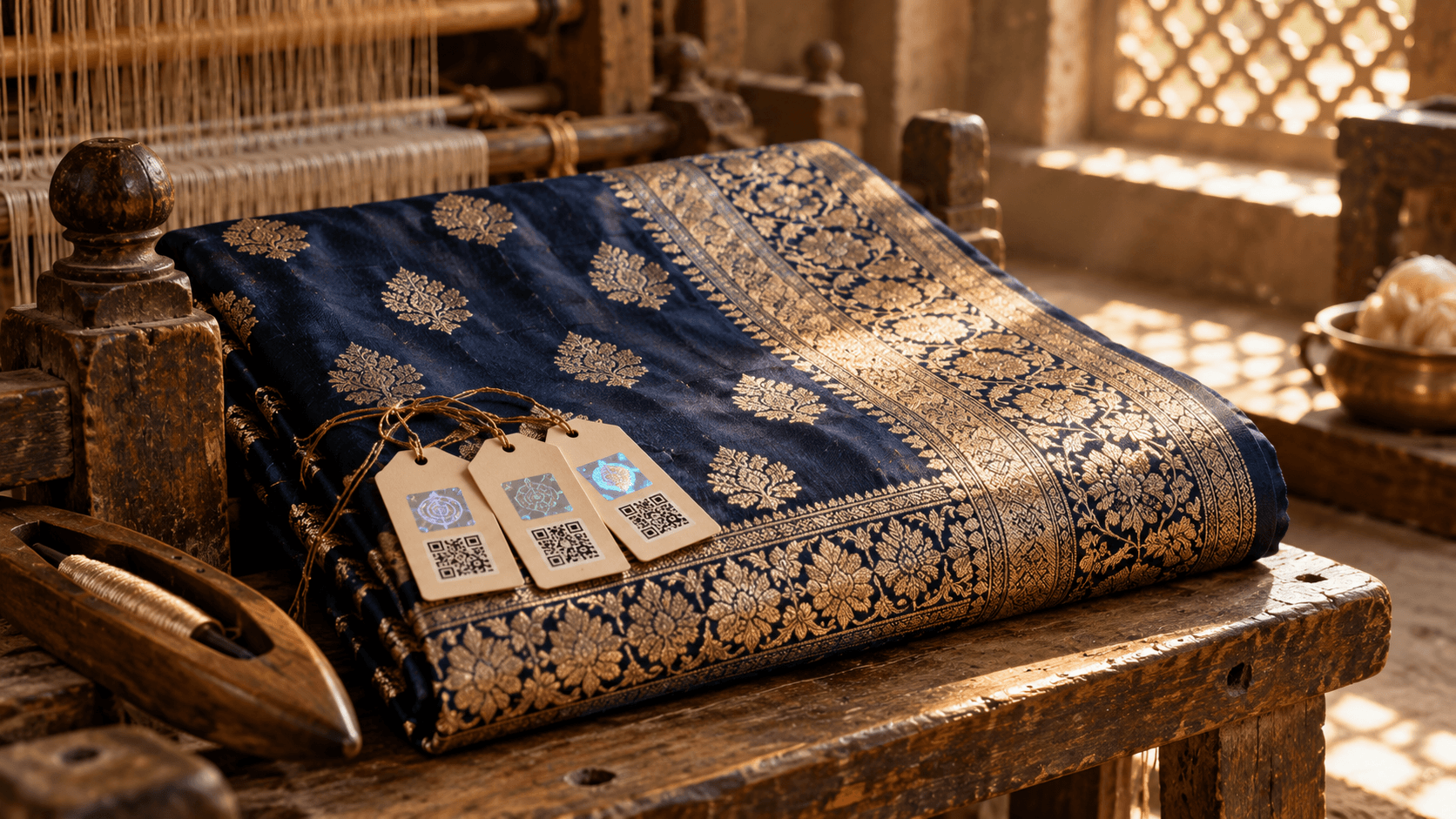
For the piece most people are actually chasing — a real, handwoven, pure-silk Banarasi — you want all three signals to line up, and you still verify:
- Handloom Mark — confirming it came off a handloom, not a powerloom.
- Silk Mark — confirming the katan silk is pure, not art silk.
- GI (Banaras Brocades and Sarees) — confirming it was genuinely woven in the region, ideally by a registered authorised user.
- A price that makes sense — a “pure silk” Banarasi selling for a few thousand rupees is almost always powerloom, blended, or both. Genuine handwoven pure-silk Banarasi begins far higher; treat prices as indicative and let the weave, not the tag, lead.
How to verify each mark in under a minute
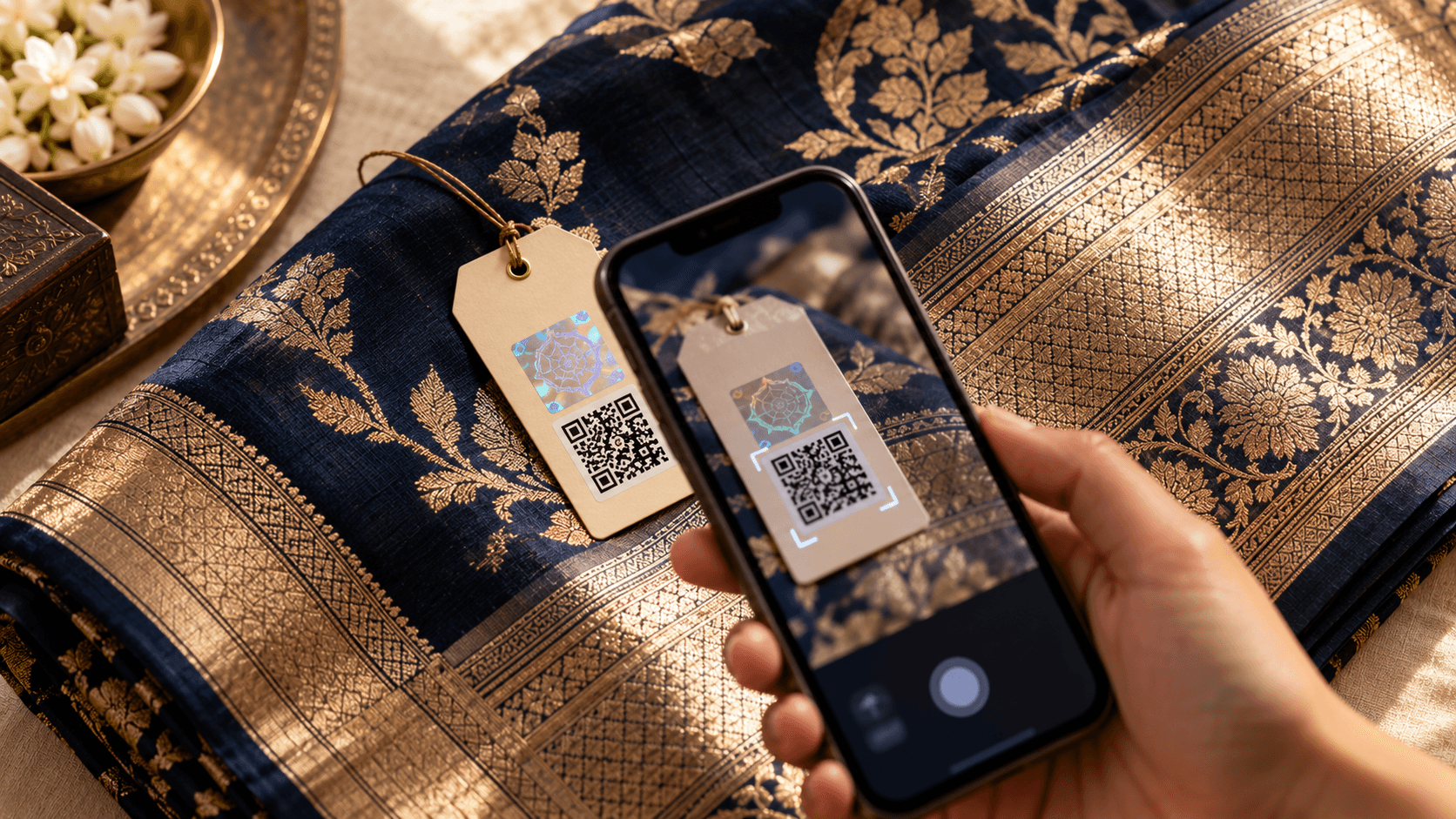
A tag is only as good as its verification. All three schemes now let you check a code rather than trust a sticker.
- Silk Mark: scan the QR on the hangtag, or enter the unique number at the Silk Mark Organisation of India site or app. It should return the authorised user’s details. Check the hologram is intact and not a re-stuck, reused tag.
- Handloom Mark: scan the QR or note the coded number, and verify it against the Handloom Mark portal/app run by the Textiles Committee. The code should resolve to a registered weaver or cluster.
- GI tag: confirm the exact registered name (“Banaras Brocades and Sarees” for Banarasi) and, where a seller claims GI, ask whether they are a registered authorised user — a genuine one can say so plainly.
Frequently asked questions
No. The Handloom Mark certifies that a fabric was genuinely woven by hand rather than on a powerloom, and is issued by the Textiles Committee. The Silk Mark certifies that a fabric is 100% pure natural silk, and is issued by the Silk Mark Organisation of India. One is about method, the other about material — a saree can carry both, one, or neither.
No. A GI tag certifies regional origin — that a Banarasi genuinely comes from the five protected Uttar Pradesh districts, for example. It does not guarantee the saree was handwoven or made of pure silk. A powerloom saree woven within the region can still fall inside the GI, which is why the GI should be read alongside the Handloom Mark and Silk Mark, not instead of them.
Scan the QR code on the hangtag or enter the unique number on the Silk Mark Organisation of India website or app; it should return the registered authorised user’s details. Check that the hologram is intact and not a peeled-and-reused tag. If in doubt, SMOI offers free testing of Silk Mark products at its accredited chapters.
For a genuine handwoven pure-silk Banarasi, you ideally want all three: the Handloom Mark for handwork, the Silk Mark for pure silk, and the “Banaras Brocades and Sarees” GI for origin. If you must prioritise, verify the fibre first — pure silk versus art silk is where the most money is lost — then confirm the handloom and origin claims.
Not necessarily. Both marks are voluntary schemes, and many genuine weavers — especially individual karigars in Varanasi — never register. A missing mark is inconclusive rather than damning. Judge the saree on the hand-feel of the silk, the quality of the zari and weave, and the seller’s transparency, using the marks as supporting evidence rather than the sole test.
Enjoyed this? Join The Nakshapatta Edit — one textile fact, one buying tip and one weave worth knowing, straight from the looms of Banaras, in your inbox.
Nakshapatta does not accept payment for recommendations. Prices and figures are indicative loom-side ranges and vary by weaver, materials and season; verify current details before you buy.