

Key Takeaways
- Chanderi sarees feature a unique luminosity, making them semi-transparent and featherlight, thanks to centuries of traditional weaving techniques.
- Chanderi fabric is a family of textiles, with variations like pure silk, silk-cotton, and cotton, each catering to different budgets and preferences.
- The fabric received a Geographical Indication (GI) tag in 2005, ensuring authenticity from Chanderi’s traditional weavers.
- Buyers should perform tests like the Light, Touch, and Weave tests to differentiate genuine Chanderi sarees from imitations.
- Caring for Chanderi sarees involves specific washing, drying, and storage methods to maintain their quality and longevity.
There is a fabric that looks like it might dissolve in afternoon light. Not because it is fragile — but because it was made that way, deliberately, by weavers who have spent generations learning how thin a thread can go before it begins to breathe.
That fabric is Chanderi.
What Is Chanderi — And Why Does It Matter?
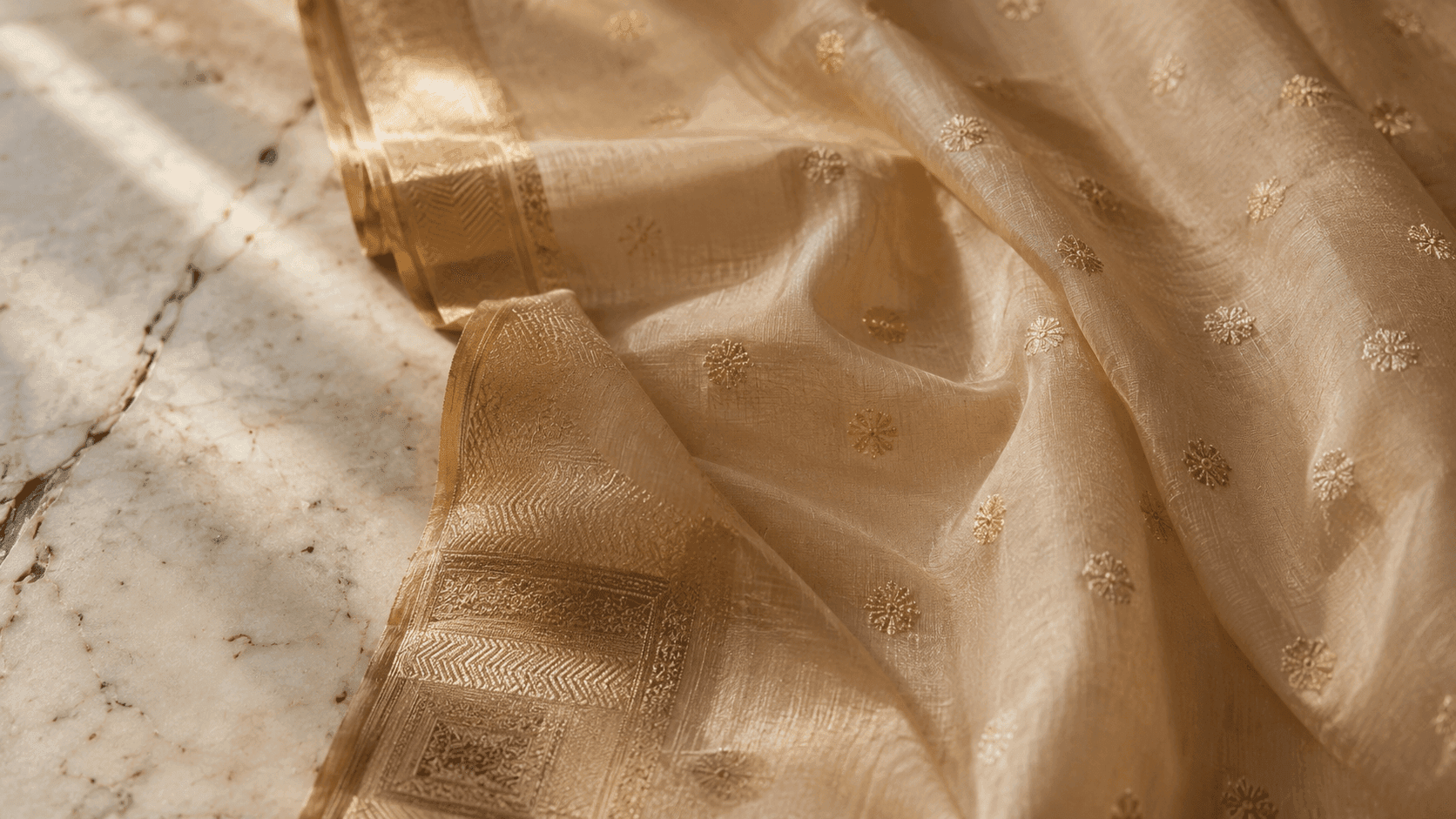
Chanderi is one of India’s oldest and most refined handloom traditions, originating in a small town in Madhya Pradesh by the same name. What sets it apart is a single quality almost impossible to fake convincingly: its luminosity.
A genuine Chanderi saree is semi-transparent, featherlight, and carries a soft inner glow — the result of centuries of refined weaving technique using exceptionally fine threads. It is one of the few Indian fabrics that has remained largely unchanged in character across six centuries, even as it has evolved in colour, motif, and market.
If you are new to Chanderi, this guide gives you the complete picture — where the fabric comes from, what you are actually buying when you pick one up, and how to make sure what you bring home is real.
The Weaver’s Town — A Brief History of Chanderi
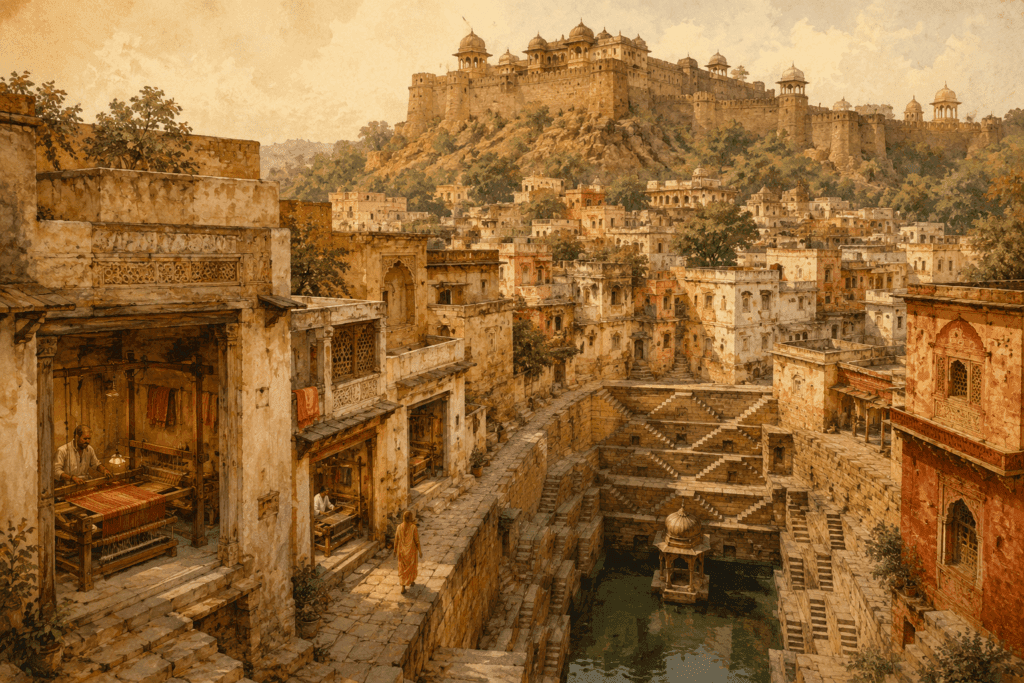
Chanderi town sits in the Ashoknagar district of Madhya Pradesh, roughly 240 kilometres from Bhopal, on a plateau between two hill ranges. It is a small town — around 25,000 people — but it contains approximately 3,500 active handlooms, most inside the homes of multigenerational weaving families.
The town’s association with fine weaving goes back to at least the 11th century. By the time of Akbar’s court, Chanderi fabrics were appearing in Mughal royal inventories. During the Maratha period, they were gifted at diplomatic occasions. The cloth was never about scale. It was always about refinement.
The ambition of a Chanderi weaver was never quantity. It was always luminosity — the art of making cloth that carries light.
– On the heritage of Chanderi
The Two Weaving Communities
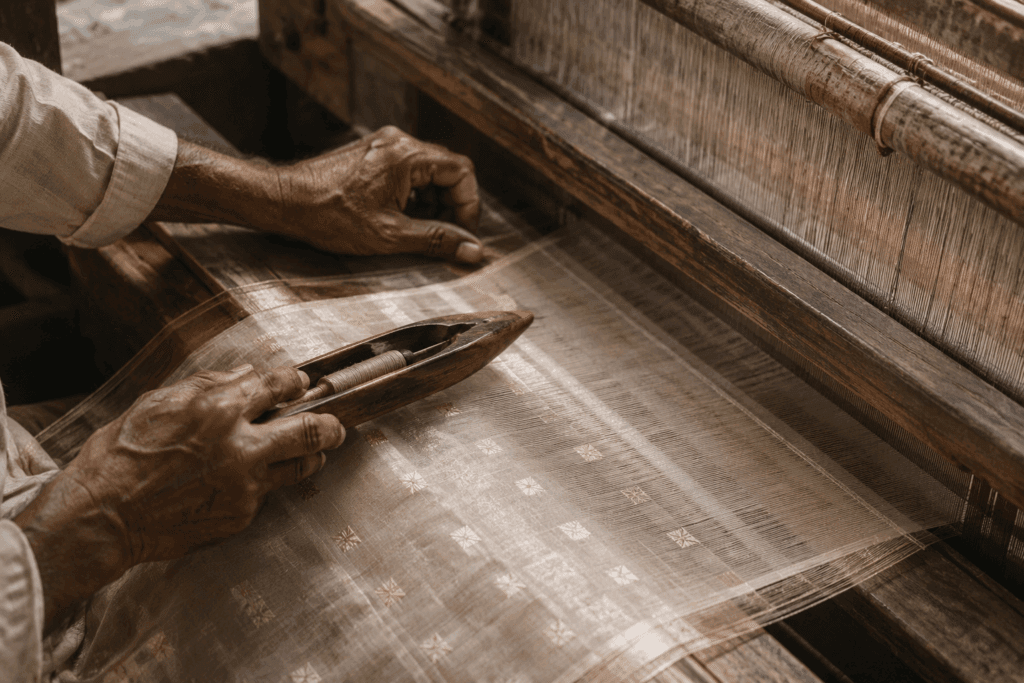
Chanderi’s weavers belong primarily to two communities: the Momins (Muslim weavers) and the Koshti community (Hindu weavers). For centuries, a friendly and productive rivalry has existed between them in pursuing the finest possible weave. Most weavers today are third, fourth, or fifth generation — their knowledge is not written down. It lives in their hands.
The GI Tag and What It Means for Buyers
In 2005, Chanderi fabric received a Geographical Indication (GI) tag from the Government of India. This is legally significant: only fabric woven in Chanderi by its traditional weavers can carry the name. The GI tag was designed to protect the tradition — though as we discuss in the buying section, the market does not always respect it.
The Fabric — What Chanderi Actually Is
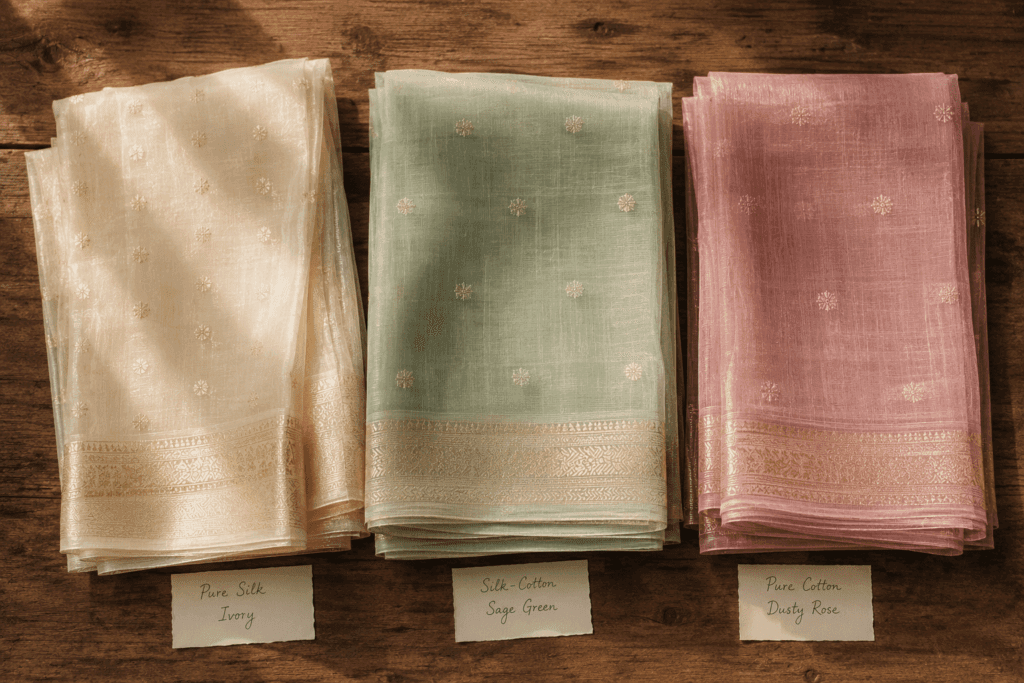
Chanderi is not one fabric. It is a family of fabrics, all sharing the same foundational characteristic — sheer, semi-transparent, luminous cloth that drapes like a sigh. The variation comes from fibre composition.
Pure Chanderi Silk
Both warp and weft are fine pure silk. This is the rarest and most expensive form, with a depth of luster no other variety quite matches. A starting-quality pure silk Chanderi from a verified source will cost upward of ₹8,000–₹12,000.
Chanderi Silk-Cotton (The Classic)
The warp is silk, the weft is fine cotton. This is the most beloved and widely produced variety — a combination of silk’s sheen and cotton’s breathability. Most classic Chanderi sarees available in the market are this type. Price range: ₹2,500–₹7,000 for genuine handloom.
Pure Cotton Chanderi
Both warp and weft are fine cotton. More matte than the silk version, equally sheer, and significantly more accessible in price. Excellent for daily wear, summer months, and buyers who want handloom aesthetics without silk pricing. Price range: ₹1,200–₹3,500.
Zari-Worked Chanderi
Any of the above, with real zari — silver or gold wire, sometimes wrapped in silk — woven into the border, pallu, or as scattered butis. Real zari has weight, warmth, and depth of colour. Imitation zari is lighter, more uniform in shine, and will dull and sometimes tarnish over time.
Read this also: Handloom vs Powerloom Saree — How to Tell the Difference Before You Buy
Signature Chanderi Motifs — Learning to Read the Weave
Chanderi has a visual language of its own. Understanding its motifs helps you evaluate what you are buying and appreciate the weaver’s skill.
Dandidar — Stalk or stem-shaped linear motifs, often running along the length of the border.
Ashrafi Butti — Coin-shaped small motifs scattered across the body. One of the most classic and recognisable Chanderi patterns.
Jhalar — A fringe-like border pattern giving the edge a delicate, ornamental finish.
Chanderi Butti — The iconic small woven flowers scattered across the body. Simple, elegant, endlessly varied.
Chatai Weave (Geometric Checks) — A woven grid pattern, more graphic and contemporary-looking, popular with younger buyers.
Peacock and lotus motifs appear frequently on pallus. Contemporary weavers increasingly incorporate modern patterns while maintaining traditional technique and thread quality.
What to look at: The border is where a weaver’s skill is most visible. On genuine Chanderi, the border will be distinct, firm, and clearly defined — not bleed-edged, irregular, or attached as a separate fabric strip.
Why Chanderi Drapes the Way It Does
The answer is thread count and tension. Chanderi weavers use exceptionally fine yarns and maintain precise warp tension throughout weaving. The result is a fabric with body but without weight — it moves in a breeze, pleats without bunching, and returns to form easily.
This also makes Chanderi one of the most forgiving fabrics to drape, even for those new to sarees. A 5.5-metre Chanderi will feel lighter to carry all day than most synthetic georgettes — while looking far more luxurious.
Read this also: The Complete Banarasi Saree Guide — Weave Types, Price Tiers & How to Identify Authentic
How to Buy Chanderi — The Intelligent Buyer’s Guide
Chanderi has a serious counterfeiting problem. Machine-made imitations — produced largely in Surat and sold across India — are routinely labelled as Chanderi with no qualification. Here is how to protect yourself.
The Three Authentication Tests
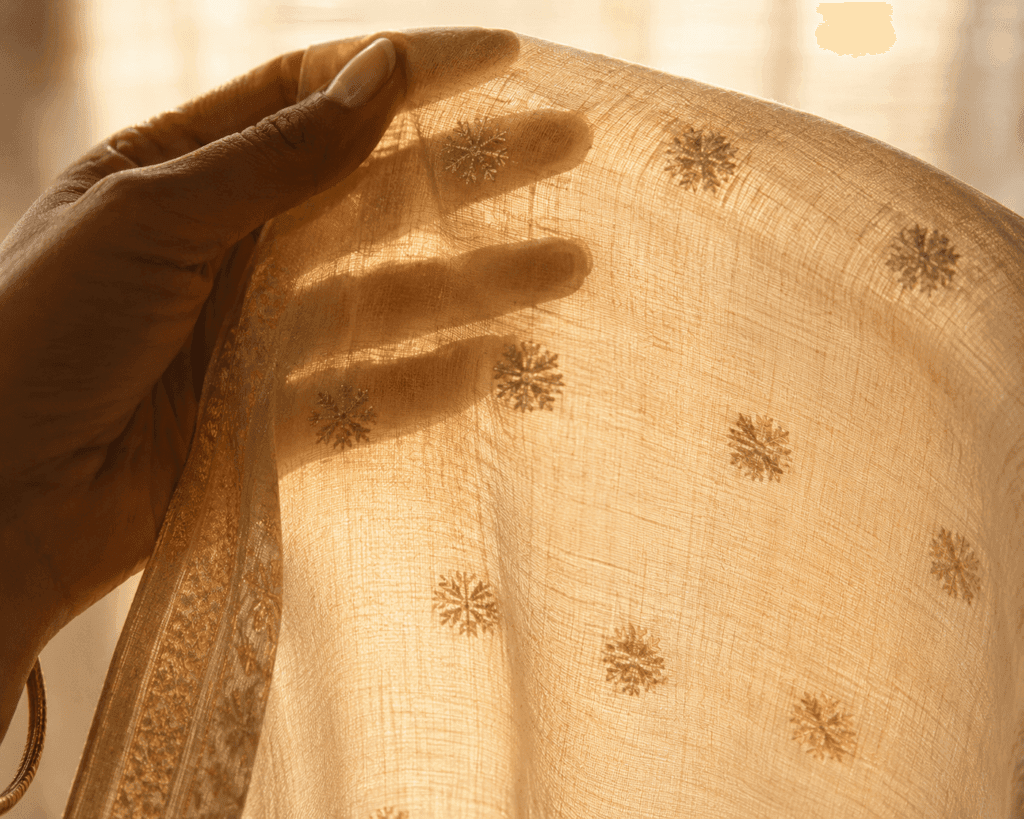
The Light Test Hold the saree up to natural light. Genuine Chanderi will be semi-transparent with a soft, even luminosity from within. Machine-made imitations tend to be either too opaque or carry an artificial, plastic-like sheen.
The Touch Test Chanderi should feel cool, slightly crisp, and fluid — like holding a large piece of fine breathing paper. If the fabric feels heavy, sticky, unnaturally smooth, or limp without structure, it is likely not handwoven Chanderi.
The Weave Test Examine the motifs under good light or a torch. Handwoven patterns show slight, natural irregularity — the mark of human hands. Machine-made patterns will be perfectly uniform, slightly flat in texture, and identical across the repeat.
What to Check Before You Buy
Ask for the fibre composition specifically. “Is this silk-cotton, pure silk, or cotton Chanderi?” A confident seller will answer immediately. Vague answers are a warning sign.
Look for the Handloom Mark or India Handloom Brand tag. These government certifications confirm the fabric was genuinely handwoven. Their absence doesn’t disqualify a saree — many authentic weavers sell without them — but their presence is meaningful assurance.
Examine the pallu. On genuine Chanderi, the pallu weave is denser and richer than the body. It should feel perceptibly heavier in hand than the main drape.
Check the zari closely. Real zari catches light warmly and softly. Imitation zari appears bright and uniform. Rub a small section between two fingers — real zari has a faint roughness and may leave a trace of metallic residue.
Ask about washing instructions. Genuine Chanderi requires gentle hand washing or dry cleaning. A seller who tells you it is machine-safe at high temperatures is either misinformed or misleading you.
Price-check against reality. Genuine silk-cotton Chanderi starts around ₹2,500. Pure silk varieties begin at ₹8,000 and above. If pricing is dramatically below this, ask why.
Where to Buy Authentic Chanderi
Directly in Chanderi Town — Widest range, lowest prices, ability to meet weavers. The weaver cooperative outlets and weekly market are the best starting points.
Government Emporiums (Mrignayani, MP State) — Certified handloom, fixed pricing, consistent quality. Ideal for first-time buyers or gift purchases.
Curated Handloom Platforms — Jaypore, The Loom Story, and Ekaya carry verified Chanderi with weaver attribution and editorial curation.
Instagram Weaver Collectives — Many Chanderi weavers now sell directly via Instagram. Look for loom videos, consistent posting history, and customer reviews before purchasing.
Handloom Fairs and Melas — Dilli Haat, Crafts Museum sales, and state-level handloom fairs regularly feature Chanderi, often with weaver-staffed stalls.
Caring for Your Chanderi Saree
- Pure silk Chanderi: Dry clean wherever possible.
- Silk-cotton and cotton Chanderi: Gentle hand wash in cold water with a mild detergent. Test a small corner first.
- Drying: Never wring. Roll in a clean cotton towel, press gently, then dry flat or on a smooth hanger away from direct sun.
- Storage: Wrap in soft cotton muslin, not plastic. Fold with acid-free tissue inside fold lines to protect zari borders from crease damage.
FAQs
Chanderi is a sheer, lightweight fabric known for its transparency and airiness, from Madhya Pradesh. Banarasi is a heavier, structured silk saree from Varanasi, known for elaborate brocade with dense zari. They are entirely different traditions, weights, and occasions.
Yes — particularly cotton Chanderi and silk-cotton Chanderi. Both are lightweight, comfortable, and easy to drape. Pure silk Chanderi with heavy zari borders is better suited to festive or formal occasions.
The burn test is most reliable: pull a few threads from an inconspicuous seam and burn them. Pure silk smells like burning hair, leaves a crushable black ash, and stops burning when the flame is removed. Synthetic fibres smell of plastic and leave a hard bead.
Not always, but frequently. Cotton Chanderi can be genuinely affordable. However, a saree priced at ₹500–₹800 and marketed as “pure silk Chanderi” is almost certainly machine-made and mislabelled. Use the authentication tests above before purchasing.
Cotton versions suit office wear, casual outings, and daywear. Silk-cotton works for weddings (as a guest), festivals, and evenings. Heavily zari-worked pure silk Chanderi is appropriate for formal ceremonies, receptions, and gifting.
Yes. Chanderi is accessible from Gwalior (approximately 3 hours), Jhansi (2.5 hours), or Bhopal (around 4 hours). The weaver cooperative outlets near the town centre are the best starting point for visitors.
A GI tag legally identifies a product as originating from a specific region using traditional methods. Chanderi received its GI tag in 2005. However, GI tags are difficult to enforce at retail level — the buyer’s tests in this guide are your more practical tool.