


Key Takeaways
- The heavy bridal Banarasi now has a lightweight sibling — georgette, organza, kora, and tissue weaves (350–650g) built to be worn every day, not once a year.
- Three modern drapes do the work: a katan-and-blazer power drape with a belt, an organza or georgette cocktail drape with a corset, and an everyday throw over a white shirt with sneakers.
- For a first modern buy, start with a Banarasi Khaddi georgette or kora organza in a pastel, roughly ₹15,000–₹25,000.
- Lightweight Banarasis are still real Banarasis — same looms, same zari, same motifs, only a lighter ground.
- Before buying, check three things: the GI tag and Silk Mark, the reverse weave (Kadwa vs cutwork), and the zari grade. A “pure silk Banarasi” under a few thousand rupees is powerloom.
I write this from Varanasi, a ten-minute walk from the pit looms of Madanpura, where I have watched the same karigar weave a bridal katan one month and a featherweight kora organza the next. The saree hasn’t changed its address. Its owner has changed her plans.
Why the Banarasi sat in the almirah for so long
For most of its life, the classic Banarasi was built for occasion. A full bridal katan silk — pure mulberry, two twisted filaments in both warp and weft — weighs between 800 grams and well over a kilogram once the zari brocade is dense enough. That weight is the point at a wedding. It falls like architecture, holds a pleat like a wall, and photographs like a painting. It is also, on a Tuesday, a lot of saree to carry to dinner.
So the six yards waited. They came out for the shaadi, the reception, the Diwali pooja, and went back into muslin for another year. An entire vocabulary of craft — Kadwa motifs, Jangla jaals, Shikargah hunting scenes — was rationed to a handful of days a year. What has shifted with this generation is not respect for the weave. It is the refusal to ration it.
The new lightweight Banarasi (and why it changes everything)
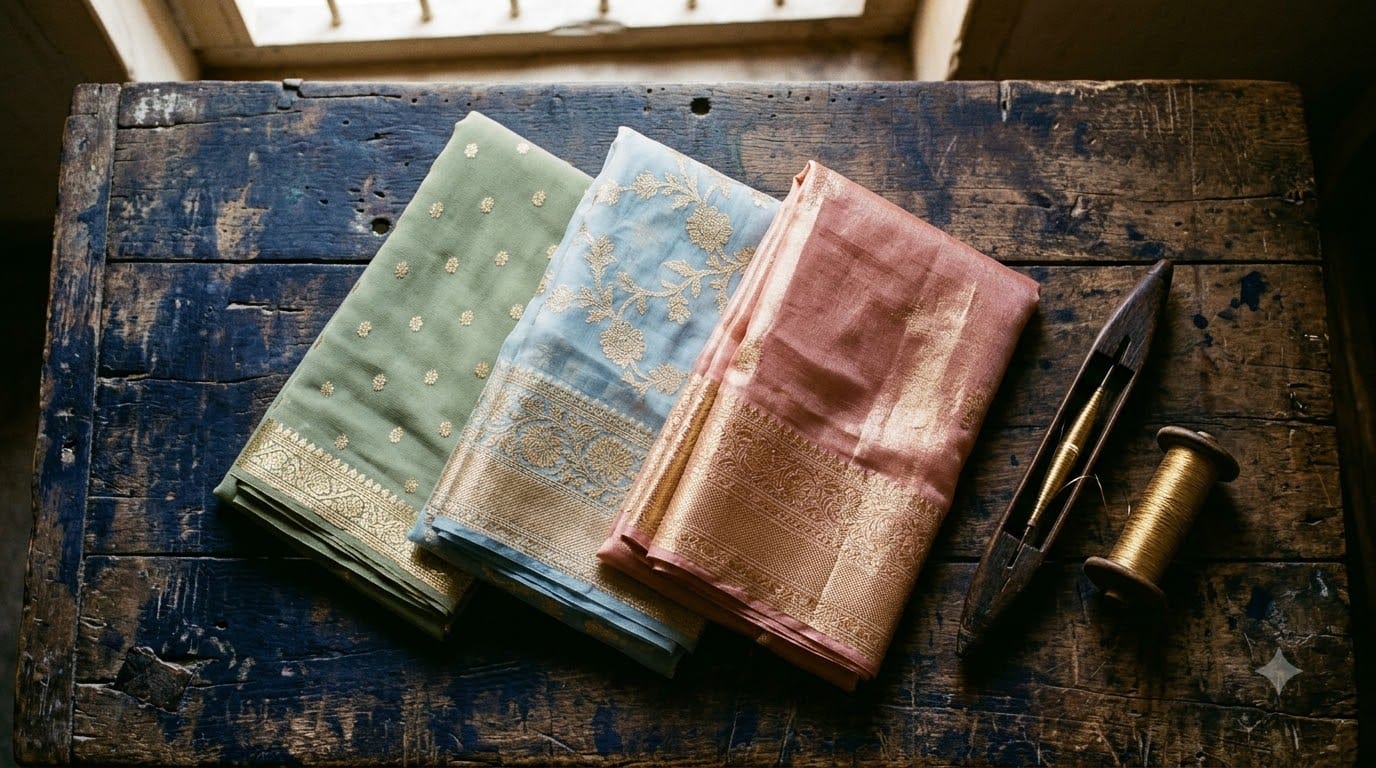
The unlock is the loom, not the styling. Over the last few years Banaras weavers have leaned hard into lighter grounds, and that single change is what lets a Banarasi leave the wedding. Four weaves are driving it:
| Weave | Weight | Drape | Price (handloom) | Best for |
|---|---|---|---|---|
| Khaddi georgette | 450–650g | Ultra-fluid, cascades | ₹14,000–₹40,000 | Sangeet, cocktails, fusion pant drapes |
| Kora organza | 350–550g | Sheer, crisp, sculptural | ₹12,000–₹45,000 | Daytime, brunches, summer weddings |
| Tissue silk | 400–650g | Molten metallic sheen | ₹17,000–₹55,000+ | Evening receptions, metallic monochrome |
| Katan silk | 700–1,100g | Structured, regal | ₹18,000–₹85,000+ | Traditional weddings, the blazer power drape |
Same city, same karigars, same zari — a much lighter hand. When people ask me how to style a Banarasi saree for everyday, my first question back is always: which weave do you own? A 1.1-kilo bridal brocade and a 450-gram georgette want completely different lives.
For the full breakdown of grounds, zari grades, and Kadwa versus cutwork, our Banarasi Sarees Complete Guide is the deeper read, and the Indian Textile Glossary decodes any term below you haven’t met before.
How to style a Banarasi saree: three modern drapes
If you are new to draping at all, start with our complete step-by-step saree draping guide, then layer these modern moves on top.
1. The Power Drape — Banarasi + tailored blazer + belt
Architectural, structured, and quietly commanding. This is the one for a convocation, a work festive evening, or a reception where you want to read as the sharpest person in the room. Best on katan, tussar, or structured tissue silk — you want a ground with enough body to hold against a jacket.
- Put on your event shoes and high-waisted seamless shapewear first — always before you tuck, so the hem floats half a centimetre off the floor.
- Tuck the top edge at the right navel and make one smooth rotation, keeping the hem even.
- Bring the fabric around and over your left shoulder to measure the pallu to mid-calf.
- Pleat the pallu into four or five crisp four-inch pleats and pin them to the shoulder seam with a concealed pin.
- Make five to seven clean front pleats, five inches wide, and tuck them firmly below the navel.
- Layer a structured blazer — cropped or slightly oversized — over your inner top.
- Either tuck the pleated pallu under the left lapel so only the brocade border runs down the jacket, or drape it over the blazer’s left shoulder for an asymmetric brocade statement.
- Cinch a metallic plate belt or a leather corset belt at the natural waist over everything. The belt is what locks the drape and gives you the sculpted line.
2. The Cocktail Drape — organza/georgette + corset or bralette
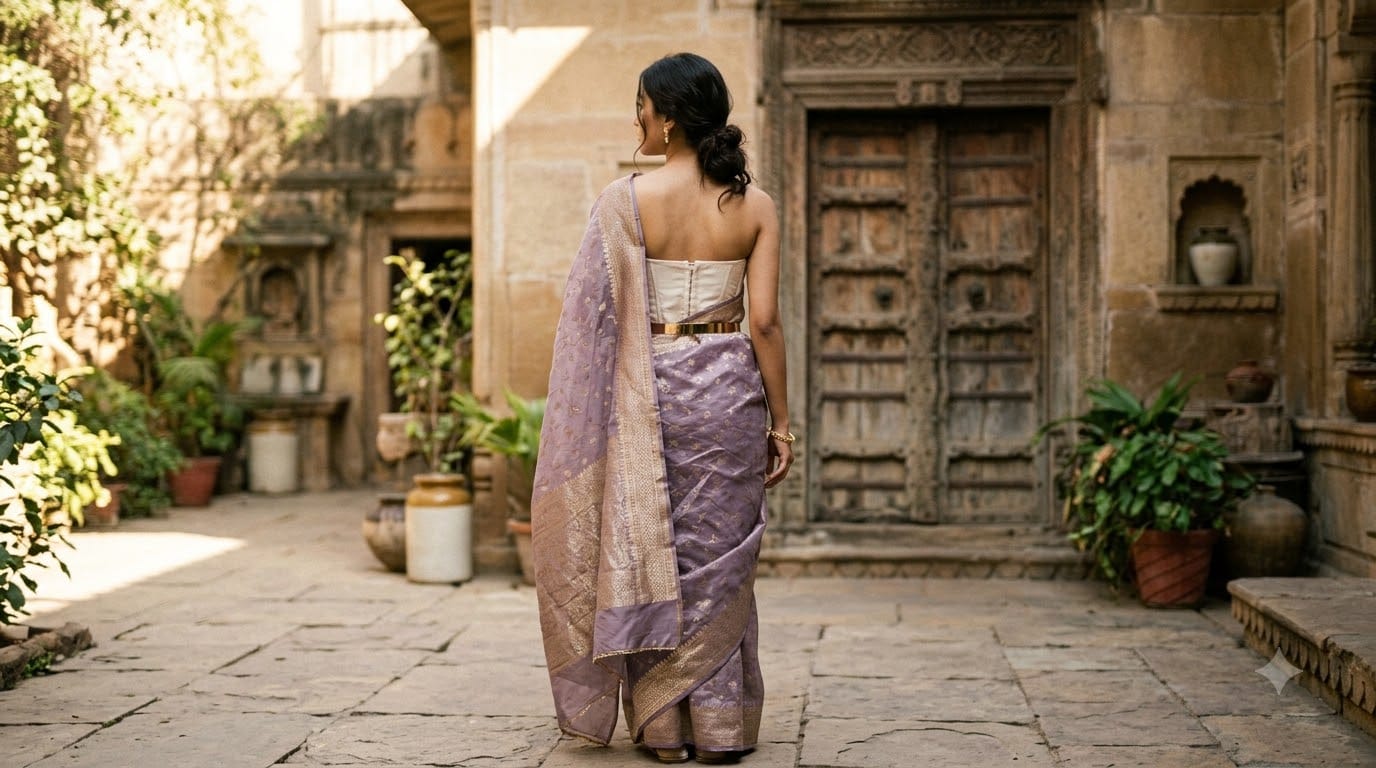
Weightless, romantic, and built to move on a dance floor. Best on Khaddi georgette, kora organza, or light tissue.
- Start with a boned satin corset, a brocade bralette, or a sweetheart crop top over a mermaid-cut satin shapewear skirt.
- Make the first full rotation tuck, keeping the fabric taut over the hips.
- Take the top border from the right, pull it diagonally and snugly across the hip to the left waist, and pin — this gives you fitted, body-skimming lines instead of bulk.
- Fold four or five slightly wider pleats and let the georgette or organza fall softly rather than pressing them stiff.
- Fan the pallu into an asymmetric pleat, pin the border taut to the back of the left shoulder, and let the sheer fabric float down your back. On a dance floor, loop the trailing edge once around your left wrist like a cuff.
3. The Everyday Throw — Banarasi + white shirt + sneakers
The lowest-effort, highest-frequency look, and the reason this whole shift is real. A light organza or georgette draped in a simple Nivi over a crisp white button-down, clean sneakers, oxidised silver studs, and a micro-bag. This is Banaras silk at a Sunday brunch, and it is exactly where a first-time buyer should start experimenting. If you’re building an office-appropriate version, our guide on how to wear a saree to the office carries the same logic into a workday.
What Gen Z is actually buying
This generation treats a real handloom as an heirloom investment, not fast fashion — a natural fibre they’ll keep for a decade rather than a poly-georgette they’ll bin in a season. That instinct shows in where they shop. The Established has documented how quickly younger buyers have taken to the saree’s versatility, discovering most of it through two-minute draping reels and GRWM videos rather than storefronts.
The brands they gravitate to tell you what they want. Raw Mango sells minimalist zari and pop colour to the buyer who wants restraint. Ekaya Banaras makes silk pantsuits and kaftans directly from handloom for the buyer who wants the weave without the drape. Tilfi and Sacred Weaves ship pure Varanasi handloom worldwide — Sacred Weaves even runs one-to-one live HD video shopping over WhatsApp so a buyer in London can inspect the reverse weave in real time before paying. Prices across this modern tier run from around ₹12,000 for a certified entry piece to ₹85,000 and well beyond for a masterpiece.
Before you buy: three quick authenticity checks
You don’t need to be an expert. You need three habits.
- Look for the GI tag and Silk Mark. ‘Banaras Brocades and Sarees’ has held a Geographical Indication since September 2009, and the Silk Mark Organisation of India, under the Central Silk Board, certifies 100% pure natural silk.
- Turn the saree over. On a Kadwa (kadhua) handloom, each motif is woven individually with its own extra-weft spool, so the reverse is smooth with zero floating threads. On cutwork (fekwa), the weft floats across the loom and is trimmed by hand, leaving soft clipped ends. Both are handloom; Kadwa is the more painstaking and more expensive.
- Ask about the zari. Real zari is silver wire, gold-plated, wrapped on a silk core — soft, warm lustre. Plastic imitation zari has a harsh shine and melts into a hard bead near a flame. Here is how to tell real zari from fake.
Frequently asked questions
Yes — and increasingly that is the norm. A lightweight Banarasi in Khaddi georgette or kora organza, draped simply over a shirt or corset with sneakers or flats, is entirely at home at a brunch, a dinner, or the office. Save the heavy bridal katan for the big occasions and let the lighter weaves do everyday duty.
Start with a Banarasi Khaddi georgette or a kora organza in a modern pastel, in the ₹15,000–₹25,000 range. Both are lightweight, forgiving to drape, and versatile enough to move from a day event to an evening one — far easier to live with than a heavy brocade for a first saree.
Choose a fluid georgette or organza, pair it with a boned corset or a structured bralette instead of a traditional blouse, and drape an asymmetric floating pallu pinned at the back of the shoulder. Finish with oxidised silver or a single statement piece and heels — light enough to dance in, sharp enough to photograph.
Check three things: a GI tag and Silk Mark certification, a smooth reverse with no long floating threads (kadhua, each motif woven separately) or neatly clipped ends (cutwork), and a seller who can name the zari grade. Be sceptical of any “pure silk Banarasi” priced under a few thousand rupees — genuine handloom cannot be made that cheaply.
Yes. Weavers in Varanasi produce organza, georgette, kora, and tissue Banarasis on the same looms, with the same zari and motifs, simply on a lighter ground. The weave technique and craft are identical — only the weight and drape change. Just confirm it is handloom, not a powerloom imitation.
Air it indoors for four to six hours away from direct sunlight, then store it in an unbleached muslin or cotton bag so the silk can breathe. Never seal it in plastic — trapped moisture tarnishes the zari. Refold along different lines every few months to prevent permanent creases.
Want the weave decoded before you buy? Join The Nakshapatta Edit — one textile fact, one styling tip, and one honest recommendation, straight from Banaras, every week.
Editorial independence: Nakshapatta does not accept payment for recommendations. Prices are indicative 2026 loom-side ranges and vary by weaver, zari grade, and technique.