



What you will know after reading this
- Genuine handloom sarees online fall into four seller categories: weaver-direct marketplaces, single-weave specialists, government emporiums, and curated multi-weave stores.
- Real prices by weave: handloom cotton ₹2,000–₹8,000, Banarasi silk ₹8,000–₹60,000+, Kanjivaram ₹15,000–₹1,00,000+.
- No seller on this list paid for placement — picks are based on public reputation and verifiable sourcing.
- Always run the pure silk test and handloom-vs-powerloom checks before buying, regardless of seller.
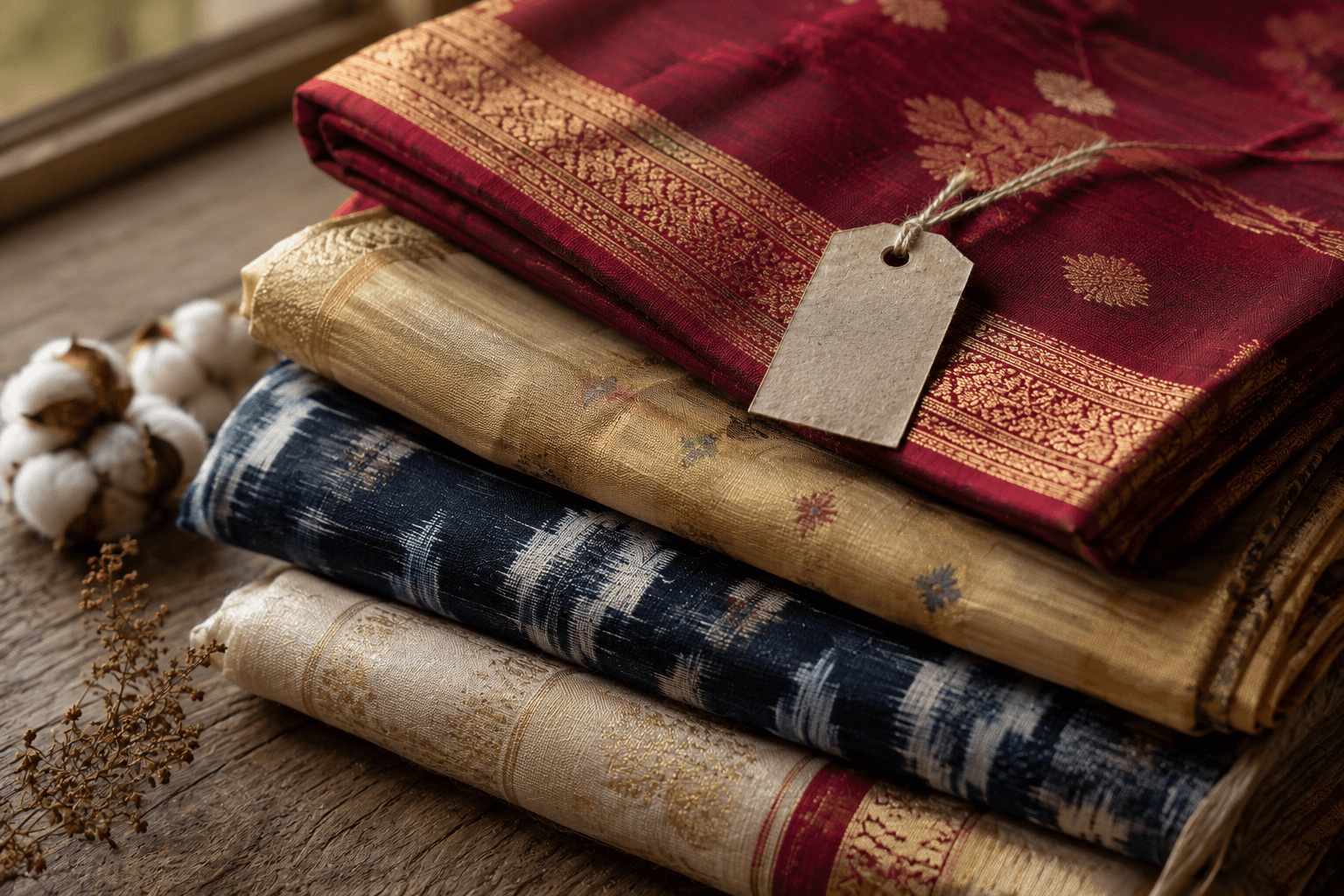
Every “handloom saree” search returns the same wall of listings, and most of them are lying to you. Somewhere between the powerloom factories and the drop-shipping sites, the word “handloom” stopped meaning anything. So we did what we’d do for a friend visiting Varanasi: we went looking for the sellers who actually earn the word.
In short: the most reliable places to buy genuine handloom sarees online in India fall into four categories — weaver-direct marketplaces, single-weave specialists, government-certified emporiums, and curated multi-weave stores. We’ve picked one to three names in each, with what they’re actually good for and what to expect to pay.
How we chose these
Nakshapatta does not accept payment for placement on this list — no seller here paid to be included, and none of the links below are paid affiliate links today. We picked names based on public reputation, verifiable weaver-sourcing claims, and (where available) Silk Mark or Handloom Mark certification. Treat this as a starting shortlist, not a guarantee — always run your own checks using our pure silk test and handloom vs powerloom guide before you buy, regardless of where you shop.
Weaver-direct marketplaces
These platforms connect you to weaver cooperatives and individual artisans directly, cutting out several layers of markup — though delivery timelines can run longer than a standard e-commerce checkout.
GoSwadeshi (by GoCoop)
A curated marketplace sourcing directly from weaver cooperatives across more than 55 clusters in India, including Maheshwari, Chanderi, and regional ikat weaves. GoCoop has been operating as a “social marketplace” since 2011, connecting weavers directly to buyers rather than routing through wholesale middlemen.
Good for: Maheshwari, Chanderi, and regional weaves outside the big five. Expect to pay: roughly ₹3,000–₹15,000 depending on weave and silk content.
Single-weave specialists
If you know exactly which weave you want, a specialist who only sells that weave tends to know it better than a generalist marketplace.
Tilfi & Sacred Weaves — for Banarasi
Varanasi-based houses working directly with master weavers in the city’s own lanes, offering katan silk, cotton, tussar, organza, and georgette Banarasi weaves. Their sarees run from roughly ₹10,000–₹20,000 for everyday pure-silk pieces up to ₹40,000–₹60,000+ for wedding-grade jangla and jamawar work. Read our full Banarasi saree guide before you shop this tier — at these prices, knowing what you’re looking at matters.
Nalli and Angadi Silks — for Kanjivaram
Nalli is one of the most established names in Kanjivaram retail, now shipping nationally and internationally with a large online catalogue. Genuine handloom Kanjivaram from either house typically starts around ₹15,000–₹20,000 and climbs well past ₹1,00,000 for bridal pieces with heavy gold-and-silver zari. Anything claiming to be “Kanjivaram silk” under ₹8,000 is very likely a silk-blend or powerloom piece woven in the Kanjivaram style, not the real weave — see our Kanjivaram saree guide for how to tell the difference.
Government-certified emporiums
State handloom corporations sell directly on behalf of registered weaver cooperatives, and their pricing tends to reflect actual production cost rather than brand markup. The trade-off is a more basic shopping experience and slower shipping.
Co-optex (Tamil Nadu)
The Tamil Nadu Handloom Weavers’ Cooperative Society’s retail arm, selling verified cooperative-woven textiles including Kanjivaram silk, with outlets across Tamil Nadu and an online storefront.
Tantuja (West Bengal)
Operated by the West Bengal State Handloom Weavers’ Cooperative Society since 1954, Tantuja represents cooperative weavers working in Tant, Jamdani, Baluchari, and Kantha traditions, with listings also available through major marketplaces.
Good for: fair-priced, verifiably cooperative-woven pieces if you don’t mind a simpler buying experience. Expect to pay: often 20–40% less than an equivalent private-label piece, since you’re closer to the weaver’s own price.
Curated multi-weave stores
A handful of online stores curate handloom sarees across multiple weaving traditions in one catalogue — useful if you’re exploring rather than shopping for one specific weave.
iTokri and Huts and Looms
Both platforms position themselves around handloom sourcing across cotton and silk weaves, with catalogues spanning multiple regions rather than one weaving cluster. A third option, BharatSthali, advertises Silk Mark-certified sarees across several weaves at accessible price points — worth a look, though as with any multi-brand store, that certification is seller-reported per listing, so verify it on the specific product page rather than the homepage claim. As with any curated multi-brand store, verify individual listings against our authenticity checks rather than assuming the “handloom” label alone is sufficient — curation quality varies by listing, not just by platform.
Tribes India (TRIFED) — for tribal and craft-adjacent weaves
Tribes India is the government-run marketplace under the Ministry of Tribal Affairs, on-boarding tribal and rural producer groups directly — useful less for the big five weaves and more for regional handloom and hand-block-printed textiles, including Ajrakh-adjacent block prints, sold through their own portal and via Amazon and Flipkart storefronts. Coverage and stock consistency vary more than with a dedicated weave specialist, so treat it as a place to browse rather than a guaranteed source for a specific weave.
Five checks to run before you click buy
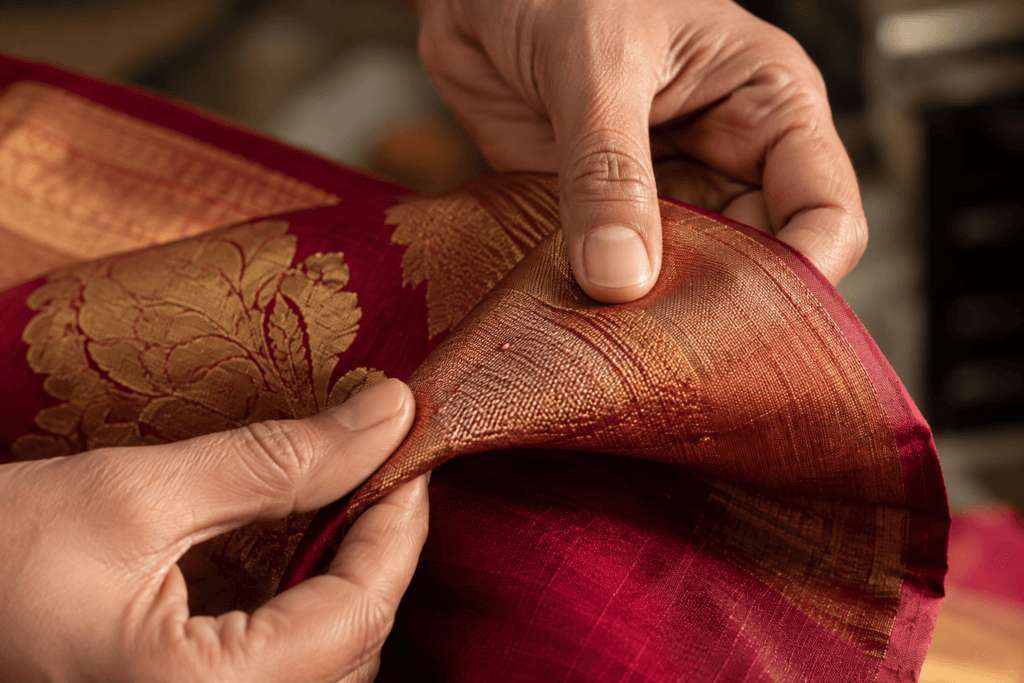
Whichever seller you choose, run these five checks on the actual listing — not just the seller’s About page — before you pay.
- Ask for a reverse-side photo. A handwoven piece, especially kadwa-technique Banarasi, shows neat, deliberate threadwork on the back. A printed or machine-woven imitation usually cannot produce a clean reverse-side photo on request.
Shipping, returns, and buying from outside India
Weaver-direct marketplaces and government emporiums generally take longer to ship than a mainstream fashion e-commerce site — seven to fourteen days domestically is normal, since many pieces are made or finished to order rather than pulled from mass inventory. International buyers should expect customs duties on top of the listed price; specialist houses like Tilfi / Sacred Weaves and larger retailers like Nalli have more experience handling international shipping and duties transparently than smaller cooperative stores, which is worth factoring in if you are ordering from outside India for a wedding deadline.
Return policies vary widely and are worth reading before, not after, you buy. A saree is a difficult item to return cheaply across state or international borders, so for anything above roughly ₹15,000, consider whether the seller offers a video call or detailed photo set before dispatch — several of the specialists above will do this on request, even if it is not advertised on the product page.
What a fair price actually looks like
Use this as a sanity check, not a rulebook — weave complexity, zari density, and silk quality all move the number within each range.
- Handloom cotton (Chanderi, Maheshwari, Kota Doria): ₹2,000–₹8,000
If a listing undercuts the low end of its category significantly, treat that as a signal to check more carefully — not necessarily a red flag on its own, but a reason to ask for close-up photos of the reverse side and request zari certification details before you buy.
None of this replaces knowing what you are looking at yourself. Bookmark our Indian Textile Glossary for the vocabulary, and read the specific weave guide — start at the Weave Guide index — before you spend serious money on any of the sellers above.
Frequently Asked Questions
Yes, provided the seller can show verifiable weaver sourcing, a Silk Mark or Handloom Mark where applicable, and clear photos of the reverse side of the fabric. Avoid sellers who cannot answer specific questions about the weave, silk content, or origin cluster.
Handloom cotton weaves like Chanderi, Maheshwari, and Kota Doria are the most accessible entry point, typically starting around ₹2,000–₹3,000 for a genuine handwoven piece, compared to ₹8,000 and up for silk weaves like Banarasi.
Price differences usually come down to silk purity (pure mulberry vs blended), zari type (tested zari vs imitation), weave density, and how many layers of markup sit between the weaver and the seller. Weaver-direct marketplaces and government emporiums tend to sit at the lower end of a fair range because they cut out wholesale middlemen.
No. As of this writing, none of the sellers listed here are paid placements or affiliate partners — they were chosen on public reputation and verifiable sourcing. If that changes in future, we will disclose it clearly on this page.