

A Banarasi saree is a silk saree woven on a handloom in Varanasi and its neighbouring districts of Uttar Pradesh, with brocade patterns in zari and silk. The name is protected by a Geographical Indication (GI) tag granted in 2009. Genuine handloom pieces start around ₹7,000 for plain katan and rise past ₹2,00,000 for tissue and shikargah work.
What you will know after reading this
- An authentic Banarasi saree must be handwoven in Varanasi, using silk warp threads, as defined by the GI tag.
- There are five types of Banarasi silk, each suitable for different occasions and budgets, including katan, georgette, and organza.
- Banarasi motifs carry historical significance and include types like kadwa and jangla, each with unique weaving techniques.
- When buying a Banarasi saree, be cautious of prices that seem too good to be true; genuine sarees typically cost more.
- Test for authenticity using touch, reverse inspection, and price comparisons to ensure you’re purchasing a real Banarasi saree.
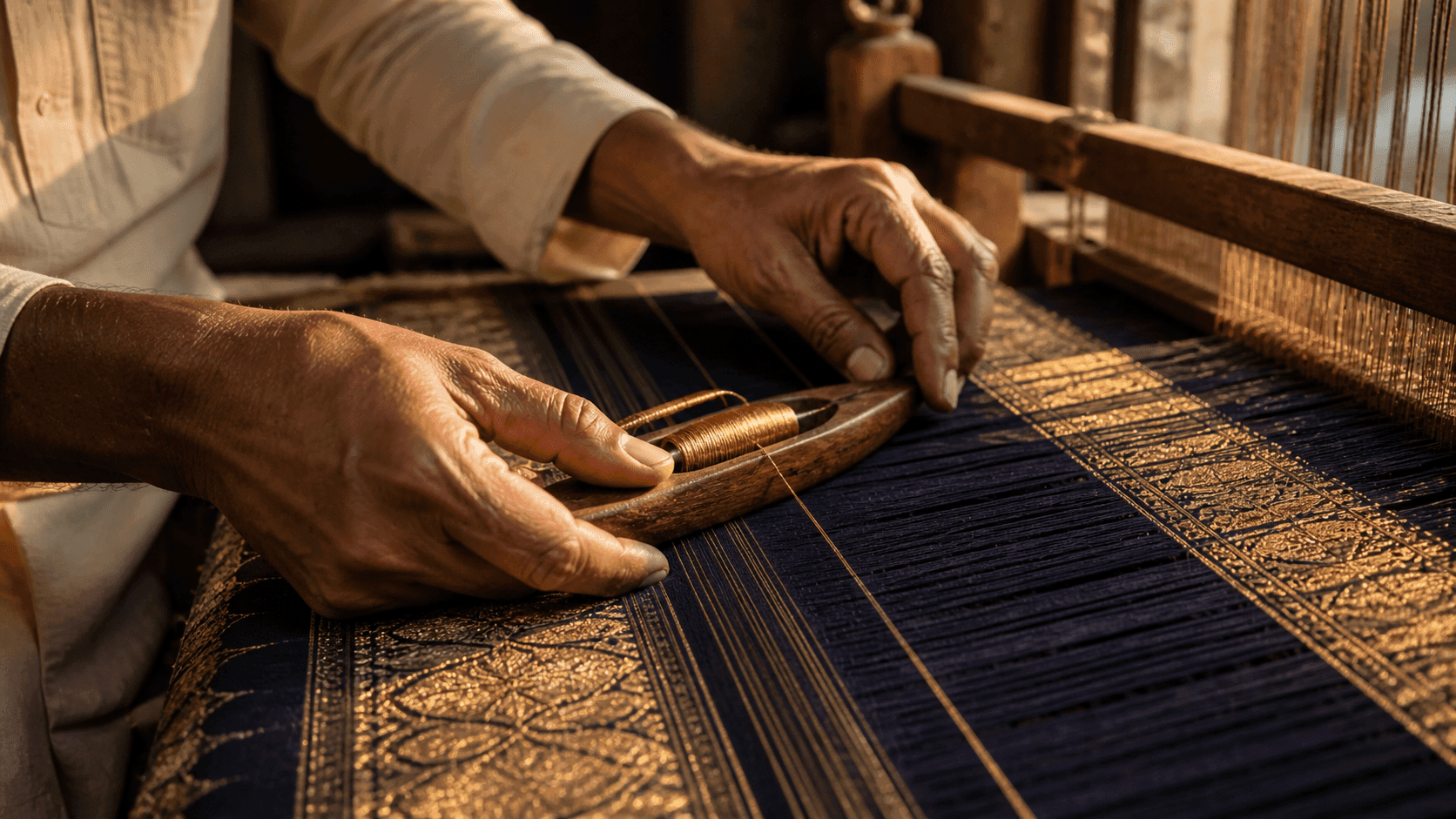
Walk through the lanes of Madanpura in Varanasi at six in the morning and you will hear the city before you see it. The rhythmic clack of the pit loom, the shuttle moving in one fluid arc across thousands of silk threads — this is the sound of a tradition that is over a thousand years old. The Banarasi saree is not a garment. It is a record of a civilization.
And yet today, most sarees sold online as “Banarasi silk” have never been near a Varanasi loom. This guide exists to give you everything a buyer in Madanpura already knows — so that wherever you are, whatever you’re spending, you can make a decision you’ll never regret.
What makes a Banarasi saree authentic?
An authentic Banarasi saree has three non-negotiable characteristics: it is handwoven (on a pit loom or jacquard handloom), in the Varanasi district of Uttar Pradesh, using silk warp threads. The Geographical Indication (GI) tag registered in 2009 protects this definition. Nothing else — not the motif, not the colour, not the zari percentage — determines authenticity. The loom, the location, and the silk do.
📍 GI Tag — Banarasi Sarees (2009)Banarasi sarees are among India’s first textiles to receive a Geographical Indication tag, meaning only sarees woven in Varanasi and its surrounding districts (Mirzapur, Chandauli, Bhadohi and Azamgarh) can legally carry this name. When buying online, look for this certification on the seller’s listing or ask directly.
What the Banarasi GI tag does, and what it does not
The GI tag protects the name “Banaras Brocades and Sarees” by place of origin: it tells you where a saree was made and by which traditional method. It does not grade quality, and on its own it does not prove that a particular piece is handloom or pure silk, because a powerloom saree woven inside the region can still fall within the GI. Read it alongside the Silk Mark (which speaks to the fibre) and the Handloom Mark (which speaks to the method). Our guide to Handloom Mark vs Silk Mark vs GI Tag shows how to verify each one.
Types of Banarasi sarees: the five silks and how to choose
Most buyers don’t realise that “Banarasi” is not a single fabric — it is a family of sarees woven in the same tradition but using different base fabrics. Choosing the right type for your occasion and budget is the first decision you need to make.
Katan silk — the queen of Banarasi
Katan is pure silk — both warp and weft are twisted silk threads. It is the heaviest, most lustrous, and most traditionally prized Banarasi fabric. A katan saree has a subtle natural sheen that photographic silk cannot replicate. It drapes with authority and improves with every wear. Best for: weddings, formal occasions, investment pieces. Price range: ₹7,000–₹80,000+ depending on weave complexity.
Georgette — lighter, wearable, modern
Banarasi georgette uses a crepe-twist silk that creates a slightly textured, matte surface. It is lighter than katan, falls in soft fluid pleats, and is far more wearable for everyday and semi-formal occasions. The zari work in Banarasi georgette is often as elaborate as in katan — but the base fabric makes it breathable and practical. Best for: office, daytime occasions, warm weather. Price range: ₹5,000–₹35,000.
Organza (Kora) — sheer, for brides
Kora uses a raw silk (barely twisted) that creates a stiff, sheer, almost translucent fabric. It is the most dramatic of the Banarasi types — it holds a drape rigidly, catches light from every angle, and shows embroidery and zari work at its most spectacular. Best for: brides, evening events, statement occasions. Price range: ₹12,000–₹1,00,000+.
Tissue — the gold-warp saree
Tissue Banarasi uses a metallic (zari) thread as the base warp, creating a fabric that is entirely gold or silver in ground colour with additional pattern weft. It is the most opulent of all Banarasi types — worn by brides and at the most formal of occasions. It is also the most difficult to authenticate since the gold warp makes the usual silk tests impossible. Trust the seller’s provenance here. Best for: bridal, very formal occasions. Price range: ₹13,000–₹2,00,000.
Tanchoi — flat weave, subtle luxury
Tanchoi is a flat-woven silk (no raised pattern, no floating threads) with a subtle self-design created by using multiple weft colours. It has a quiet, refined luxury that appeals to buyers who want quality without ostentation. Best for: professional settings, art collectors, those who prefer minimal aesthetics. Price range: ₹6,000–₹40,000.
Must read: Handloom vs Powerloom Saree — How to Tell the Difference Before You Buy
Understanding Banarasi motifs — what the patterns mean
Banarasi weave patterns (called buti when small, buta when large) are not decorative accidents. They come from centuries of Mughal court aesthetics filtered through Hindu temple architecture. The most significant motif families:
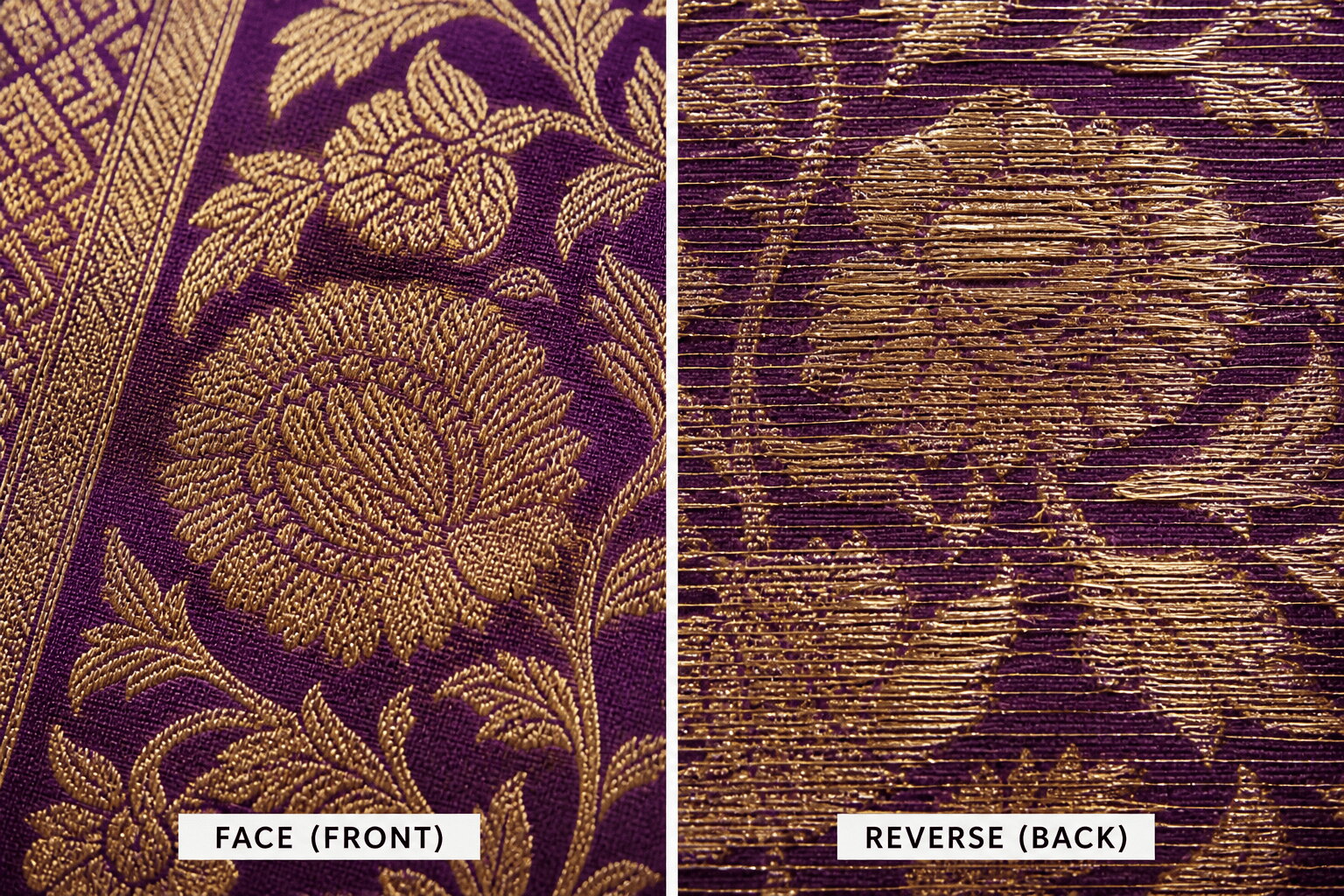
- Kadhua (kadwa) — each motif is woven separately by hand with its own small shuttle, so no long float runs across the back. The most labour-intensive Banarasi technique; the reverse looks clean and dense.
- Butidar — scattered small motifs across the ground. Floral, geometric, or figurative.
- Jangla — an allover dense pattern covering the entire field. The most complex and expensive Banarasi type.
- Shikargah — hunting scenes. A Mughal-origin pattern featuring animals, trees, and figures. Rare and collectible.
- Meenakari — coloured enamel-like inlay effect in the zari work. Multiple coloured threads create jewel-like detail.
Banarasi saree price guide — what you should expect to pay
The single most useful thing we can tell a Banarasi buyer: if the price seems too good to be true, it is. Here is what genuine Banarasi handloom costs in 2026, directly from weaver and wholesale sources in Varanasi. For every type, technique and zari grade in detail, see our Banarasi saree price guide.
- Plain katan, minimal zari border — ₹7,000 to ₹14,000
- Katan with elaborate zari border and pallav — ₹14,000 to ₹35,000
- Katan butidar (allover scattered motifs) — ₹18,000 to ₹50,000
- Jangla (dense allover pattern) — ₹35,000 to ₹90,000
- Tissue or shikargah — ₹25,000 to ₹2,00,000
⚠ The ₹3,000 red flagA “pure Banarasi handloom silk” saree priced under ₹3,000 is almost certainly not what it claims to be. The silk yarn alone for a 500–700 gram katan saree runs to several thousand rupees, before two to three weeks of a weaver’s skilled labour. Trust your arithmetic as much as your eye.
How to identify authentic Banarasi — the 5 tests
These tests work in any shop, at any fair, and — with detailed photography — when buying online. Do them in order. For checks that apply to any silk saree, see our five tests to identify pure silk.
- The touch test: Pure katan silk has a cool, substantial hand. Let it fall from your palm — it should drape with weight. Synthetic falls differently: too light, too slippery.
- The reverse inspection: Turn the saree over. A handloom Banarasi shows its working on the back: a clean, dense reverse where each motif was woven separately (kadhua), or floating threads and neatly clipped ends where the pattern was carried across or trimmed (fekwa and cutwork). A powerloom copy or screen-printed piece has a flat, uniform reverse.
- The zari rub test: Rub the zari border firmly against the inside of your wrist. Real zari (silver wire with gold coating) leaves no mark. Metallic-printed thread leaves a faint grey or green residue.
- The burn test: Pull a few threads from the inner border and burn them. Silk burns slowly, smells like singed hair, leaves crushable grey ash. Synthetic burns fast, smells chemical, leaves a hard black bead.
- The price test: Compare the price to the guide above. A suspiciously low price is itself a test result.
“The best Banarasi sarees I have ever seen were not in a shop. They were folded on a shelf in a weaver’s home in Madanpura, still smelling of the loom. That is where this guide is written from.”
Where Banarasi sarees are woven: Madanpura and the lanes around it
Inside Varanasi, weaving is concentrated in a handful of mohallas. The GI application names Madanpura as one of the two most important brocade-weaving areas, where the city’s weaving is believed to have begun. Madanpura, Lallapura and Peeli Kothi are the names buyers hear most, and in these lanes the weaver’s home is also the workshop: a pit loom sunk into the floor of the ground room, the weaver seated at floor level working the treadles, and the pattern mechanism rigged above. A katan saree with a zari border occupies one loom for two to three weeks; a dense jangla or kadhua brocade takes longer.
Buyers travel to these lanes for trust, not nostalgia. You can see the loom, the weaver and the saree on it, and ask what the yarn and the labour cost. If you cannot travel, the same logic applies online: ask to see the loom, the reverse side and the silk type named.
Where to buy authentic Banarasi sarees
In Varanasi: Weaver cooperatives in Madanpura, Lallapura, and Peeli Kothi are the most direct source. Look for UPICA (Uttar Pradesh Weavers Cooperative) outlets and the government-run Handloom House near Chowk.
Government emporiums: UP Handloom Corporation showrooms carry GI-certified pieces. The Cottage Industries Exposition (Cottage Emporium) in Delhi and Mumbai is a reliable national alternative.
Online: Look for sellers based in Varanasi (not just “ships from Varanasi”), detailed photography of the reverse side, and the specific silk type named. The Handloom Mark on the product page is a positive signal. For sellers that meet these checks, see our guide to the best handloom sarees online in India. Nakshapatta takes no payment for any recommendation; see our editorial standards.
Banarasi saree FAQs
A katan Banarasi saree is woven from pure silk threads, giving it a smooth texture and structured, rich drape ideal for weddings. A georgette Banarasi saree is lighter, made with tightly twisted yarns, and has a slightly crinkled texture that flows more easily. The choice depends on whether you prefer traditional weight or everyday comfort.
To identify a genuine Banarasi saree, check the weave on the reverse side for neat craftsmanship, feel the fabric for natural silk texture, and examine the zari for subtle sheen rather than harsh shine. Authentic pieces are handwoven and rarely inexpensive. A GI tag or trusted seller also strengthens confidence in authenticity.
Zari refers to the metallic thread used to create the intricate patterns on a Banarasi saree. Traditionally made from silver coated with gold, zari gives the saree its signature richness. Today, variations include tested zari and metallic blends, but in a well-crafted Banarasi saree, zari always adds depth and elegance rather than excessive shine.
The Banarasi saree GI tag, granted in 2009, is a Geographical Indication that certifies sarees made in specific regions around Varanasi. It protects the identity of the craft and ensures that only sarees woven in these traditional clusters can be called an authentic Banarasi saree, helping buyers distinguish genuine work from imitations.
The price of a real Banarasi saree varies widely depending on silk quality, weave complexity, and zari. Entry-level plain katan starts around ₹7,000, while finely woven katan or intricate designs can go beyond ₹1,00,000, and tissue or shikargah work can reach ₹2,00,000. If a Banarasi saree is priced unusually low, it is often machine-made or blended rather than handwoven.
Store your Banarasi saree in a breathable cotton or muslin cloth, away from moisture and direct sunlight. Refold it every few months to prevent creases and stress on zari. Avoid hanging for long periods. Dry cleaning is preferred over washing. With proper care, a Banarasi saree can retain its beauty for generations.
Banarasi sarees are woven in the weaving mohallas of Varanasi, including Madanpura (named in the GI application as one of the two most important brocade-weaving areas) and Lallapura, and across the surrounding GI districts of Mirzapur, Chandauli, Bhadohi and Azamgarh. A saree woven on a pit loom or jacquard handloom in this region is the traditional article, and the GI tag confirms the region of origin.
Sources
- Geographical Indications Registry, Government of India: Banaras Brocades and Sarees (registered 2009).
- Geographical Indications Journal No. 29 (19 March 2009), application no. 99, Banaras Brocades and Sarees: geographical area of production.
- Price ranges: Nakshapatta, from weaver and wholesale rates in Varanasi.
A Banarasi doesn’t have to stay in the almirah – here are modern ways to style a Banarasi saree, and you can explore the full weave guide for the handlooms that sit alongside it. Weighing a Banarasi against a South Indian silk? Read our Kanjivaram vs Banarasi comparison.