

Key Takeaways
- Ajrakh print is a 4,000-year-old textile tradition known for its geometric patterns and deep indigo color.
- The making of Ajrakh involves a complex 22-step process, taking 14–21 days to produce each piece.
- Authentic Ajrakh features patterns visible on both sides and has a distinct earthy smell from natural dyes.
- Kutch Ajrakh is more reliable for traceability, while Sindhi Ajrakh tends to be bolder and larger in scale.
- Ajrakh can be worn in various forms like sarees and dupattas, making it versatile for daily wear or special occasions.
A 4,000-year-old textile tradition, a 22-step process, and the most distinctive print in India — its origin, its making, and how to buy and wear it.
There is a city beneath the salt flats of Kutch — a 4,000-year-old settlement called Dholavira where excavators have found evidence of cotton textile production that predates most civilisations. The people of Kutch have been making cloth since before history was written down. Ajrakh is the living continuation of that tradition: a block-printed, natural-dyed textile made today in almost exactly the same way it was made five centuries ago.
What is Ajrakh?
Ajrakh is a resist-block-print textile produced by the Khatri community of artisans in Kutch district, Gujarat, and across the border in Sindh, Pakistan. The name comes from the Arabic azraq, meaning blue — a reference to the deep indigo that is the tradition’s signature colour. The fabric is cotton, printed with carved wooden blocks in an intricate geometric pattern on both sides simultaneously, a technique unique to Ajrakh and one that takes a lifetime to master.
For the full vocabulary of weaves, prints, and terms used across this guide, see the Indian Textile Glossary.
The making — a 22-step process
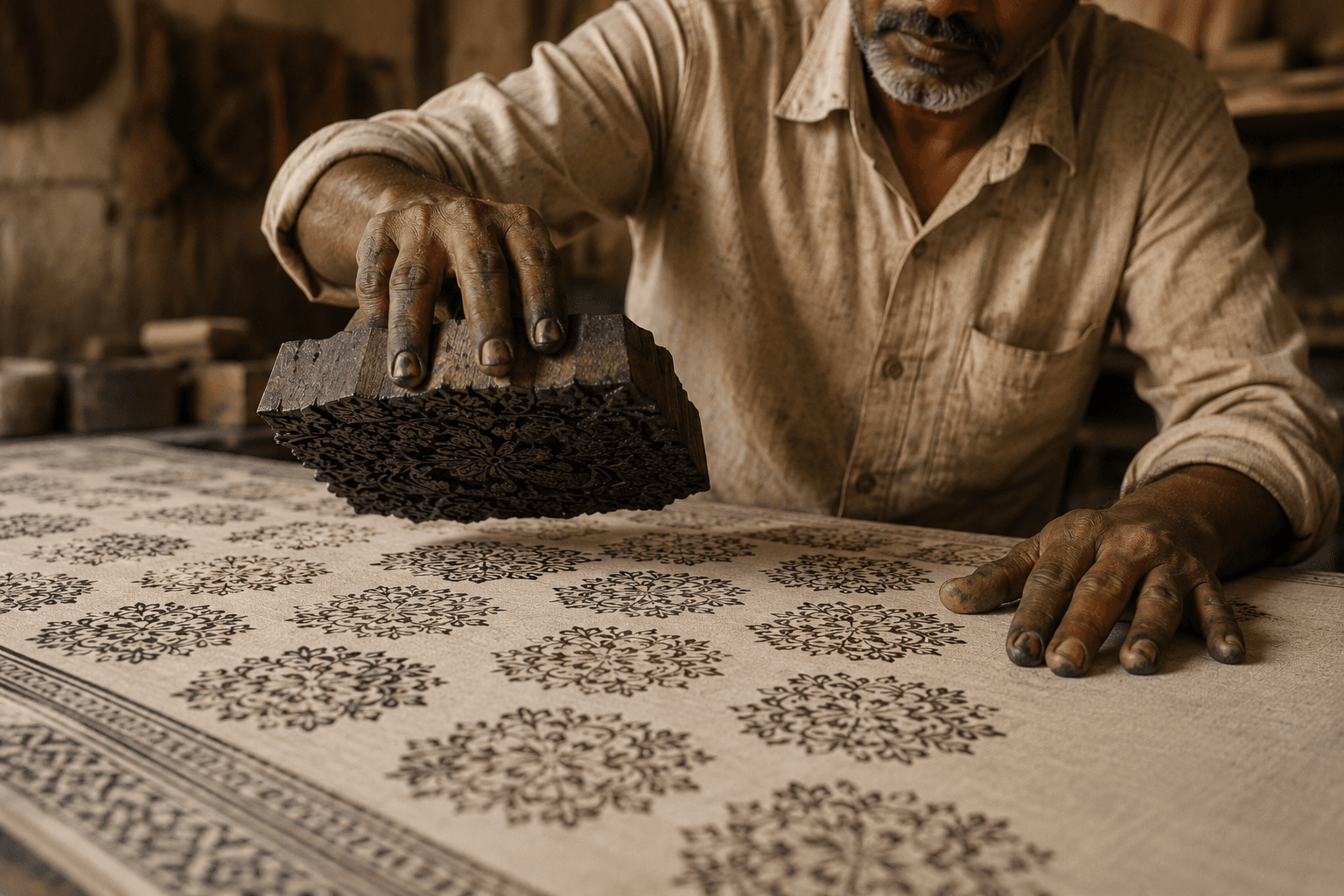
No other printed textile in India has a more complex production process than Ajrakh. The full traditional process takes 14–21 days and involves 22 distinct steps. The core sequence looks like this:
- Saaj — washing the cotton fabric to remove starch and impurities
- Hari mithi — soaking in a solution of camel dung and castor oil, a natural mordant preparation
- Resist printing (first pass) — printing with a resist paste, originally mud, to protect areas from dye
- Indigo dyeing — the deep blue ground colour applied in multiple dips
- Madder dyeing — red from the madder plant root, applied to create the second colour
- Final washing — river washing to remove the resist paste and reveal the pattern
The remaining sixteen steps are variations and repetitions of resist, dye, and wash, each building the complexity of the final pattern. A master Ajrakh artisan calibrates the resist paste viscosity, the indigo vat chemistry, and the block pressure by feel — knowledge developed over decades. This is why no two Ajrakh pieces are identical, even when printed from the same block.
“When you hold an Ajrakh piece to the light and see the pattern is identical front and back — that is 22 steps of craft, not one. That is the thing you are buying when you buy Ajrakh.”
The Ajrakh colour world
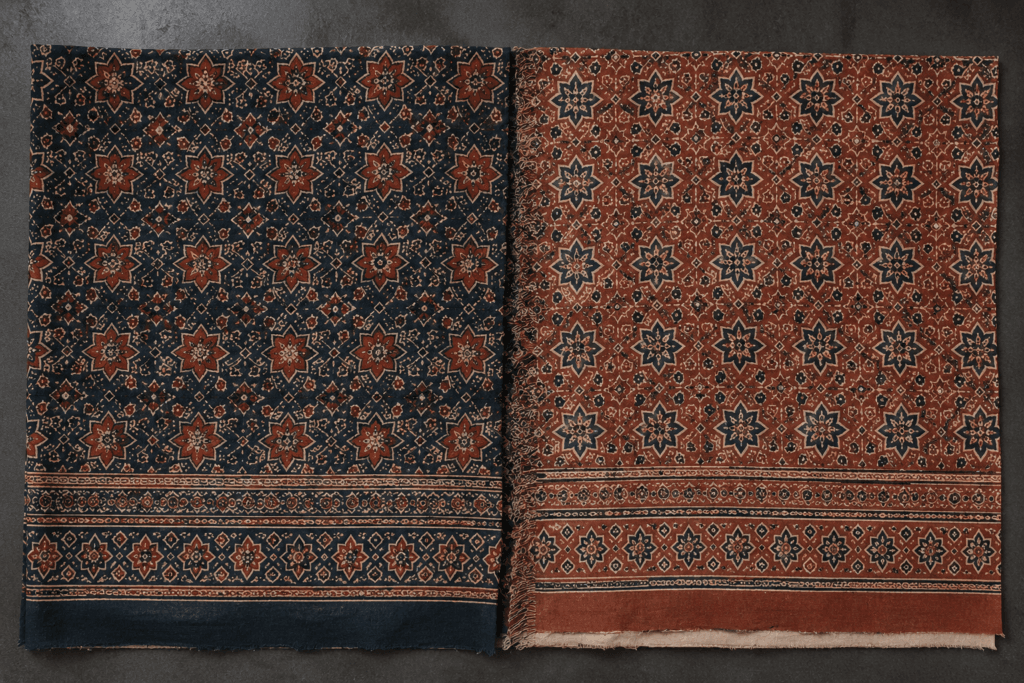
Traditional Ajrakh uses four colours: indigo blue, madder red, black (from iron-rich mud), and the natural cream of unbleached cotton. These four create the entire visual vocabulary of Ajrakh — geometric patterns of extraordinary complexity from the simplest possible palette. Contemporary Ajrakh artisans experiment with additional natural dyes, but the classic four-colour Ajrakh remains the most prized by collectors and the most historically accurate.
Ajrakh motifs — the geometric language of the desert
Ajrakh patterns are built from a vocabulary of interlocking geometric forms: stars, crosses, diamonds, and arabesque-influenced scrollwork. The surkh (red centre panel), the rekh (border), and the gero (field pattern) are the three structural zones of an Ajrakh piece. The motifs reference the night sky over Kutch — the geometric stars in Ajrakh are, by tradition, a representation of the constellation Orion, once used by desert nomads for navigation across the Rann.
Kutch vs Sindh Ajrakh — what’s the difference?
Ajrakh predates the 1947 Partition, and the craft continues on both sides of the border it created. Kutch Ajrakh, made by Khatri families in villages like Dhamadka and Ajrakhpur, tends toward finer, denser motif work and a slightly cooler indigo, reflecting Gujarat’s water and mineral profile. Sindhi Ajrakh, from Hala and Matiari in Pakistan, often runs bolder and larger in scale, with a warmer red. For a buyer, the practical difference is provenance and certification — Kutch Ajrakh sold in India will carry traceable sourcing from a known artisan cluster, while Sindhi Ajrakh is imported and harder to verify. If authenticity and traceability matter to you, buying from a named Kutch workshop is the more reliable path.
How to identify authentic Ajrakh
Three checks, in order of ease.
First, look at the reverse. Authentic double-sided Ajrakh has the same pattern on both sides — slightly less crisp on the reverse, but recognisably the same design. Screen-printed imitations have a blank or completely different reverse; they cannot fake this without the actual block-printing process.
Second, smell the fabric. Natural-dye Ajrakh has a faint earthy, mineral quality — not unpleasant, but distinctly organic, especially near the indigo areas. Chemical-dye imitations smell of nothing, or of synthetic dye.
Third, examine the print edges. Hand-block printing has slightly irregular edges — the block shifts fractionally with each placement, block to block. Machine-printed “Ajrakh-style” fabric is pixel-perfect and, by definition, not Ajrakh at all — it’s a print inspired by the tradition, not the tradition itself.
This same instinct — reverse side, smell, edge irregularity — is worth applying across handloom in general. See our full Handloom vs Powerloom buying guide for the equivalent tests on woven silk.
How to wear Ajrakh
Ajrakh’s versatility is part of what makes it enduring — the same block-print tradition appears across sarees, dupattas, stoles, kurtas, and increasingly, home textiles. As a saree, Ajrakh cotton drapes with body rather than fluidity, so it suits structured blouses and a classic Nivi drape better than experimental styles. Because the print carries its own visual weight, minimal jewellery — silver oxidised pieces or a single statement cuff — reads better than gold-heavy accessories, which compete with the geometry rather than complement it.
For everyday wear, an Ajrakh dupatta or stole over a plain kurta is the easiest entry point — it introduces the craft without asking a first-time buyer to commit to a full saree. Ajrakh also works well layered: a stole worn over a solid-colour outfit, or a jacket cut from Ajrakh fabric over Western separates, is an increasingly common way younger buyers are bringing the print into a fusion wardrobe.
Price guide and where to buy
Authentic hand-block Ajrakh commands a premium proportional to the labour behind it. A cotton Ajrakh dupatta from a recognised Kutch workshop typically starts around ₹1,500–₹3,000. A full Ajrakh cotton saree runs ₹4,000–₹12,000 depending on the density of the block work and the number of colour passes; pieces with finer, multi-block detailing or silk-cotton blends can run higher. Anything priced dramatically below these ranges and described as “hand-block Ajrakh” is very likely a digital or screen print.
The most direct — and most reliable — way to buy is from Kutch artisan collectives and Khatri family workshops, many of which now sell online with documented provenance, in villages like Ajrakhpur and Dhamadka. State-run emporiums and craft-focused marketplaces that name the specific artisan or workshop are the next most trustworthy option. As with any handloom or hand-block purchase, a seller willing to show you the reverse side in product photographs, and willing to name the village the piece was printed in, is signalling something genuine.
Explore the rest of India’s textile traditions in the Weave Guide Index.
FAQ
It comes from the Arabic azraq, meaning blue, referring to the deep indigo that anchors the tradition’s colour palette.
Hand-printed, not handwoven. The base cotton fabric is typically machine-woven; the craft and value lie entirely in the 22-step hand-block resist-dyeing process applied afterward.
Check the reverse side for a matching (if softer) pattern, smell the fabric for a faint natural-dye earthiness, and look for slightly irregular block edges rather than machine-perfect repeats.
Both are authentic continuations of the same pre-Partition tradition. Kutch Ajrakh is easier to verify and trace to a named Indian workshop, which is why it’s generally the safer choice for buyers prioritising provenance.
Hand-wash separately in cold water with a mild detergent, dry in shade rather than direct sun to protect the natural dyes, and avoid soaking for long periods, especially in the first few washes when a small amount of dye may still release.
Cotton Ajrakh in dupatta, stole, or kurta form is entirely suited to daily wear — it’s the saree and finer silk-cotton pieces that tend to be reserved for more considered occasions.