
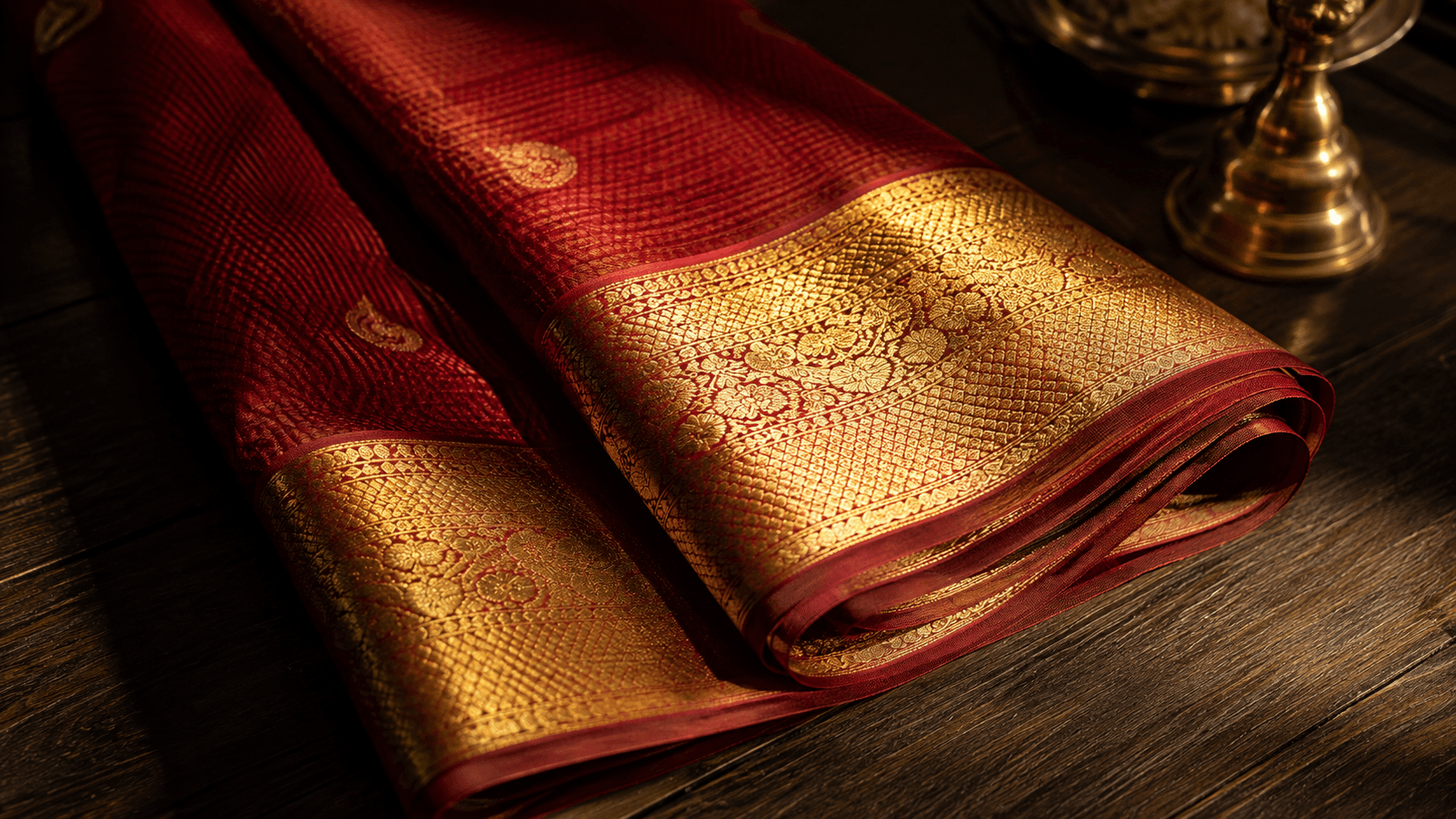
Yes. Kanjivaram and Kanchipuram saree refer to the same thing — a handwoven pure silk saree made in and around the temple town of Kanchipuram, Tamil Nadu. “Kanjivaram” is the anglicised, more commonly used name; “Kanchipuram silk saree” is the formal and GI-registered term. What makes it distinct from other Indian silk sarees isn’t the town alone — it’s the korvai weaving technique, the heavier mulberry silk, and the wide contrast zari borders that Kanchipuram weavers have perfected for over four centuries.
Key Takeaways
- Kanjivaram sarees, woven by hand in Kanchipuram, are known for their korvai technique and unique construction using thick mulberry silk.
- The sarees have distinctive motifs influenced by temple architecture, including the temple border and motifs like peacocks and rudraksha seeds.
- To identify an authentic Kanjivaram saree, check for the korvai join, the weight of the fabric, and perform the zari rub test.
- Kanjivaram sarees differ from Banarasi sarees in construction, with Kanjivaram focusing on contrast and durability, while Banarasi emphasizes dense gold patterns.
- Prices for genuine Kanjivaram sarees vary widely, with single-warp starting around ₹8,000 and bridal pieces exceeding ₹2,00,000.
In the fifteenth century, as the Vijayanagara empire fell, silk weaving families from Saurashtra in Gujarat migrated south and settled in Kanchipuram, a temple town outside modern Chennai already famous for its hundred-odd temples and its silk trade with the Chola and Pallava courts before it. What those weavers built there — fusing their weaving craft with the temple town’s existing silk economy — became the Kanjivaram saree: the heaviest, most structurally distinct silk tradition in India, and still, five centuries later, the default choice for a South Indian bride.
Kanjivaram is often mentioned in the same breath as Banarasi, but the two are built on almost opposite principles. This guide covers what makes Kanjivaram distinct, how it’s actually constructed, and how to tell a genuine piece from the powerloom copies that dominate online search results for the name.
What is a Kanjivaram saree?
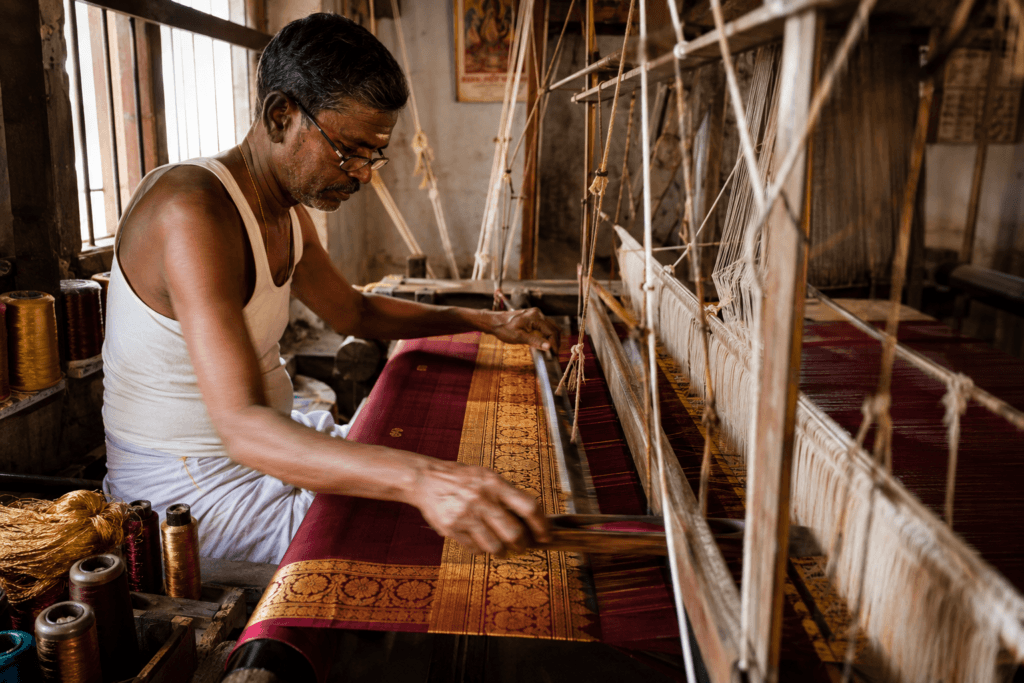
A Kanjivaram (also spelled Kanchipuram) saree is a handloom silk saree woven in and around Kanchipuram, Tamil Nadu, using thick mulberry silk and a distinctive construction technique called korvai, where the body and border are woven as two separate pieces of fabric, in two different colours, then interlocked together on the loom rather than stitched. Genuine Kanjivaram received its Geographical Indication tag in 2005, restricting the name to silk woven in Kanchipuram district by its traditional weaving community.
The silk of Kanchipuram — what makes it special
Kanjivaram uses a heavier-grade mulberry silk than Banarasi or Kanjivaram’s northern cousins, typically sourced from South India and Karnataka, twisted more tightly before weaving. This is why a Kanjivaram saree has real heft in the hand — a plain katan Banarasi can feel comparatively light by contrast. The zari used is traditionally pure silver wire electroplated with gold, sourced historically from Gujarat and increasingly today from within Tamil Nadu itself, and it’s woven far more densely into the border and pallav than in most other silk traditions. A well-made Kanjivaram saree, folded, has a distinct weight and stiffness you can feel through the wrapping paper before you even unfold it.
The three weaving types — single warp, double warp, and korvai
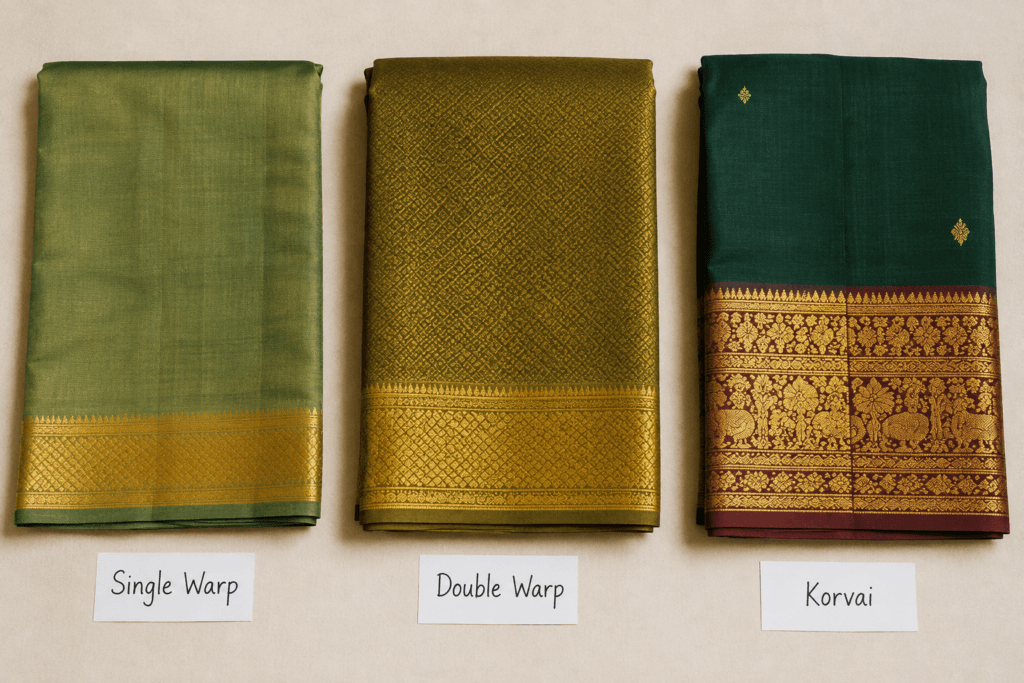
Single warp Kanjivaram uses one silk thread per warp position — lighter, more affordable, and more common in daily-wear or lower-budget pieces. Double warp uses two threads twisted together per warp position, producing a noticeably heavier, richer-draping fabric associated with higher-end pieces. Korvai is not a fabric weight but a joining technique, and it’s the one that actually defines a Kanjivaram as a Kanjivaram: the body of the saree is woven in one colour, the border in a contrasting colour on a separate set of shuttles, and the two are interlocked thread-by-thread at the loom during weaving — not stitched afterward. This is why an authentic Kanjivaram border, examined closely, shows a slightly zig-zagged join line where body meets border, and why the border resists fraying or separating even after decades of wear. A saree with a border that is simply a printed or embroidered strip attached to a plain body is not a korvai Kanjivaram, whatever the label says.
Kanjivaram motifs and their meanings
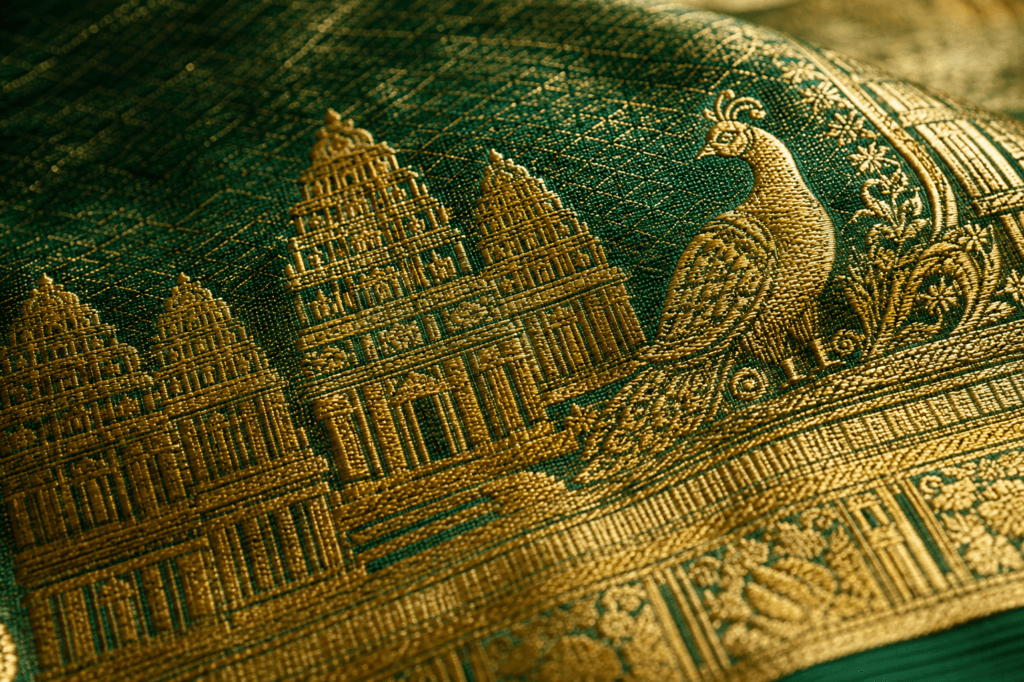
Kanjivaram’s visual language draws directly from the temple architecture surrounding the weaving community. The most recognisable motifs:
- Temple border (gopuram) — a stepped, pyramidal motif directly referencing the tiered temple towers of Kanchipuram and Madurai.
- Rudraksham — a border pattern of small round beads, referencing the rudraksha seeds worn by Shaivite worshippers.
- Checks (rekku) — an allover checked body pattern, one of the oldest and most traditional Kanjivaram grounds.
- Mayil (peacock) and annam (swan) — figurative motifs woven into the pallav, drawn from temple sculpture.
- Yaali — a mythical lion-elephant creature carved on temple pillars across Tamil Nadu, occasionally woven into elaborate bridal pallavs.
How to identify authentic Kanjivaram?
Three checks, in the order a Kanchipuram buyer would actually use them. First, the korvai join — turn the border over and look at where it meets the body; a genuine korvai join shows a visible zig-zag interlocking line, slightly raised, not a flat stitched seam. Second, the weight test — pick the saree up; authentic double-warp Kanjivaram silk has a substantial, almost stiff heft that powerloom imitations, which use thinner or blended silk, cannot replicate. Third, the zari rub test, the same check used across every silk tradition on this site — rub the border firmly against the inside of your wrist; real zari leaves no mark, while metallic-coated synthetic thread leaves a faint grey residue and dulls within months.
Kanjivaram vs Banarasi — which for your wedding?
Both are the two most recognisable Indian bridal silks (see our complete Banarasi guide), and the honest answer is that they solve different problems. Banarasi, woven on a pit loom with the naqsha punch-card system, is built for maximalist brocade — dense, all-over gold patterning is its signature. Kanjivaram, built on the korvai join, is built for contrast and durability — a bold-coloured border against a different-coloured body, engineered to survive generations without the border ever separating from the body. Kanjivaram’s heavier silk and thicker zari also give it a more structured, upright drape, which is why it’s the default choice for South Indian weddings where the bride is often seated for long ceremonial stretches, while Banarasi’s lighter katan variants drape more fluidly for North Indian ceremonies with more movement.
| Kanjivaram | Banarasi | |
|---|---|---|
| Region | Kanchipuram, Tamil Nadu | Varanasi, Uttar Pradesh |
| Signature technique | Korvai — body and border interlocked, not stitched | Naqsha — punch-card pattern read by hand for brocade |
| Typical weight | Heavier, stiffer drape | Lighter, more fluid drape |
| Motif style | Temple architecture, checks, figurative pallav | Mughal-court florals, jangla, shikargah |
| GI tag | 2005 | 2009 |
| Genuine starting price | ₹8,000–₹15,000 | ₹7,000–₹14,000 |
Price guide and where to buy
| Kanjivaram | Banarasi | |
|---|---|---|
| Region | Kanchipuram, Tamil Nadu | Varanasi, Uttar Pradesh |
| Signature technique | Korvai — body and border interlocked, not stitched | Naqsha — punch-card pattern read by hand for brocade |
| Typical weight | Heavier, stiffer drape | Lighter, more fluid drape |
| Motif style | Temple architecture, checks, figurative pallav | Mughal-court florals, jangla, shikargah |
| GI tag | 2005 | 2009 |
| Genuine starting price | ₹8,000–₹15,000 | ₹7,000–₹14,000 |
Co-optex, the Tamil Nadu state handloom corporation, runs certified emporiums across the state carrying GI-tagged Kanjivaram at fixed prices — the most reliable first stop for buyers who can’t travel to Kanchipuram directly. In Kanchipuram itself, weaver cooperative societies sell directly from the loom, and the NHDC’s Handloom Haat network occasionally carries curated pieces in Delhi and Mumbai. Online, insist on a seller who names the weave type (single warp, double warp, korvai) explicitly — “Kanjivaram silk” alone, without that detail, is the same red-flag vagueness that signals a powerloom copy in every other tradition on this site. For more on reading handloom pricing generally, see our handloom vs powerloom guide.

Frequently Asked Questions
Korvai is the technique of weaving the body and border of a Kanjivaram saree separately, often in contrasting colours, then interlocking them thread-by-thread on the loom rather than stitching them together afterward. It’s what makes the border structurally part of the fabric instead of an attachment.
Kanjivaram is built around the korvai join — a contrast border interlocked into the body — and uses a heavier double-warp silk for a stiffer, more structured drape. Banarasi is built around the naqsha brocade system for dense, all-over gold patterning, and typically drapes lighter and more fluidly. Both are genuine handloom silk traditions; they simply solve different aesthetic problems.
Check the border join for the zig-zag korvai interlock rather than a flat stitched seam, feel for the substantial weight genuine double-warp silk carries, and rub the zari against your wrist — real zari leaves no mark, imitation metallic thread does.
A single-warp Kanjivaram with a simple border starts around ₹8,000–₹15,000. Double-warp korvai pieces with real zari run ₹15,000–₹40,000, and heavy bridal pieces with temple borders can run ₹40,000 to over ₹2,00,000.
The gopuram or temple border is a stepped, pyramidal pattern directly referencing the tiered temple towers found across Kanchipuram and Madurai — one of the oldest and most recognisable Kanjivaram border motifs.
Not sure which handloom tradition suits your wardrobe — or your wedding? Join the Edit for our weekly guide to buying handloom with confidence, plus first access to our Saree Authenticity Checklist.